Ultra-long-range
Dassault Falcon 7X
Three-engine long-range flagship
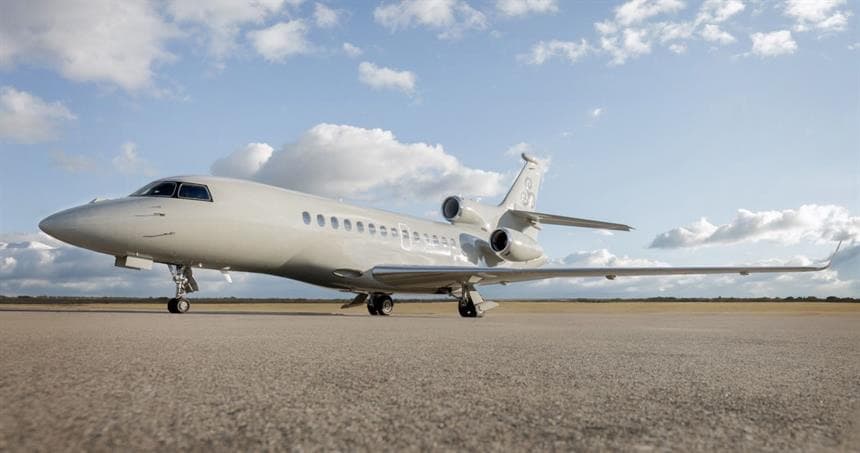
Estimated hourly rate — exact price on request.
- Passengers
- 14
- Range
- 11,000 km
- Cruise speed
- ≈ 900 km/h
- Max flight time
- ≈ 13 h
- Cabin length
- 11.91 m
- Cabin width
- 2.34 m
- Cabin height
- 1.88 m
- Aircraft length
- 23.19 m
Cruise speed is high-speed cruise. Manufacturers calculate range at the slower long-range cruise, with four passengers and NBAA IFR reserves — so a maximum-range leg takes longer than range ÷ speed, and a full cabin flies less far.
The Dassault Falcon 7X is a three-engine ultra-long-range jet that pairs long legs with the ability to use steep, short and high-altitude airports like London City. Seating up to fourteen, it flies routes such as Europe to the Gulf or Asia non-stop in quiet comfort.
We don’t own the jets — we source them. With access to 4,500+ aircraft, we pick the exact tail that fits your route, your group and your budget. These are estimated from-prices per flight hour, to give you a sense of cost. Your exact quote depends on the aircraft, route and dates — just ask.
In detail
The Dassault Falcon 7X in practice
The Falcon 7X is the three-engine one, and nearly everything worth knowing about it follows from that. Three Pratt & Whitney Canada PW307As — two on the sides of the fuselage, the third buried in the tail and fed by an S-duct — give it field performance a twin this size does not have: 1,740 m to take off at maximum weight, 630 m to land, an approach speed of 104 kt, and steep-approach certification that includes London City. Fourteen seats, 11,000 km, a cabin 2.34 m across and 1.88 m high, and enough spare payload that a full cabin barely touches the range. From around €10,500 per flight hour, exact quote on request. Avily Lux does not own aircraft; we charter the 7X from operators across Europe and the Gulf, and we name the tail we are quoting.
Where it came from
Dassault launched the programme at the Paris Air Show in June 2001 under the project name FNX, and named it Falcon 7X that November. The target was to beat the Falcon 900EX on both range and speed. The answer was a new wing, longer and more swept than the 900's, a fuselage a fifth longer on the same cabin cross-section, and the first digital flight control system fitted to a business jet — carried across from four decades of Dassault fighter work. The prototype flew on 5 May 2005. EASA and the FAA certified the type on the same day, 27 April 2007, and it entered service that June.
In May 2011 a 7X suffered an uncommanded pitch-trim runaway in the cruise. EASA grounded the fleet, the cause was traced to a soldering defect on a pin in an electronic control unit, and a modification returned the aircraft to service in June that year. On 2 May 2014 a 7X flew Teterboro to London City in 5 h 54 m, a city-pair record — a useful shorthand for what the type is: long legs at one end, a short and difficult runway at the other.
Around 300 were delivered before production ended in 2023, by which point the stretched Falcon 8X — the same three engines, a longer cabin — had taken over the line. The 7X is now the previous generation, and the reason it still sells on charter is the airports it can use.
Who charters a Falcon 7X, and why three engines
Eight to fourteen people on a sector of six hours or more, where the aircraft has to leave from or arrive at an airport the alternatives cannot use. Its competition is the Global 6000 and the Gulfstream G650, and against both it concedes a little cabin width and a little cruise speed. What it gives back is the third engine.
The centre engine sits in the tail on an S-duct, and three engines rather than two show up in the numbers that decide trips: 1,740 m of balanced field at maximum weight, 630 m to land, 104 kt across the fence. Dassault states that all Falcons are EASA and FAA steep-approach certified and approved for London City. Samedan — 1,800 m of runway at 5,600 ft of elevation — is within reach with an approved operator, and the 7X is the largest ultra-long-range type regularly chartered in there; that approval is per operator and we confirm it per tail. Cannes–Mandelieu takes nothing this size.
What 11,000 km actually means
11,000 km — 5,950 nm — is Dassault's figure, calculated at M 0.80 cruise with eight passengers, three crew and NBAA IFR reserves. Two things follow from it.
First, speed. Our table shows ≈900 km/h, which is high-speed cruise, around M 0.85; the redline is M 0.90. The range above is flown slower, at about 850 km/h. The two do not coexist on one flight — on a long sector the crew trades speed for distance.
Second, payload, which is this type's strongest card. With full tanks the 7X still lifts roughly 1,700 kg: fourteen people and their bags without offloading a drop of fuel. The headline range barely moves with a full cabin — expect a few hundred nautical miles of erosion from bags and routing, not the 500 to 800 a twin gives up. Nice–New York, London–New York, Nice–Malé, Nice–Delhi and Moscow–Hong Kong are nonstop. London–Los Angeles is marginal westbound with everyone aboard and routinely done in favourable winds. Singapore needs a stop.
Inside the cabin
11.91 m long, 2.34 m across, 1.88 m high, flat floor, 44 m³ of volume, normally three zones. Charter layouts run twelve to fourteen seats; the type is certified for up to nineteen, which no charter operator uses. A twelve- to fourteen-seat cabin has two lavatories, forward and aft. There is no shower and no true bedroom — the bed is a converted divan, and the forward divan is also where the crew rests on a thirteen-hour sector.
Baggage is 4 m³ and accessible in flight: enough for fourteen people travelling normally, modest for an aircraft this size, so ski and golf loads are worth counting before we quote. Dassault publishes no cabin-altitude figure for the 7X — the 3,900 ft advertised for the Falcon 8X is a different aircraft — so we publish none. Connectivity is the other per-tail question: later airframes carry Ka-band, earlier ones only SwiftBroadband.
The corridors it flies
London–Dubai is the everyday one: about 6 h 30 m nonstop with a full cabin, comfortably inside the type's thirteen-hour capability, which is why nobody on board is working hard. London–Larnaca is around 4 h 20 m and asks nothing of it.
The short European legs are here for reasons other than range. London–Nice at about 1 h 40 m and London–Geneva at 1 h 25 m appear on 7X quotes either because the trip continues — the Riviera or Geneva is one leg of a longer itinerary and the aircraft stays with the party — or because of the departure airport. This is one of the few cabins of its size that can work out of London City, and leaving from the middle of London is worth more than half an hour of block time. On a plain London–Nice return the aircraft is more than the trip needs, and we will say so before you book it.
What moves the price
From around €10,500 per flight hour, quoted against a named aircraft and specific dates.
Positioning. Around 300 7Xs were built and only a minority are on the European charter market, so the empty legs at each end are a larger share of the quote than they would be on a Challenger. A trip that starts where an aircraft already sits is a materially different price from the same trip a day earlier.
Crew. Sectors near thirteen hours exceed what an unaugmented two-pilot crew may fly under European flight-time rules, so a third pilot is rostered; a cabin attendant is standard at this cabin size.
Then the route itself: Gulf, Asian and African overflight and navigation charges, and handling at the far end. And the calendar — August on the Riviera, the Gulf winter peak — when the slot and the parking are the constraint rather than the aircraft.
What it does well
- Three engines, the centre one fed by an S-duct: takeoff and engine-out performance a twin of this size does not have.
- 1,740 m to take off at maximum weight, 630 m to land and 104 kt on approach, with steep-approach certification that includes London City.
- About 1,700 kg of payload with full tanks — fourteen people and their bags without offloading fuel, so the 11,000 km headline survives a full cabin.
- A 2.34 m cabin, 1.88 m high, flat floor, 44 m³ of volume, and two lavatories in a twelve- to fourteen-seat layout.
- Certified to 51,000 ft, which puts it above most weather and most traffic on a long sector.
Where it gives ground
- It is the previous generation. The Falcon 8X and the G650 are newer aircraft, the 7X flies with EASy II avionics, and connectivity is a per-tail question rather than a property of the type.
- 4 m³ of baggage is modest for an aircraft this size — a heavy-class Legacy 650 carries twice as much — so ski, golf and camera loads need checking before the quote.
- No shower and no separate bedroom: the bed is a converted divan, and on a thirteen-hour sector the crew rests on the forward divan too.
The Dassault Falcon 7X against the alternatives
- Dassault Falcon 8X14 · 11,900 km
The same three engines and the same flight deck philosophy in a newer, longer aircraft: 11,900 km, a 13.00 m cabin against 11.91, about fourteen hours of sector, and a cabin altitude Dassault actually publishes at 3,900 ft. Take it when the trip is at the 7X's limit or the client wants the current generation.
- Bombardier Global 600013 · 11,100 km
When cabin length matters and airport access does not. The Global gives you 13.18 m and 2.41 m of width at effectively the same range, and there are more of them on the European charter market — but it is a twin, and the short and steep runways the Falcon opens are not part of the deal.
- Bombardier Challenger 60512 · 7,400 km
When the trip fits inside about 7,000 km. Dubai, Larnaca and New York all stay nonstop, the cabin is wider at 2.49 m, and it starts from about €7,000 an hour against €10,500. You give up the third engine, the field performance and the 51,000 ft ceiling.
Routes the Dassault Falcon 7X flies
- London → Dubai6h 50mfrom €60,500
- London → Larnaca4h 30mfrom €22,000
- London → Nice1h 40mfrom €9,500
- London → Geneva1h 25mfrom €7,600
Flight times are typical for this type with a full cabin. Headwinds, payload and slot restrictions move them.
Dassault Falcon 7X charter — frequently asked questions
- Why does it have three engines?
- Because three engines change what the aircraft can do on the ground and on the route. The centre engine is fed by an S-duct, and the arrangement buys takeoff and engine-out performance a twin this size cannot match — 1,740 m at maximum weight — plus routing freedom over the Atlantic and Siberia. The cost is a third engine to maintain, and it is in the hourly rate.
- Can it fly into London City, or St Moritz?
- London City, yes — Dassault states that all Falcons are EASA and FAA steep-approach certified and approved for it. Samedan, the airport for St Moritz, is within the aircraft's performance and it is the largest ultra-long-range type regularly chartered in there, but the approval belongs to the operator, so we confirm it on the specific tail before quoting. Cannes–Mandelieu takes nothing this size.
- Does London–Los Angeles work nonstop with a full cabin?
- Usually, and it is wind-dependent. The sector is about 4,716 nm against a published 5,950 nm, and westbound winter headwinds are what decides it. The point worth making is that unlike a twin of the same class, the 7X does not ask you to leave people or bags behind to make the numbers work — with full fuel it still lifts about 1,700 kg.
- Is it as new as a Falcon 8X or a G650?
- No. The 7X was certified in 2007 and built until 2023; the 8X is the current aircraft on the same three-engine layout, and the G650 is its generation's benchmark. What the 7X still has is the airport access and, on the charter market, a lower hourly rate than either. If a client wants the newest cabin and the newest connectivity, quote the 8X.
Specifications
Full technical sheet
General
- Manufacturer
- Dassault Aviation
- Category
- Ultra-long-range
- ICAO designator
- FA7X
- Production
- 2007–2023
- Flight crew
- 2–3
Performance
- Range (IFR reserves)
- 11,000km
- Range (nautical miles)
- 5,950nm
- Cruise speed (high-speed)
- ≈ 900km/h
- Long-range cruise
- 850km/h
- Max operating Mach (MMO)
- M 0.90
- Max operating speed (VMO)
- 370KIAS
- Approach speed
- 104kts
- Takeoff distance (balanced field)
- 1,740m
- Landing distance
- 630m
- Service ceiling
- 51,000ft
- Max flight time
- ≈ 13h
Powerplant and avionics
- Engine type
- Turbofan
- Engines
- 3 × Pratt & Whitney Canada PW307A
- Thrust per engine
- 6,402lbf
- Avionics
- Honeywell Primus Epic EASy II
Dimensions and capacity
- Aircraft length
- 23.19m
- Aircraft height
- 7.93m
- Wing span
- 26.21m
- Cabin length
- 11.91m
- Cabin width
- 2.34m
- Cabin height
- 1.88m
- Baggage volume
- 4.0m³
- Seats (charter layout)
- 14
- Seats (max certified)
- 19
- Max payload
- 2,722kg
- Max takeoff weight (MTOW)
- 31,751kg
- Max landing weight (MLW)
- 28,304kg
- Fuel capacity
- 18,042L
Manufacturer and type-certificate figures, verified field by field. A line we could not source is left out rather than filled with a plausible number.
Gallery