Ultra-long-range
Dassault Falcon 8X
The longest-legged Falcon
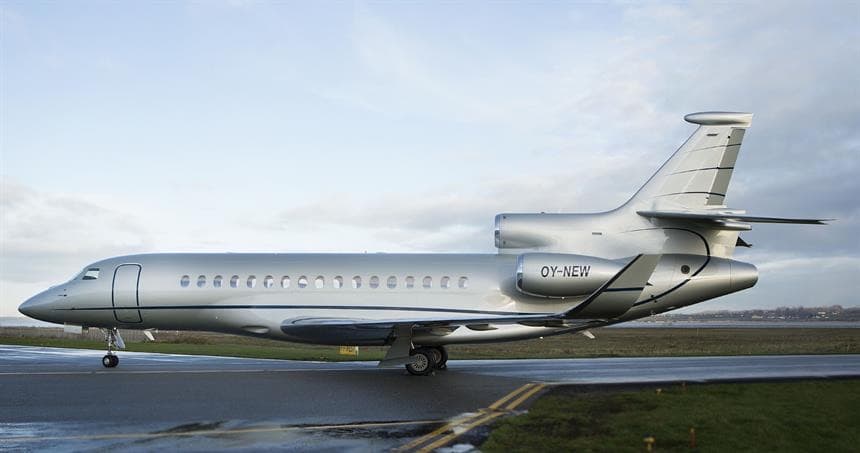
Estimated hourly rate — exact price on request.
- Passengers
- 14
- Range
- 11,900 km
- Cruise speed
- ≈ 900 km/h
- Max flight time
- ≈ 14 h
- Cabin length
- 13.00 m
- Cabin width
- 2.34 m
- Cabin height
- 1.88 m
- Aircraft length
- 24.46 m
Cruise speed is high-speed cruise. Manufacturers calculate range at the slower long-range cruise, with four passengers and NBAA IFR reserves — so a maximum-range leg takes longer than range ÷ speed, and a full cabin flies less far.
The Dassault Falcon 8X extends the 7X with more range and the longest cabin of any Falcon, crossing routes like Los Angeles to Geneva non-stop. Seating up to fourteen, it offers a flexible, quiet cabin and Dassault’s signature short-runway ability.
We don’t own the jets — we source them. With access to 4,500+ aircraft, we pick the exact tail that fits your route, your group and your budget. These are estimated from-prices per flight hour, to give you a sense of cost. Your exact quote depends on the aircraft, route and dates — just ask.
In detail
The Dassault Falcon 8X in practice
The Falcon 8X is Dassault's longest-range aircraft and the only three-engine jet in this class. Fourteen seats, 11,900 km of published range, and the longest cabin Dassault has built at 13.00 m — 2.34 m across, 1.88 m high, flat floor, walked down without stooping. That cabin length is measured from the cockpit divider to the aft wall and excludes the baggage hold. Charter starts from about €11,500 per flight hour, with the exact quote depending on the tail, the routing and the dates. The fact that settles most 8X decisions is not distance but access: it is approved for London City, and at 33 tonnes with a 26.29 m wingspan it fits ramps, taxiways and weight limits that a 52-tonne Global does not. Avily does not own aircraft; we source them from a large operator network, and on a type this scarce the specific airframe matters.
Where it came from
Dassault launched the Falcon 8X at EBACE on 19 May 2014, and presented it as a longer-legged development of the Falcon 7X rather than a clean sheet: the same three-engine layout and the same 2.34 m cross-section, with a stretched fuselage, an aerodynamically reworked and lighter wing, more fuel and higher-thrust PW307D engines. The first aircraft flew from Bordeaux-Mérignac on 6 February 2015. The flight-test campaign ran a little over a year: EASA certified the type on 27 June 2016 and the FAA the following day, and the first delivery went to the Greek charter operator Amjet Executive in October 2016. Three years from announcement to service entry is fast for a new airframe, and it was possible because so much of the 7X carried over.
The defining moment came in May 2017, when the 8X was approved for London City. That completed a set no other manufacturer holds — Dassault's entire in-production range cleared for the airport's 5.5-degree approach — and it is the reason the type is marketed on a Los Angeles-to-London City sector rather than on raw distance. Deliveries have been steady rather than spectacular: around seventy aircraft by the end of 2020, more than half of them into western Europe, with the Bordeaux-Mérignac line still running. Today the 8X remains the distance flagship of the Falcon range, above the wider, shorter-legged 6X, while the 7X it grew out of left production in 2023.
Who charters a Falcon 8X, and where it goes
Two briefs, mostly. The first is a sector nothing smaller holds with everyone aboard: London or Nice to Los Angeles, Nice to Singapore, Nice to Tokyo, Nice to Hong Kong, London to São Paulo. On this site that shows up as London to Dubai, about 6h 50m, and London to Larnaca, about 4h 30m — long enough that both the range and the cabin earn their keep, and normally flown with the full group and its luggage. The second brief is a client who wants the aircraft on a particular ramp rather than the nearest large one.
It also flies short European legs — London to Nice in about 1h 40m, London to Geneva in 1h 25m. That is rarely someone buying range. It is a party of twelve that will not fit in a midsize jet, an empty leg already heading your way, or the first sector of a trip that continues east later the same week on the same tail.
The 8X against the Global 7500 and the G650ER
This is the comparison clients actually make, and it is a choice of philosophy rather than a ranking. The Global 7500 flies 14,260 km against the 8X's 11,900 and adds four living spaces, a full-size bed, an optional shower and a 2,900 ft cabin altitude — at 52 tonnes to the Falcon's 33, on a 31.7 m wingspan against 26.29 m. The G650ER sits between them at 13,890 km, with the widest cabin of the three and by far the largest fleet, so it is the easiest to book on given dates.
The 8X answers on access and cost. Three engines mean no ETOPS constraint on ocean and Siberian routings. At 33 tonnes on a 26.29 m wingspan it fits ramps and weight limits a Global does not, and it is approved for London City as part of Dassault's whole in-production line. At about €11,500 an hour it is the cheapest of the three. What it does not win is cabin: 13.00 by 2.34 m, against 14.27 by 2.49 in a G650ER and 16.59 by 2.44 in a 7500. In this company the Falcon is the small aircraft.
Range with a full cabin, and the speed on the card
Dassault publishes 6,450 nm / 11,900 km with eight passengers and three crew, NBAA IFR reserves, at Mach 0.80. Both halves of that basis matter. Work through the public weights and with full tanks the aircraft has roughly 1,200 kg of payload left — ten or eleven people with real bags — so a fourteen-seat cabin with full baggage means handing fuel back. Expect somewhere between 800 and 1,100 km off the headline. That is our arithmetic from published weights, not a Dassault figure, and we run the actual payload check before quoting rather than after.
The speed in our table is high-speed cruise, about 900 km/h. Dassault computes the range at Mach 0.80, nearer 850 km/h, which is why a maximum-range leg takes about fourteen hours rather than 11,900 divided by 900. The aeroplane will cruise faster; it costs distance.
Airfields, cabin and the overnight sector
Field figures: 1,792 m to take off at maximum weight at sea level on a standard day, 677 m to land, approach speed 107 kt. London City has been approved since May 2017. St Moritz is the interesting case — Falcons of this family are chartered in, but the approval is held operator by operator, so we confirm it on the tail, not the type. Cannes is out. What separates the Falcon from a Global here is not runway length, which is close, but weight and wingspan.
Inside: three zones over 13.00 m, about 48 m³ of cabin, 1.88 m of stand-up height, a flat floor, and a maximum cabin altitude of 3,900 ft — Dassault's best figure, though both of the big twins publish lower. Two lavatories fore and aft plus a crew rest area. Baggage is 4 m³ and reachable in flight rather than sealed off at the back. There is no shower and no fixed stateroom: the aft zone converts to a bed, so roughly six people sleep properly and the rest recline.
What moves the price
From about €11,500 per flight hour is a starting point, not a quote. Positioning is the single largest variable on a type with this few airframes in Europe — if the aircraft is not where you are, the ferry legs at both ends are on your invoice, and there is rarely a second 8X down the ramp to bid against it.
Crew duty is next. A sector near fourteen hours, or a same-day return, needs an augmented crew and their rest, which changes the price and sometimes the departure time. Then the fixed costs of a long trip: overflight and navigation charges across several countries, handling and parking at both ends, de-icing in winter, and airport fees that vary more than people expect — London City is not Farnborough. Peak weeks tighten everything at once: Cannes in May, Monaco, the ski season, the Gulf season around New Year. Slots run out before aircraft do. Every trip is quoted individually.
What it does well
- Approved for London City since May 2017, as part of the only in-production range where every model clears the 5.5-degree approach.
- About 48 m³ of cabin over 13.00 m in three zones, with two lavatories fore and aft and a crew rest area — the longest cabin Dassault has built.
- 33 tonnes and a 26.29 m wingspan against a Global's 52 tonnes and 31.7 m: it fits ramps, taxiways and weight limits the larger twins do not.
- Three engines, so no ETOPS constraint on ocean and Siberian routings and better performance out of hot or high airfields.
- 1.88 m of stand-up height on a flat floor, and 4 m³ of baggage reachable in flight rather than sealed off at the back.
Where it gives ground
- The narrowest cabin of the three top ultra-long-range types: 2.34 m, against 2.44 m in a Global 7500 and 2.49 m in a G650ER. Long, not wide.
- No shower and no fixed bedroom. The aft zone converts to a bed, so about six people sleep properly and the rest recline.
- 11,900 km is Dassault's figure with eight passengers. Fourteen with full baggage costs roughly 800–1,100 km, and that payload arithmetic is ours from public weights, not a published number.
The Dassault Falcon 8X against the alternatives
- Bombardier Global 750017 · 14,260 km
When the sector runs past fourteen hours or someone has to arrive rested and horizontal. It adds 2,360 km, a fourth living space, a full-size bed, an optional shower and a 2,900 ft cabin altitude — at roughly €14,000 an hour, and it is heavier and wider, so some of the airfields the Falcon uses close.
- Gulfstream G650ER16 · 13,890 km
The easiest of the three to actually book: more than 500 airframes in service, 13,890 km of range and the widest cabin at 2.49 m. Choose it for London–Singapore-class trips where availability and width matter more than airfield access.
- Dassault Falcon 7X14 · 11,000 km
The previous generation of the same aircraft, and usually cheaper. 11,000 km instead of 11,900 and a cabin a metre shorter, but the three engines, the London City approval and a 1,740 m takeoff run are all still there. If your longest sector is Europe to the Gulf, you will not notice the difference.
Routes the Dassault Falcon 8X flies
- London → Dubai6h 50mfrom €60,500
- London → Larnaca4h 30mfrom €22,000
- London → Nice1h 40mfrom €9,500
- London → Geneva1h 25mfrom €7,600
Flight times are typical for this type with a full cabin. Headwinds, payload and slot restrictions move them.
Dassault Falcon 8X charter — frequently asked questions
- Falcon 8X or Gulfstream G650ER?
- The G650ER flies about 2,000 km further, is wider, and is far easier to source. The 8X trades that distance for three engines, airfield access the Gulfstream does not have in practice — London City above all — and about €2,000 an hour less. If the trip starts or ends at a constrained airport the Falcon wins; if it is long with a large group, the Gulfstream does.
- Can it fly London to Los Angeles nonstop with a full cabin?
- Usually, and Dassault markets the aircraft on exactly that sector, London City included. Westbound the winds are against you and fourteen passengers with full baggage cost roughly 800–1,100 km of range, so it becomes a load-and-weather question rather than a certainty. We run the payload and fuel numbers on the specific tail and dates before quoting it.
- Can it get into London City, or St Moritz?
- London City yes — the type has been approved since May 2017 and 1,792 m of takeoff run at maximum weight is not the constraint there. St Moritz is different: the steep-approach capability exists, but the approval is held operator by operator, so we confirm it on the specific aircraft. Cannes is out for this type.
- Does the third engine make it more expensive to charter?
- On paper a third engine costs more to maintain, and it does not show up in the way you would expect. Charter rates are set by what the market pays for the type, its availability and the trip, not by the operator's engine bill. From about €11,500 per flight hour, the 8X is the cheapest of the three top ultra-long-range types, below both a G650ER and a Global 7500.
Specifications
Full technical sheet
General
- Manufacturer
- Dassault Aviation
- Category
- Ultra-long-range
- ICAO designator
- FA8X
- Production
- 2016–present
- Flight crew
- 2–3
Performance
- Range (IFR reserves)
- 11,900km
- Range (nautical miles)
- 6,450nm
- Cruise speed (high-speed)
- ≈ 900km/h
- Long-range cruise
- 850km/h
- Max operating Mach (MMO)
- M 0.90
- Max operating speed (VMO)
- 370KIAS
- Approach speed
- 107kts
- Takeoff distance (balanced field)
- 1,792m
- Landing distance
- 677m
- Service ceiling
- 51,000ft
- Cabin altitude
- 3,900ft
- Max flight time
- ≈ 14h
Powerplant and avionics
- Engine type
- Turbofan
- Engines
- 3 × Pratt & Whitney Canada PW307D
- Thrust per engine
- 6,722lbf
- Avionics
- Honeywell Primus Epic EASy IV
Dimensions and capacity
- Aircraft length
- 24.46m
- Aircraft height
- 7.94m
- Wing span
- 26.29m
- Cabin length
- 13.00m
- Cabin width
- 2.34m
- Cabin height
- 1.88m
- Baggage volume
- 4.0m³
- Seats (charter layout)
- 14
- Seats (max certified)
- 19
- Max takeoff weight (MTOW)
- 33,112kg
- Max landing weight (MLW)
- 28,304kg
- Fuel capacity
- 19,850L
Manufacturer and type-certificate figures, verified field by field. A line we could not source is left out rather than filled with a plausible number.
Gallery