Ultra-long-range
Bombardier Global 7500
Four true living zones
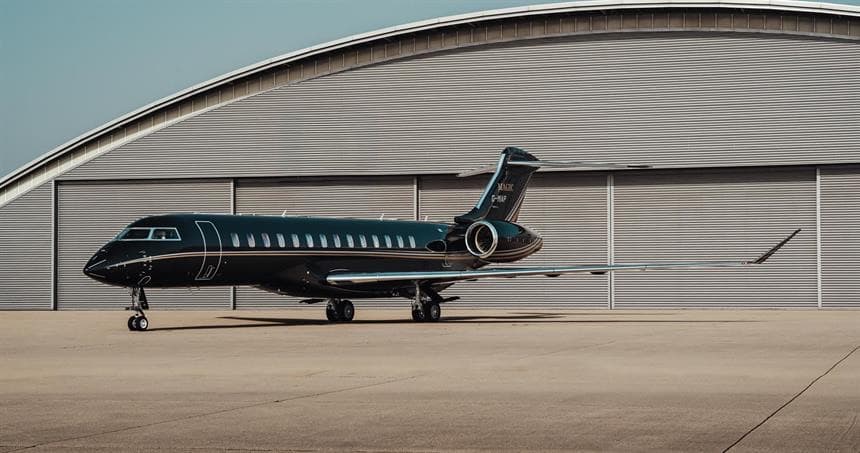
Estimated hourly rate — exact price on request.
- Passengers
- 17
- Range
- 14,260 km
- Cruise speed
- ≈ 900 km/h
- Max flight time
- ≈ 16 h
- Cabin length
- 16.59 m
- Cabin width
- 2.44 m
- Cabin height
- 1.88 m
- Aircraft length
- 33.80 m
Cruise speed is high-speed cruise. Manufacturers calculate range at the slower long-range cruise, with four passengers and NBAA IFR reserves — so a maximum-range leg takes longer than range ÷ speed, and a full cabin flies less far.
The Bombardier Global 7500 is one of the largest and longest-ranged business jets in the world, with four distinct living zones and an available private suite. Seating up to seventeen, it flies the very longest routes non-stop — think New York to Hong Kong — in first-class comfort.
We don’t own the jets — we source them. With access to 4,500+ aircraft, we pick the exact tail that fits your route, your group and your budget. These are estimated from-prices per flight hour, to give you a sense of cost. Your exact quote depends on the aircraft, route and dates — just ask.
In detail
The Bombardier Global 7500 in practice
The Global 7500 is the largest purpose-built business jet in service and, on published figures, the longest-legged: 14,260 km, seventeen seats in the layouts we quote, and a cabin 16.59 m long divided into four living spaces rather than the usual three. It cruises at about 900 km/h, 2.44 m across and 1.88 m high with a flat floor, and holds a maximum cabin altitude of 2,900 ft at 41,000 ft — the lowest figure Bombardier publishes for anything but the newer Global 8000. Charter starts from about €14,000 per flight hour, with the exact quote depending on the tail, the routing and the dates. The one fact that settles most decisions about it: the 14,260 km and the seventeen seats are not true at the same time. Avily does not own aircraft; we source them from a large operator network, and this is a scarce type.
Where it came from
Bombardier announced the Global 7000 and Global 8000 together at the NBAA convention in October 2010, as the top of the Global family: a clean-sheet aircraft rather than another stretch, with a new wing and General Electric Passport engines instead of the Rolls-Royce BR710s that had powered every Global before it. Development took longer than planned. The first aircraft flew on 4 November 2016, six years after the announcement.
What came out of flight test was better than what had been sold. On 28 May 2018 Bombardier renamed the aircraft the Global 7500 to reflect a confirmed range of 7,700 nm rather than the 7,400 originally advertised — an unusual direction for an aerospace programme to move in. Transport Canada certified the type in September 2018, the FAA in November, and EASA in early 2019; the first customer aircraft was delivered on 20 December 2018 with about a hundred orders already on the books.
The demonstrations that followed defined the type's reputation: London City to Los Angeles nonstop on 10 May 2019, the longest flight ever flown out of London City, and a long run of city-pair speed records — more than 150 of them by late 2025, the most ever set by a single business aircraft type. The 150th aircraft was delivered in September 2023 and the 200th in December 2024. The Global 8000, a longer-legged and faster development on the same airframe, entered service in December 2025.
Who charters a Global 7500, and where it goes
The 7500 is chartered for two reasons that rarely arrive together. The first is a sector no other aircraft holds: Europe to Buenos Aires, Nice to Cape Town, London to Hong Kong, Moscow to Buenos Aires at the edge. The type flew London City to Los Angeles nonstop in May 2019, the longest flight ever made out of that airport, which is the clearest single statement of what it does. The second reason is arrival condition — a fourteen-hour sector where someone has to walk off and work, so a real bed, a shower and a 2,900 ft cabin altitude are the product being bought, not the distance.
On this site the natural corridors are London to Dubai, about 6h 50m, and London to Larnaca, about 4h 30m. Both are normally flown with a full group and full baggage, which is exactly where the 7500's size stops being an extravagance.
Why a 14,000 km aircraft flies a two-hour hop
London to Nice in about 1h 40m or London to Ibiza in 2h 30m looks absurd on a 7500, and it happens every summer. Three reasons. The aircraft is already positioned in Europe and repositioning costs money whether or not anyone is aboard, so a leg going back the way you are going surfaces as an empty leg at a fraction of the type's usual rate. A party of sixteen with luggage does not fit into anything smaller, however short the flight. And a short hop is often the outbound leg of a trip that continues intercontinental later the same week, on the same tail and the same crew — moving that group onto a second, smaller aircraft for two hours costs more than it saves.
What you should not do is charter a 7500 at full rate for a two-hour sector because it is the biggest thing on the list. A Challenger 605 or a Falcon 2000 does that trip properly for a great deal less.
14,260 km, and the conditions attached to it
Bombardier's 7,700 nm / 14,260 km is a theoretical range with NBAA IFR reserves, ISA, Mach 0.85, and eight passengers with four crew. Eight, not seventeen. Bombardier does not publish weights on the factsheet; working from public figures, full tanks leave roughly 1,500 kg of payload, which is eight or nine people with light bags — the brochure case exactly. Load fourteen to seventeen with full baggage and you hand fuel back: expect somewhere between 750 and 1,100 km off the headline, call it 13,200 km. That is our arithmetic from public weights, not a Bombardier number, and we run the real payload check before quoting.
Even so, 13,200 km with a full cabin is further than anything else in this class flies empty except a G650ER. What survives: London to Los Angeles, Nice to Singapore, Nice to Tokyo, Nice to Buenos Aires. What does not, for any jet in this class: Europe to Sydney.
Four living spaces, and what is actually in them
Bombardier's claim is that this is the only business jet big enough for four true living spaces, and the layout backs it: a club four, a conference and dining zone that seats six at a table, a media or lounge zone and a master suite with a full-size bed — a real fixed bed, not a converted divan, which is the difference against every other aircraft on this page. A stand-up shower is available in the suite. There is a full kitchen and a dedicated crew suite, so on a fifteen-hour sector the cabin crew are not resting in your space.
The cabin is 16.59 m from the cockpit divider to the aft wall, excluding the baggage hold, with 1.88 m of standing height and a flat floor. Two lavatories, plus the suite's en-suite on most layouts. Cabin air is fully replaced in as little as 90 seconds through the HEPA system, and the maximum cabin altitude is 2,900 ft at 41,000 ft.
Airfields, baggage, price
Field performance is better than the aircraft's size suggests: 1,756 m to take off at maximum weight at sea level on a standard day — shorter than a Global 6000's 1,974 m — and 682 m to land. It is steep-approach certified and has operated at London City. What closes doors is not runway length but bulk: 52 tonnes and a 31.7 m wingspan rule out St Moritz, Cannes and a good many small ramps that a Falcon 8X uses without discussion. Baggage is 5.52 m³ and reachable in flight.
From about €14,000 per flight hour is a starting point. Positioning dominates on a type with roughly two hundred airframes worldwide and few of them in Europe — there is usually no second 7500 bidding against the first. Crew duty is next: a fifteen-hour sector needs an augmented crew and their rest. Then overflight and navigation charges across several countries, handling and parking at both ends, de-icing in winter, and peak weeks that tighten slots before they tighten aircraft. Every trip is quoted individually.
What it does well
- 14,260 km at Mach 0.85 with NBAA reserves, and roughly 13,200 km even with a full cabin — further than anything in this class flies empty, bar a G650ER.
- A genuine fixed bed in a master suite, with an available stand-up shower, rather than the converted divan every neighbouring type offers.
- A 2,900 ft maximum cabin altitude at 41,000 ft — the lowest figure published for any aircraft on this site, and the reason a fifteen-hour sector costs you less on arrival.
- Four living spaces across 16.59 m of cabin plus a dedicated crew suite, so the crew rest somewhere other than your cabin on a fifteen-hour sector.
- 1,756 m of takeoff run at maximum weight — shorter than a Global 6000 needs, despite being a far bigger aircraft — and 5.52 m³ of baggage reachable in flight.
Where it gives ground
- The headline range and the seat count do not coexist. 14,260 km is quoted with eight passengers; seventeen with full baggage costs roughly 750–1,100 km, and that arithmetic is ours from public weights, not a published figure.
- 52 tonnes and a 31.7 m wingspan close airports that runway length alone would allow: St Moritz, Cannes and a good many small ramps a Falcon 8X uses without discussion.
- Around two hundred airframes worldwide and few in Europe. Positioning legs are long, there is rarely a second one bidding for your trip, and roughly €14,000 an hour is the highest rate on this site short of an airliner.
The Bombardier Global 7500 against the alternatives
- Gulfstream G650ER16 · 13,890 km
Nearly the same reach — 13,890 km — with the widest cabin at 2.49 m, a near-identical 3,000 ft cabin altitude and more than 500 airframes in service, so it is far easier to book on your dates and usually cheaper. What it gives up is the fourth living space, the fixed bed and the shower.
- Dassault Falcon 8X14 · 11,900 km
When the airfield decides. Three engines, approval for London City, and 33 tonnes on a 26.29 m wingspan against the 7500's 52 tonnes and 31.7 m, so ramps and weight limits that close for the Global stay open. It costs about €2,500 an hour less and flies 2,360 km less.
- Bombardier Global 600013 · 11,100 km
The sensible answer when the longest sector is twelve hours and nobody has to sleep in a fixed bed. Same family and the same three-zone logic for roughly €3,000 an hour less, with far more airframes to choose from — at the cost of 1,974 m of runway.
Routes the Bombardier Global 7500 flies
- London → Dubai6h 50mfrom €60,500
- London → Larnaca4h 30mfrom €22,000
- London → Nice1h 40mfrom €9,500
- London → Ibiza2h 30mfrom €12,400
Flight times are typical for this type with a full cabin. Headwinds, payload and slot restrictions move them.
Bombardier Global 7500 charter — frequently asked questions
- Can a Global 7500 really fly 14,260 km?
- Yes, on Bombardier's basis: eight passengers, four crew, NBAA IFR reserves, Mach 0.85. With seventeen aboard and full baggage you offload fuel and lose roughly 750 to 1,100 km, so plan on about 13,200 km. That still covers Europe to Buenos Aires and London to Los Angeles nonstop. We run the payload check on the specific tail before quoting.
- Is there a real bedroom and a shower?
- Yes to the bedroom — a master suite with a full-size fixed bed, not a divan that converts. A stand-up shower is available in the suite and fitted to many charter airframes, but not all, so we confirm it on the specific aircraft. There are also two lavatories, a full kitchen and a separate crew suite.
- Global 7500 or Gulfstream G650ER?
- Range is close: 14,260 km against 13,890, and cabin altitude closer still at 2,900 ft against 3,000. The 7500 wins on layout — four living spaces over 16.59 m, a fixed bed and an optional shower, against three or four zones and a berthable divan. The G650ER is 5 cm wider, holds more than 500 airframes against roughly 200, and is therefore easier to source and usually cheaper.
- Can it use London City?
- Yes — it is steep-approach certified, and in May 2019 it flew London City to Los Angeles nonstop, the longest flight ever made out of the airport. Field length is not its constraint at 1,756 m. Weight and wingspan are: 52 tonnes and 31.7 m keep it out of St Moritz, Cannes and many smaller ramps.
Specifications
Full technical sheet
General
- Manufacturer
- Bombardier
- Category
- Ultra-long-range
- ICAO designator
- GL7T
- Production
- 2018–present
- Flight crew
- 2–3
Performance
- Range (IFR reserves)
- 14,260km
- Range (nautical miles)
- 7,700nm
- Cruise speed (high-speed)
- ≈ 900km/h
- Long-range cruise
- 903km/h
- Max operating Mach (MMO)
- M 0.925
- Takeoff distance (balanced field)
- 1,756m
- Landing distance
- 682m
- Service ceiling
- 51,000ft
- Cabin altitude
- 2,900ft
- Max flight time
- ≈ 16h
Powerplant and avionics
- Engine type
- Turbofan
- Engines
- 2 × General Electric Passport 20-19BB1A
- Thrust per engine
- 18,920lbf
- Avionics
- Bombardier Vision flight deck
Dimensions and capacity
- Aircraft length
- 33.80m
- Aircraft height
- 8.2m
- Wing span
- 31.7m
- Cabin length
- 16.59m
- Cabin width
- 2.44m
- Cabin height
- 1.88m
- Baggage volume
- 5.52m³
- Seats (charter layout)
- 17
- Seats (max certified)
- 19
- Max takeoff weight (MTOW)
- 52,095kg
- Max landing weight (MLW)
- 39,735kg
- Fuel capacity
- 29,098L
Manufacturer and type-certificate figures, verified field by field. A line we could not source is left out rather than filled with a plausible number.
Gallery