Ultra-long-range
Bombardier Global 6000
Ocean-crossing comfort
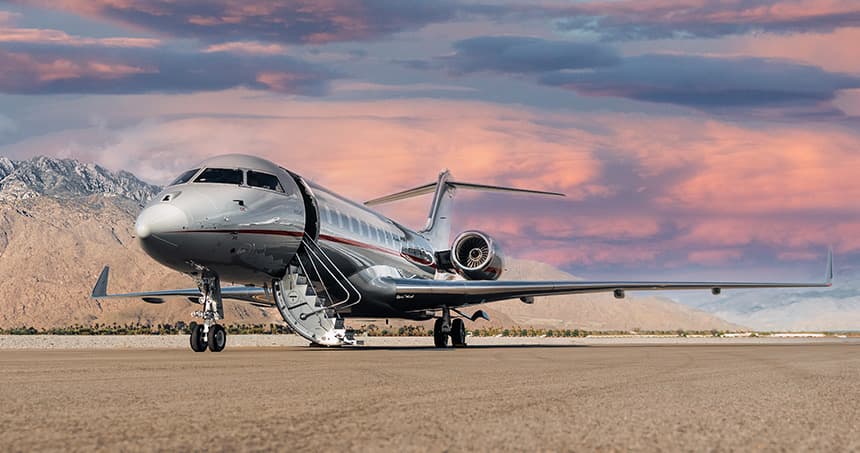
Estimated hourly rate — exact price on request.
- Passengers
- 13
- Range
- 11,100 km
- Cruise speed
- ≈ 900 km/h
- Max flight time
- ≈ 12 h
- Cabin length
- 13.18 m
- Cabin width
- 2.41 m
- Cabin height
- 1.88 m
- Aircraft length
- 30.30 m
Cruise speed is high-speed cruise. Manufacturers calculate range at the slower long-range cruise, with four passengers and NBAA IFR reserves — so a maximum-range leg takes longer than range ÷ speed, and a full cabin flies less far.
The Bombardier Global 6000 is a true ultra-long-range flagship, crossing oceans non-stop with a full-size cabin, dedicated rest area and stand-up headroom throughout. Seating up to thirteen, it lets a group arrive rested after Europe to Asia or the Americas.
We don’t own the jets — we source them. With access to 4,500+ aircraft, we pick the exact tail that fits your route, your group and your budget. These are estimated from-prices per flight hour, to give you a sense of cost. Your exact quote depends on the aircraft, route and dates — just ask.
In detail
The Bombardier Global 6000 in practice
The Global 6000 is Bombardier's ultra-long-range twin, and for a decade it has been the default aircraft for European operators flying intercontinental charter. Thirteen seats in the usual three-zone layout, 11,100 km of published range, about 900 km/h in the cruise, and a flat-floor cabin 13.18 m long that you walk down without stooping — 1.88 m of headroom, 2.41 m across. That cabin figure is measured from the cockpit divider to the aft cabin wall and does not include the baggage hold. Sectors of around twelve hours are within it. Charter starts from about €11,000 per flight hour, with the exact quote depending on the tail, the routing and the dates. Avily does not own aircraft; we source them from a large operator network, which on a type this widely flown usually means a choice of several airframes for the same trip.
Where it came from
Bombardier announced the Global Express at the NBAA convention on 28 October 1991 and launched the programme in December 1993 — a clean-sheet ultra-long-range twin with a new supercritical wing and Rolls-Royce BR710 engines. The prototype flew on 13 October 1996, Transport Canada certified it on 31 July 1998, the FAA followed in November, and the type entered service in July 1999. A shorter-fuselage derivative, the Global 5000, was announced in 2001 and first flew on 7 March 2003. The Global Express XRS came next, announced on 6 October 2003: a forward fuel tank in the wing-body fairing worth about 1,486 lb of usable fuel, two extra cabin windows, higher cabin pressurisation and better takeoff performance. The first two customer aircraft were delivered on 25 November and 6 December 2005. In May 2011 Bombardier renamed the XRS the Global 6000 and fitted the Global Vision flight deck — Rockwell Collins Pro Line Fusion, four 15-inch displays and a head-up display with synthetic vision. Transport Canada approved it in June 2011, EASA and the FAA in February 2012, and the first Vision-equipped Global 6000 was handed over on 31 March 2012. Bombardier revealed the re-engined Global 6500 on 27 May 2018 and it entered service on 1 October 2019, ending 6000 production. Around 330 Global 6000s remain in the worldwide fleet, which is why the type is usually available on a given set of dates rather than the newest option on the ramp.
Who charters a Global 6000, and where it goes
Two briefs, mostly. The first is a sector a super-midsize jet cannot hold: London to Los Angeles, Nice to Tokyo, Nice to Hong Kong, London to São Paulo, and on this site London to Dubai and London to Larnaca. The Global flies them nonstop, which removes the tech stop and the delay risk attached to it. The second is a group of eight to thirteen who want the cabin more than the range — three zones, a working conference layout, a hold you can reach in flight. At €11,000 an hour you pay for two things: a cabin you can work, eat and sleep in for twelve hours, and the fuel to stay up there that long.
It also flies short European legs, which surprises people. The aircraft is already positioned in Europe and repositioning costs money either way, so London–Nice or London–Geneva surfaces as an empty leg at a fraction of the usual rate for the type. A party of twelve with luggage does not fit in a light jet, whatever the flight time. And a short hop is often the first leg of a trip that continues east later the same week, on the same tail.
Global 6000 against its neighbours
The Falcon 7X and 8X trade range and cruise speed for airfield access: 1,740 m and 1,829 m of takeoff run against the Global's 1,974 m, three engines instead of two, and a narrower cabin at 2.34 m. Dassault sells a lower cabin pressure as a Falcon virtue, but the published figures do not bear it out here: the 8X's cabin sits at 3,900 ft against the Global 7500's 2,900 ft, and for the 7X Dassault publishes nothing we can verify, so neither do we. The 7X is the only jet in this class that gets into St Moritz.
Above the 6000 sits the Global 7500: roughly 1,700 nm further, four living spaces, a full-size bed, an optional shower and a 2,900 ft cabin altitude at FL410. It costs far more per hour and there are far fewer of them. The G650ER flies 7,500 nm, tops out faster (M 0.925 against the Global's M 0.89) and has a wider, taller cabin at 2.49 × 1.91 m, with 500-plus airframes in service, so it is the easier of the two to source.
Range with a full cabin
Bombardier quotes 6,000 nm / 11,100 km with eight passengers and four crew, NBAA IFR reserves, at M 0.85. The basis matters. Work through the published weights and the aircraft has about 1,000 kg of payload left with full tanks — eight or nine people with light bags, which is exactly the brochure case. Put thirteen aboard with full baggage and you give back roughly 300 kg of fuel, which is about 250–300 nm, call it 500 km, off the headline. That is our arithmetic from Bombardier's figures, not a published number.
What survives a full cabin: London–Los Angeles, Nice–Tokyo, Nice–Hong Kong, Moscow–Los Angeles and London–São Paulo stay nonstop. Nice–Singapore is marginal and turns on winds and load. London–Buenos Aires needs a tech stop. Europe to Sydney is beyond every jet in this class.
Runway, baggage, sleeping and crew
The one real operational weakness is field length: 1,974 m at maximum takeoff weight, sea level, standard day — the longest requirement in its class. Short, hot or high-altitude runways mean either a reduced fuel load and a stop, or a different type. London City is fine; Bombardier's own speed records for the type include Aspen to London City and London City to New York. St Moritz and Cannes are out.
Baggage is 5.5 m³ and, unusually, reachable in flight rather than sealed off at the back. There are two lavatories, forward and aft, plus a crew rest area. There is no shower and no fixed stateroom — the bed is a converted divan, so four to six people sleep properly and the rest recline. Ka-band internet is common but confirm it per tail. A cabin attendant is standard on sectors this long.
What moves the price
From about €11,000 per flight hour is a starting point, not a quote. Positioning is the largest single variable: if the aircraft is not where you are, you pay for the ferry legs at both ends. Crew duty is the second — a sector near the twelve-hour mark, or a same-day return, needs an augmented crew and their rest, which changes both the price and sometimes the departure time.
Then the fixed costs of a long sector: overflight and navigation charges across several countries, handling and parking at each end, de-icing in winter. Peak weeks tighten everything — Cannes in May, Monaco, the ski season, the Gulf season around New Year — and slots go before aircraft do. Every trip is quoted individually.
What it does well
- A 13.18 m cabin in three zones with 1.88 m of stand-up height and a flat floor, measured cockpit divider to aft cabin wall with the baggage hold excluded — twelve hours of it without a fuel stop.
- 11,100 km at M 0.85 with NBAA reserves puts London–Los Angeles, Nice–Tokyo, Nice–Hong Kong and London–São Paulo inside one sector.
- 5.5 m³ of baggage reachable in flight rather than sealed off at the back, plus two lavatories fore and aft and a crew rest area.
- London City works: Bombardier's own speed records for the type include Aspen to London City and London City to New York.
- About 330 airframes in the worldwide fleet — far easier to source than a Global 7500, and on most dates there is a choice of tails for the same trip.
Where it gives ground
- Full fuel and a full cabin do not coexist. With the tanks full there is roughly 1,000 kg of payload left, which is eight or nine people with light bags; thirteen with full baggage costs about 500 km off the headline.
- 1,974 m of takeoff run at maximum weight, sea level, standard day — the longest requirement in the class. Short, hot or high fields mean a reduced fuel load and a stop, and St Moritz and Cannes are out entirely.
- No shower and no fixed bedroom. The bed is a converted divan, so four to six people sleep properly and the rest recline.
The Bombardier Global 6000 against the alternatives
- Dassault Falcon 7X14 · 11,000 km
When the airfield decides. 1,740 m of takeoff run against the Global's 1,974 m, approved for London City, and the only jet in this class regularly chartered into St Moritz. It also carries a full cabin without giving back much of its range.
- Bombardier Global 750017 · 14,260 km
When the sector runs past twelve hours, or someone has to arrive rested. A fourth living space, a full-size bed instead of a converted divan and an optional shower — at roughly €14,000 an hour, with far fewer airframes to choose from.
- Gulfstream G650ER16 · 13,890 km
For the longest sectors with a large group: 13,890 km, a cabin 2.49 m wide and 1.91 m tall, and more than 500 airframes in service, so it is much easier to source than a 7500. London–Singapore class trips are its ground.
Routes the Bombardier Global 6000 flies
- London → Dubai6h 50mfrom €60,500
- London → Larnaca4h 30mfrom €22,000
- London → Nice1h 40mfrom €9,500
- London → Geneva1h 25mfrom €7,600
- London → Ibiza2h 30mfrom €12,400
Flight times are typical for this type with a full cabin. Headwinds, payload and slot restrictions move them.
Bombardier Global 6000 charter — frequently asked questions
- Can a Global 6000 fly 11,100 km with thirteen passengers?
- No. The 11,100 km figure is Bombardier's, quoted with eight passengers and four crew. With full tanks the aircraft has around 1,000 kg of payload left, so thirteen people with full baggage means offloading fuel — roughly 500 km off the headline. Most real trips sit well inside that. We run the payload check before quoting, not after.
- Global 6000 or Global 7500?
- Same family, different aircraft. The 7500 adds about 1,700 nm, a fourth living space, a full-size bed instead of a converted divan, an optional shower and a 2,900 ft cabin altitude at FL410. It also costs considerably more per hour and is much harder to source. If your longest sector is twelve hours, the 6000 covers it.
- Can it use London City?
- Yes — Bombardier's own speed records for the type include Aspen to London City and London City to New York. What it cannot do is short or high-altitude fields: the takeoff requirement is 1,974 m at maximum weight, so St Moritz and Cannes are out, and a hot-and-high departure may need a lighter fuel load and a stop.
- How many people can sleep on board?
- Four to six comfortably. The cabin has three zones and a flat floor with 1.88 m of headroom, but the beds are converted divans — there is no fixed stateroom and no shower. Two lavatories and a crew rest area. On a twelve-hour sector a cabin attendant is part of the standard crew.
Specifications
Full technical sheet
General
- Manufacturer
- Bombardier
- Category
- Ultra-long-range
- ICAO designator
- GLEX
- Production
- 2012–2019
- Flight crew
- 2–3
Performance
- Range (IFR reserves)
- 11,100km
- Range (nautical miles)
- 6,000nm
- Cruise speed (high-speed)
- ≈ 900km/h
- Long-range cruise
- 903km/h
- Max operating Mach (MMO)
- M 0.89
- Takeoff distance (balanced field)
- 1,974m
- Landing distance
- 682m
- Service ceiling
- 51,000ft
- Max flight time
- ≈ 12h
Powerplant and avionics
- Engine type
- Turbofan
- Engines
- 2 × Rolls-Royce BR700-710A2-20
- Thrust per engine
- 14,750lbf
- Avionics
- Bombardier Vision flight deck
Dimensions and capacity
- Aircraft length
- 30.30m
- Aircraft height
- 7.80m
- Wing span
- 28.70m
- Cabin length
- 13.18m
- Cabin width
- 2.41m
- Cabin height
- 1.88m
- Baggage volume
- 5.5m³
- Seats (charter layout)
- 13
- Seats (max certified)
- 19
- Max payload
- 2,617kg
- Max takeoff weight (MTOW)
- 45,132kg
- Max landing weight (MLW)
- 35,652kg
- Fuel capacity
- 25,256L
Manufacturer and type-certificate figures, verified field by field. A line we could not source is left out rather than filled with a plausible number.
Gallery