Heavy jet
Bombardier Challenger 605
Wide-cabin heavy jet
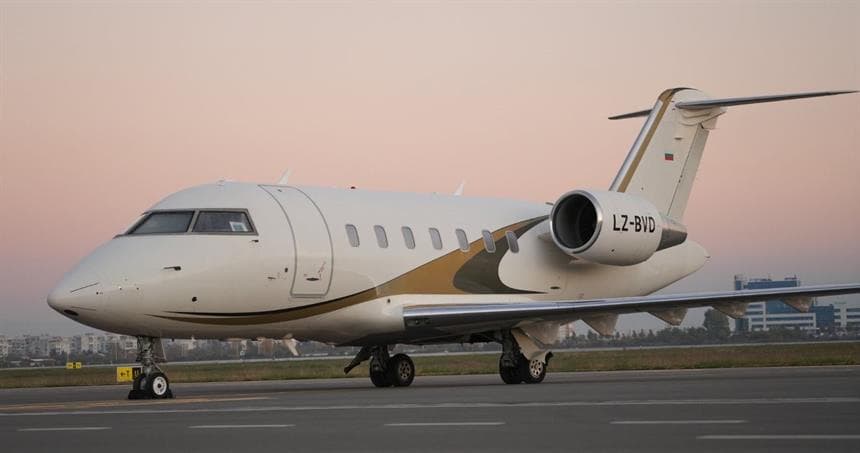
Estimated hourly rate — exact price on request.
- Passengers
- 12
- Range
- 7,400 km
- Cruise speed
- ≈ 870 km/h
- Max flight time
- ≈ 8 h
- Cabin length
- 8.61 m
- Cabin width
- 2.49 m
- Cabin height
- 1.85 m
- Aircraft length
- 20.85 m
Cruise speed is high-speed cruise. Manufacturers calculate range at the slower long-range cruise, with four passengers and NBAA IFR reserves — so a maximum-range leg takes longer than range ÷ speed, and a full cabin flies less far.
The Bombardier Challenger 605 offers one of the widest cabins in its class, seating up to twelve with room for separate work and lounge areas. With transatlantic range and a smooth, quiet ride, it’s a proven choice for intercontinental group travel.
We don’t own the jets — we source them. With access to 4,500+ aircraft, we pick the exact tail that fits your route, your group and your budget. These are estimated from-prices per flight hour, to give you a sense of cost. Your exact quote depends on the aircraft, route and dates — just ask.
In detail
The Bombardier Challenger 605 in practice
The Challenger 605 is the workhorse of the European heavy-jet fleet. Twelve seats, a cabin 2.49 m across that you can walk the length of, and 7,400 km of range on paper — enough to leave London in the morning and land in New York or Dubai without stopping. Something else matters as much as the specification: there are a lot of 605s on the charter market. On most dates one is sitting a short positioning leg from your departure airport, crews know the type, and the hourly rate reflects supply rather than scarcity. Avily Lux does not own aircraft. We charter the 605 through operators across Europe and the Gulf, and we name the tail we are quoting.
Where it came from
The type traces back to Bill Lear's LearStar 600 concept, which Canadair bought in April 1976 and launched as the Challenger 600 on 29 October that year. The prototype flew on 8 November 1978, Transport Canada certified it in August 1980 and the FAA in November, and 81 were built. The Challenger 601 brought General Electric CF34 engines and winglets — first flight 10 April 1982, first delivery 6 May 1983 — followed by the 601-3A with a glass cockpit in 1987 and the extended-range 601-3R from 1989. The Challenger 604 was the large step: first flight 18 September 1994, Transport Canada certification 20 September 1995, first deliveries in January 1996, with a supercritical wing, saddle fuel tanks aft, higher weights and Collins Pro Line 4. 365 were built through 2006. Bombardier announced the 605 at NBAA on 8 November 2005. It first flew on 22 January 2006, was certified by Transport Canada on 5 October 2006 with the FAA and EASA following that month, and deliveries began on 29 January 2007. The changes were to the cabin and the flight deck rather than the airframe: larger windows, a redesigned tail cone that freed cabin space, and Rockwell Collins Pro Line 21. The 200th 605 entered service in October 2012, and the Challenger 650 took over the production line in 2015. Around 290 remain in the worldwide fleet, roughly 130 of them offered for charter.
Who charters a Challenger 605
Groups of eight to twelve who need a real cabin for several hours, on a sector a midsize jet cannot hold. Corporate teams to the Gulf, families to Cyprus in August, production crews with fifteen cases. The Challenger 350 below it costs less per hour and flies the same short European legs well — the 605 adds three seats, 30 cm of cabin width and about 1,500 km of range.
Each neighbour gives up something. The Challenger 850 has a far bigger cabin on the same fuselage and 5,200 km of range, which puts a fuel stop on every Europe–US sector. The Falcon 2000LXS uses shorter runways and publishes its range at eight passengers rather than six. The Legacy 650 takes one more seat and much more baggage. The 605 sits between them, and it is the one most likely to be free on your dates.
What 7,400 km actually means
7,400 km is Bombardier's published figure: 4,000 nm at long-range cruise, NBAA reserves, six passengers on board. Fill the cabin with ten or twelve and the honest number is around 6,950 km. That is the figure to plan a full-load trip against, and better known now than at the flight-planning stage.
One more thing worth saying plainly. Our table publishes ≈870 km/h, which is high-speed cruise; the range figure is calculated at long-range cruise, which is slower. You do not get both on the same flight — on a long sector the crew trades speed for distance.
With everyone on board, London–New York and Paris–New York work nonstop. Winter westbound headwinds can cost 10–15%, so a Shannon or Gander stop stays in the plan as a contingency rather than the norm. Los Angeles, Johannesburg and the Maldives need a fuel stop.
Inside the cabin
8.61 m long, 2.49 m across at the centreline, 1.85 m high, flat floor. You stand up straight and walk from the forward galley to the back. One fully enclosed lavatory, aft. No shower.
The divan converts and operators list five sleeping berths, so on a night sector part of the group lies flat and the rest recline. There is no private bedroom and no dedicated crew rest area — worth knowing before you plan a red-eye for twelve. Baggage is 3.2–3.3 m³, roughly fifteen pieces, and Bombardier describes access as unrestricted: the hold is reachable from the cabin in flight. At this cabin size a flight attendant is standard on charter. Wi-Fi is fitted to most charter 605s, but it is tail-specific — we confirm it on the aircraft, not on the type.
The corridors it flies
London–Dubai is the sector this aircraft was built for: about 6 h 50 m nonstop, inside the type's eight-hour working sector, with twelve people and their luggage on board. London–Larnaca is 4 h 30 m and asks nothing unusual of it. The shorter legs — London–Nice at 1 h 40 m, London–Ibiza at 2 h 30 m, London–Barcelona at 2 h 10 m — go on a 605 for group size rather than range: it moves the whole party in one hull instead of two.
A full cabin costs range, not runway. Inside Europe that makes no practical difference; Dubai is the one leg where twelve passengers and heavy bags are worth checking against the day's winds. Balanced field length is roughly 1,720–1,814 m at maximum weight — Luton, Farnborough, Nice, Geneva and Larnaca are all comfortable. The shortest alpine and island strips are not this aircraft's ground.
What moves the price
From around €7,000 per flight hour, with the exact quote made against a specific tail and specific dates. Four things move it.
Positioning. If the nearest free 605 is in Vienna and you leave from Luton, someone pays for the empty legs at each end. Because the type is numerous in Europe, that gap is usually small — one of the practical reasons to take it.
Crew duty. A Dubai sector and a same-day return breaks duty limits: the operator either night-stops the crew or carries a second one, and both appear in the price.
Overflight and handling. Gulf and eastern Mediterranean routings carry navigation charges that intra-European legs do not, and peak-season handling at Nice or Ibiza is not a February number.
Slots. In Cannes Festival week, or August in the Balearics, the aircraft is the easy part — the slot and the parking are what you are really booking.
What it does well
- 2.49 m of cabin width at the centreline, 1.85 m of stand-up height and a flat floor — the widest cross-section in the heavy class, and 30 cm more than a Challenger 350.
- 3.2–3.3 m³ of baggage, around fifteen pieces, with what Bombardier describes as unrestricted access — the hold is reachable from the cabin in flight, which few jets this size allow.
- 7,400 km published (4,000 nm, six passengers, long-range cruise) and about 6,950 km with all twelve seats filled, so London–New York and London–Dubai stay nonstop either way.
- One of the most numerous heavy jets in Europe: about 290 airframes in the worldwide fleet and roughly 130 of them on the charter market, so positioning legs are usually short and the rate reflects supply.
- From about €7,000 per flight hour — the lowest hourly rate at which a twelve-seat, 2.49 m cabin is available.
Where it gives ground
- The 7,400 km headline is a six-passenger figure. Load ten to twelve and the honest number is about 6,950 km, which is what a full-load trip has to be planned against.
- Bombardier markets a low cabin altitude for the type but publishes no figure we can verify against the manufacturer, so we publish none.
- The avionics and cabin systems date from 2006. A Praetor 600 or a late Falcon 2000LXS has a newer flight deck and newer connectivity, and the Falcon lands and takes off from far shorter runways.
The Bombardier Challenger 605 against the alternatives
- Dassault Falcon 2000LXS10 · 7,400 km
When the airport decides the trip. The 2000LXS needs about 1,425 m of balanced field against the 605's 1,720–1,814 m, which opens short, hot and alpine strips, and its 7,400 km is published at eight passengers rather than six, so the range figure survives a full cabin.
- Bombardier Challenger 3509 · 5,900 km
For four to eight people flying inside Europe. It handles the same short legs from about €5,900 an hour; you give up three seats, 30 cm of cabin width and roughly 1,500 km of range.
- Embraer Legacy 65013 · 7,200 km
When the baggage is the constraint rather than the range. Thirteen seats and an 8.1 m³ hold accessible in flight, against 3.2–3.3 m³ on the 605 — ski, golf and camera loads that would otherwise need a second aircraft.
Routes the Bombardier Challenger 605 flies
- London → Dubai6h 50mfrom €60,500
- London → Larnaca4h 30mfrom €22,000
- London → Nice1h 40mfrom €9,500
- London → Ibiza2h 30mfrom €12,400
- London → Barcelona2h 10mfrom €11,000
Flight times are typical for this type with a full cabin. Headwinds, payload and slot restrictions move them.
Bombardier Challenger 605 charter — frequently asked questions
- Does a Challenger 605 fly London–New York nonstop with everyone on board?
- Yes, in normal conditions. The sector is about 3,000 nm and a full twelve-seat cabin still leaves roughly 3,750 nm of range, so it fits. Winter westbound headwinds can take 10–15% out of that, and on those days the crew carries a Shannon or Gander stop as a contingency. Eastbound is not an issue.
- Can we reach our luggage in flight?
- Yes. The hold is 3.2–3.3 m³, around fifteen pieces, and Bombardier describes access as unrestricted — meaning it is reachable from the cabin in the air, which is unusual and genuinely useful on a long sector. If you are carrying skis, golf bags or camera cases, send us the piece count and we check it against the specific aircraft.
- Can anyone actually sleep flat?
- Partly. The divan converts and operators list five sleeping berths across the cabin, so on a night flight to Dubai some of the group lies flat and the rest recline in their seats. There is no separate bedroom, no shower and no dedicated crew rest area. For a full twelve-passenger night sector, plan for rest rather than a bed each.
- Challenger 605 or Challenger 350 — what do I gain?
- Three seats, 30 cm of cabin width and about 1,500 km of range, at a higher hourly rate. The 350 is the better answer for four to eight people inside Europe. The 605 earns the difference when the group is ten or more, or when the sector is Dubai, Cyprus or the Atlantic and you want it nonstop.
Specifications
Full technical sheet
General
- Manufacturer
- Bombardier
- Category
- Heavy jet
- ICAO designator
- CL60
- Production
- 2006–2015
- Flight crew
- 2
Performance
- Range (IFR reserves)
- 7,400km
- Range (nautical miles)
- 4,000nm
- Cruise speed (high-speed)
- ≈ 870km/h
- Long-range cruise
- 785km/h
- Max operating Mach (MMO)
- M 0.85
- Max operating speed (VMO)
- 300KIAS
- Takeoff distance (balanced field)
- 1,780m
- Landing distance
- 719m
- Service ceiling
- 41,000ft
- Max flight time
- ≈ 8h
Powerplant and avionics
- Engine type
- Turbofan
- Engines
- 2 × General Electric CF34-3B
- Thrust per engine
- 8,729lbf
- Avionics
- Rockwell Collins Pro Line 21
Dimensions and capacity
- Aircraft length
- 20.85m
- Aircraft height
- 6.30m
- Wing span
- 19.61m
- Cabin length
- 8.61m
- Cabin width
- 2.49m
- Cabin height
- 1.85m
- Baggage volume
- 3.26m³
- Seats (charter layout)
- 12
- Seats (max certified)
- 19
- Max payload
- 2,200kg
- Max takeoff weight (MTOW)
- 21,863kg
- Max landing weight (MLW)
- 17,237kg
Manufacturer and type-certificate figures, verified field by field. A line we could not source is left out rather than filled with a plausible number.
Gallery