Super-midsize jet
Bombardier Challenger 350
The super-midsize benchmark
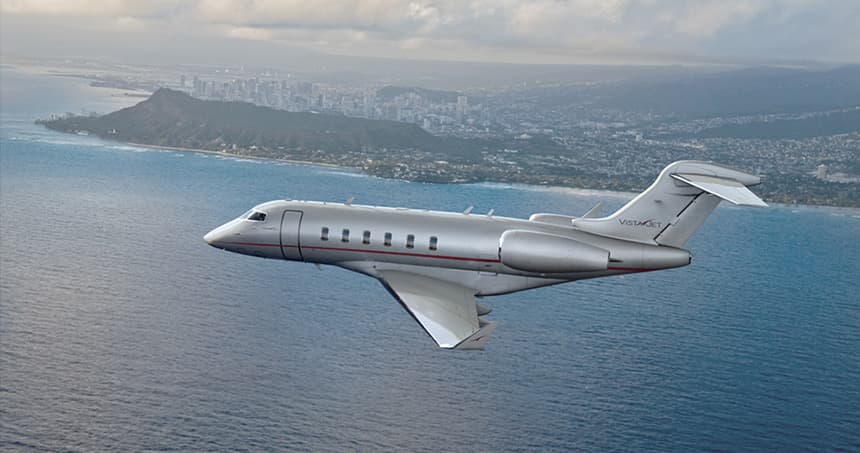
Estimated hourly rate — exact price on request.
- Passengers
- 9
- Range
- 5,900 km
- Cruise speed
- ≈ 850 km/h
- Max flight time
- ≈ 6.5 h
- Cabin length
- 7.68 m
- Cabin width
- 2.19 m
- Cabin height
- 1.83 m
- Aircraft length
- 20.92 m
Cruise speed is high-speed cruise. Manufacturers calculate range at the slower long-range cruise, with four passengers and NBAA IFR reserves — so a maximum-range leg takes longer than range ÷ speed, and a full cabin flies less far.
The Bombardier Challenger 350 is the best-selling super-midsize jet, famous for its wide flat-floor cabin and smooth ride. It seats up to nine, crosses Europe non-stop and reaches Cyprus or North Africa with every seat sold, and pairs a stand-up cabin with a fully enclosed lavatory for genuine long-leg comfort.
We don’t own the jets — we source them. With access to 4,500+ aircraft, we pick the exact tail that fits your route, your group and your budget. These are estimated from-prices per flight hour, to give you a sense of cost. Your exact quote depends on the aircraft, route and dates — just ask.
In detail
The Bombardier Challenger 350 in practice
The Challenger 350 is the super-midsize jet European brokers reach for first, and the most chartered aircraft in its class on this side of the Atlantic. Nine seats, 5,900 km of range, about 850 km/h in the cruise, and the widest cabin in the category at 2.19 m. You can stand up in it — 1.83 m of headroom over a flat floor — walk to a full lavatory behind a solid door, and reach your suitcase in flight. It is not a two-way transatlantic aeroplane and it is not a heavy jet, but on European and Middle East sectors with the cabin full it is hard to beat on cost. From around €5,900 per flight hour, exact quote on request. Avily does not own aircraft; we charter across a large operator network.
Where it came from
Bombardier launched the programme at the 1999 Paris Air Show under the name Continental, aimed at the gap between the Learjet 60 and the Challenger 604: a clean-sheet aircraft with transcontinental range and a cabin wider than anything in the midsize class. It first flew on 14 August 2001 as the Challenger 300, was certified by Transport Canada on 31 May 2003 and by the FAA on 4 June 2003, and entered service with Flexjet on 8 January 2004.
The Challenger 350 followed a decade on. It flew on 2 March 2013, was announced at EBACE that May, and was certified by Transport Canada in June 2014, by the FAA on 25 June 2014 and by EASA on 2 September 2014. The changes were to the wing and the engines rather than the fuselage: canted winglets on a strengthened wing, uprated Honeywell HTF7350 engines and an updated flight deck. Steep-approach approval for London City arrived in 2018.
Deliveries settled the argument. Around 350 Challenger 350s had been handed over by mid-2020, on top of roughly 450 Challenger 300s, and the 350 was the most-delivered super-midsize jet for seven consecutive years before the line passed to the Challenger 3500 in 2022. It is why a European charter search returns more 350s than anything else in the class.
Who charters a Challenger 350
The typical booking is six to nine people who need to arrive together and work on the way — a board flying to a closing, a family moving between two houses, a sports or music party with equipment.
Inside the class the decision usually comes down to two rivals. The Citation Sovereign is cheaper by the hour, but its cabin is 1.68 m wide and 1.73 m high, and that height exists only in a dropped centre aisle: most adults cannot stand up in it. The Legacy 500 has the longer cabin — 8.38 m against 7.68 m — but it is 2.08 m wide and seats eight. The Challenger trades cabin length for width and payload, which is the trade most groups actually want. Above it, the Praetor 600 buys range and the heavy Challenger 605 buys a 2.49 m cabin, both at a higher hourly rate.
Range with a full cabin, and the Atlantic
The published 5,900 km is a four-passenger figure, flown to NBAA IFR reserves in still air. The gap between that and real life is narrower on this type than on its neighbours: with full fuel the Challenger 350 still carries 1,907 lb of payload, roughly nine adults with light bags. Full seats and full tanks are close to compatible here, which is rare in the class. With eight or nine aboard and real luggage, expect to give up 300 to 500 km — plan on 5,450 to 5,600 km and a sector of about six and a half hours.
Across the Atlantic, direction decides everything. Eastbound, New York or Teterboro to Shannon, London or Paris is routine, especially in winter with the jetstream behind you. Westbound normally needs a fuel stop at Shannon, Keflavik or Gander; nonstop happens only on light days.
The cabin, the bags and the lavatory
Nine seats in two zones, a flat floor, 1.83 m of stand-up height and 2.19 m of width — the widest cabin in the class, and the reason a nine-seat load does not feel like nine seats. The aft lavatory is full size, behind a solid door and serviced from outside, so it stays usable to the end of a six-hour sector; an optional belted seat in there is what makes the tenth place on some tails.
Baggage is 3.0 m³, heated, pressurised and reachable in flight — something the Citation Sovereign cannot offer, since most of its hold is sealed off once the door closes. On a ski or golf trip that matters more than it sounds. Wi-Fi is the one thing not to assume: Ka-band and Gogo AVANCE installations are common on charter tails but not universal, so we confirm connectivity on the aircraft, not on the model.
Where it flies, and the airports it can use
From London the Challenger 350 reaches Geneva in about 1h 25m, Nice in 1h 40m, Milan in 1h 50m, Ibiza in 2h 30m and Larnaca in 4h 30m — all with the cabin full and no fuel stop. London to Dubai is the honest edge case: 5,500 km against a realistic full-cabin 5,450 to 5,600 km, and a block time near seven hours. Light, it goes nonstop; with nine aboard, full bags and a headwind home, plan a fuel stop or take a longer-range type.
Field length is 1,474 m at maximum take-off weight and 721 m to land. The type is steep-approach certified for London City, though the approval is a retrofit, so we check the individual tail. Cannes-Mandelieu, at 1,610 m, is fine at normal weights but needs fuel planning on a hot day; Samedan is operable with seasonal restrictions and a mandatory crew briefing; Sion and Ibiza are no problem.
What moves the price
From around €5,900 per flight hour is the starting point; the exact quote turns on four things.
Positioning: the aircraft is rarely parked where you are, and the empty legs flown to collect you and return to base are part of the price — a departure from a city with resident Challengers costs less than the same flight from a quiet field. Crew duty: a same-day return to Larnaca can push a two-pilot crew past its legal limit, so the answer is a night stop or a second crew, and both cost money. Season and slots: Nice in July, Geneva in ski season, Cannes during the festival — slots, parking and handling all move together. And cabin crew: at this size a flight attendant is an option rather than a standard fit, so a hot meal service needs asking for at the quoting stage.
What it does well
- 2.19 m of cabin width, the widest in the super-midsize class, over a flat floor with 1.83 m of headroom.
- 1,907 lb of payload with full fuel: full seats and full tanks are close to compatible here, which almost nothing else in the class manages.
- A 3.0 m³ hold that is heated, pressurised and reachable from the cabin in flight.
- 1,474 m to take off at maximum weight, 721 m to land, and steep-approach certification for London City.
- The most-delivered jet in its class, so a European trip usually has several tails competing for it rather than one on offer.
Where it gives ground
- Westbound Atlantic crossings normally need a fuel stop at Shannon, Keflavik or Gander. Only the eastbound leg is routinely nonstop.
- Cannes-Mandelieu's 1,610 m runway works below maximum weight but needs fuel planning on a hot day, and Samedan carries seasonal restrictions and a mandatory crew briefing.
- A flight attendant is an option rather than a standard fit at this size, so a hot meal service has to be specified when the trip is quoted.
The Bombardier Challenger 350 against the alternatives
- Cessna Citation Latitude8 · 5,000 km
The sensible step down when six or seven people are flying two or three hours inside Europe. It is stand-up too, and materially cheaper per hour; you lose cabin width, in-flight baggage access and about 2,000 km of range.
- Embraer Praetor 6009 · 7,400 km
Worth the higher rate when the sector is the point — a full cabin to the Gulf, or a westbound Atlantic crossing you want nonstop rather than planned around a fuel stop.
- Bombardier Challenger 60512 · 7,400 km
The answer when the group is ten or more, or when a six-hour night sector calls for berths. A 2.49 m cabin and about 1,500 km of extra range, at a higher hourly rate.
Routes the Bombardier Challenger 350 flies
- London → Nice1h 40mfrom €9,500
- London → Geneva1h 25mfrom €7,600
- London → Milan1h 50mfrom €9,150
- London → Ibiza2h 30mfrom €12,400
- London → Larnaca4h 30mfrom €22,000
Flight times are typical for this type with a full cabin. Headwinds, payload and slot restrictions move them.
Bombardier Challenger 350 charter — frequently asked questions
- Can a Challenger 350 cross the Atlantic?
- Eastbound, yes — New York to Shannon, London or Paris is a routine sector for the type, particularly in winter when the jetstream is behind you. Westbound is the harder direction: Europe to the US East Coast normally needs a fuel stop at Shannon, Keflavik or Gander, and only goes nonstop on a light load and a good day.
- Can it land at London City?
- Yes. The Challenger 350 is certified for the steep approach London City requires, approved from 2018. That approval is a retrofit rather than a standard fit on every airframe, so it has to be confirmed on the individual aircraft rather than the model — we do that before confirming any arrival into or departure from LCY.
- How far does it really go with nine people?
- The 5,900 km headline assumes four passengers and NBAA IFR reserves. With eight or nine aboard and their luggage, plan on 5,450 to 5,600 km. The drop is small by class standards, because the aircraft still carries 1,907 lb of payload with full fuel — full seats and full tanks are close to compatible, which is why it covers European and Middle East sectors so well.
- What is the difference between the Challenger 350 and the 3500?
- The cabin shell, its width and height, and the overall dimensions of the aircraft are identical. The 3500 adds roughly 200 nautical miles of range and a refreshed interior. Everything on this page describes the 350, which is what the European charter market will usually offer you. If a 3500 is available for your dates, we will say so.
Specifications
Full technical sheet
General
- Manufacturer
- Bombardier
- Category
- Super-midsize jet
- ICAO designator
- CL35
- Production
- 2014–2022
- Flight crew
- 2
Performance
- Range (IFR reserves)
- 5,900km
- Range (nautical miles)
- 3,200nm
- Cruise speed (high-speed)
- ≈ 850km/h
- Max operating Mach (MMO)
- M 0.83
- Max operating speed (VMO)
- 320KIAS
- Approach speed
- 115kts
- Takeoff distance (balanced field)
- 1,474m
- Landing distance
- 721m
- Service ceiling
- 45,000ft
- Cabin altitude
- 4,850ft
- Max flight time
- ≈ 6.5h
Powerplant and avionics
- Engine type
- Turbofan
- Engines
- 2 × Honeywell HTF7350
- Thrust per engine
- 7,323lbf
- Avionics
- Rockwell Collins Pro Line 21 Advanced
Dimensions and capacity
- Aircraft length
- 20.92m
- Aircraft height
- 6.10m
- Wing span
- 21.03m
- Cabin length
- 7.68m
- Cabin width
- 2.19m
- Cabin height
- 1.83m
- Baggage volume
- 3.00m³
- Seats (charter layout)
- 9
- Seats (max certified)
- 10
- Suitcases
- 8
- Carry-on bags
- 8
- Max payload
- 1,542kg
- Max takeoff weight (MTOW)
- 18,416kg
- Max landing weight (MLW)
- 15,490kg
- Fuel capacity
- 7,934L
Manufacturer and type-certificate figures, verified field by field. A line we could not source is left out rather than filled with a plausible number.
Gallery