Heavy jet
Dassault Falcon 2000LXS
Efficient French heavy jet
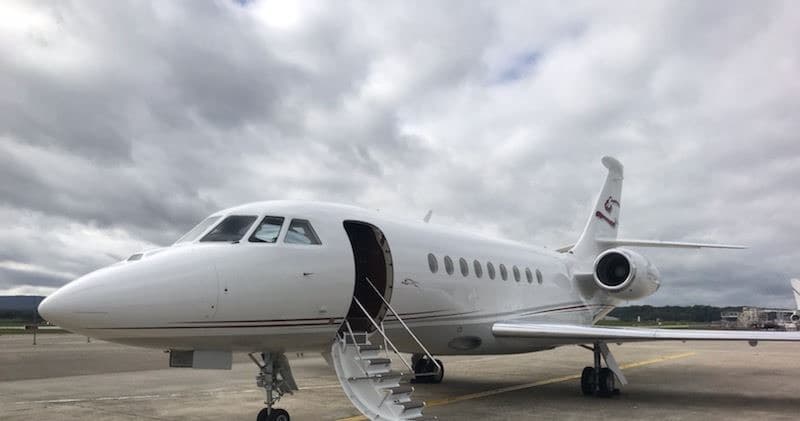
Estimated hourly rate — exact price on request.
- Passengers
- 10
- Range
- 7,400 km
- Cruise speed
- ≈ 880 km/h
- Max flight time
- ≈ 8 h
- Cabin length
- 7.98 m
- Cabin width
- 2.34 m
- Cabin height
- 1.88 m
- Aircraft length
- 20.23 m
Cruise speed is high-speed cruise. Manufacturers calculate range at the slower long-range cruise, with four passengers and NBAA IFR reserves — so a maximum-range leg takes longer than range ÷ speed, and a full cabin flies less far.
The Dassault Falcon 2000LXS blends a wide, tall cabin with the fuel efficiency of Dassault’s twin-engine design. Seating up to ten, it flies transatlantic legs while still operating comfortably from shorter, more challenging runways.
We don’t own the jets — we source them. With access to 4,500+ aircraft, we pick the exact tail that fits your route, your group and your budget. These are estimated from-prices per flight hour, to give you a sense of cost. Your exact quote depends on the aircraft, route and dates — just ask.
In detail
The Dassault Falcon 2000LXS in practice
The Falcon 2000LXS is the heavy jet to charter when the airport is the hard part of the trip, and the one whose range figure is honest about a full cabin. Dassault publishes 4,000 nm — 7,400 km — with EIGHT passengers aboard and NBAA IFR reserves, where Bombardier quotes the same distance at six and Embraer at four. Its balanced field length is 1,425 m at maximum weight, the shortest in the class by roughly 300 m, and it has been approved for London City since 2014. Ten seats, a 1.88 m cabin, a 47,000 ft ceiling, from around €7,300 per flight hour, exact quote on request. Avily Lux owns no aircraft; we charter the type through European operators and quote a named tail.
Where it came from
Dassault announced the aircraft at the Paris Air Show in June 1989, under the name Falcon X, and built it with Alenia as a twin-engine, shortened development of the Falcon 900 trijet. The prototype flew on 4 March 1993, certification followed in 1994 and the type entered service in 1995.
The run since then has been a steady sequence of range and systems upgrades rather than a new airframe: the longer-legged 2000EX in 2003, the Honeywell EASy flight deck in 2004, the 2000DX in 2007 and the 2000LX with blended winglets and a 4,000 nm range in 2009. The short-field work came last. Dassault unveiled the 2000S in May 2011 with inboard slats added to the wing, then announced the 2000LXS in October 2012 — the same slats and winglets on the longer-range airframe. EASA certified both on 19 March 2013, the FAA on 16 April 2013, and the LXS replaced the LX in production that year. London City approval for both models was announced in April 2014.
The type is still being built. 675 Falcon 2000-series aircraft had been delivered by October 2022, and in June 2025 Dassault announced a partnership with Reliance to assemble the LXS in India, with the first aircraft from that line expected in 2028. For a charter customer that means current production support, a European service network and a flight deck that is not a museum piece.
Who charters a Falcon 2000LXS
Six to ten people, on trips where either the destination airport or the honest range decides the aircraft. Alpine and island fields in winter and summer, hot-and-high days that make other heavies offload fuel, and long sectors where the group does not want to hear that the published range assumed half the seats were empty.
Against the Challenger 605 at a similar rate, you trade cabin width for capability: 2.34 m against 2.49 m, ten seats against twelve, and in return roughly 300 m less runway, 6,000 ft more ceiling and a range figure quoted at eight passengers rather than six. Against the Challenger 850 the comparison is stark in both directions — the 850 has nearly twice the cabin length and 2,200 km less range. If the group is small and the airports are easy, a Praetor 600 does the same distance from about €6,000 an hour in a narrower cabin.
A range figure that survives a full cabin
The 4,000 nm headline is a manufacturer figure at eight passengers with NBAA IFR reserves, and it is the best-documented range basis of any aircraft on this site. Dropping to four passengers buys about 65 nm more — that is how flat the curve is here. The limit case is weight, not seats: loaded to the 2,245 kg maximum payload, range falls to about 2,915 nm, near 5,400 km. Ten passengers with heavy winter or expedition baggage move you towards that end.
One note on the table. The ≈880 km/h we publish is high-speed cruise; the range is calculated at long-range cruise, around 810 km/h. With eight aboard, London and Paris to New York work nonstop — Dassault publishes Paris–New York as a city pair — while Los Angeles, Johannesburg and the Maldives need a fuel stop.
Inside the cabin
7.98 m long, 2.34 m wide and 1.88 m high — the tallest cabin of the four heavy jets, with a flat floor and about 29 m³ of volume. Three seating zones, a full galley forward, one aft lavatory with a vanity. The divan berths, but there is no separate bedroom and no shower, so a night sector means rest rather than a bed each. Dassault reduced cabin noise by 3 dB over the earlier 2000s, which is audible on a six-hour leg.
Baggage is 3.70 m³, roughly half a Legacy 650's hold. The aft compartment can be reached from the rear of the cabin in flight on most configurations, and we confirm that on the individual aircraft. The ceiling is 47,000 ft, the highest in the class, but Dassault publishes no cabin-altitude figure we can verify, so we publish none.
Runways and the corridors it flies
1,425 m of balanced field at maximum weight, 689 m to land and 105 knots over the threshold, on inboard and outboard slats and double-slotted Fowler flaps — Dassault's claim is 1,000 ft less runway than the closest competitor, and the practical effect is that Sion, Samedan, Cannes–Mandelieu and the shorter Greek island strips stay available on days when a Challenger has to leave fuel or passengers behind. London City has been approved for the 2000S and 2000LXS since April 2014; the operator must hold the approval too, which we confirm per aircraft.
Block times with eight aboard: Paris–Nice about 1 h 20 m, London–Geneva 1 h 25 m, London–Nice 1 h 40 m, London–Larnaca 4 h 20 m, London–Dubai about 6 h 45 m nonstop. The working sector is around eight hours.
What moves the price
From around €7,300 per flight hour, which sits in the upper half of the heavy class, and the quote is built per tail and per date.
Positioning. The Falcon 2000 family is large and long-lived, but the LXS is the newest slice of it, so on some dates the nearest one is a longer empty leg away than the nearest Challenger 605. Return trips absorb that better than one-ways.
Crew duty. London–Dubai and back inside a day breaks duty limits; a night stop or a second crew is the honest answer and both are visible in the price.
Airport and season. Short-field access buys you the convenient airport, not a cheap one — London City, Cannes and Sion charge accordingly, and in festival week or February half-term the slot and the parking stand are what you are really competing for. Gulf and eastern Mediterranean sectors add overflight charges that intra-European legs never see.
What it does well
- 1,425 m of balanced field at maximum weight and 689 m to land — the shortest runway requirement in the heavy class, around 300 m less than a Challenger 605.
- Its 7,400 km is published at eight passengers with NBAA IFR reserves, so the headline range survives a full cabin instead of assuming half of it is empty.
- Approved for London City since April 2014, subject to the operator holding the approval, which we check on the specific aircraft.
- 1.88 m of stand-up height, the tallest cabin of the four heavy jets, and a 47,000 ft ceiling — the highest in the class.
- Still in production, with a Honeywell EASy II flight deck and a support network built around 675 delivered Falcon 2000s.
Where it gives ground
- 2.34 m of cabin width against 2.49 m on either Challenger, and ten seats against twelve or fourteen.
- 3.70 m³ of baggage, less than half a Legacy 650's 8.1 m³, and in-flight access to the aft hold depends on how the aircraft is configured.
- Loaded to its 2,245 kg maximum payload the range falls to about 5,400 km: 7,400 km is an eight-passenger number, not a ten-passenger one with heavy bags.
The Dassault Falcon 2000LXS against the alternatives
- Bombardier Challenger 60512 · 7,400 km
When the runway is not the question and the cabin is. 2.49 m of width against 2.34 m, twelve seats against ten, at around €300 an hour less. You give up the short-field access, 6,000 ft of ceiling and the eight-passenger range basis — the 605's 7,400 km is quoted at six.
- Embraer Legacy 65013 · 7,200 km
When baggage or headcount decides the trip. Thirteen seats and an 8.1 m³ hold accessible in flight against 3.70 m³ here, on comparable range — the ski, golf and camera loads that would otherwise need a second aircraft.
- Bombardier Challenger 85014 · 5,200 km
When twelve to fourteen people are travelling inside Europe. Nearly twice the cabin length, three zones and two lavatories for about €100 an hour less; the price is 5,200 km instead of 7,400 and 1,922 m of runway instead of 1,425.
Routes the Dassault Falcon 2000LXS flies
- London → Dubai6h 50mfrom €60,500
- London → Larnaca4h 30mfrom €22,000
- London → Nice1h 40mfrom €9,500
- Paris → Nice1h 20mfrom €8,500
- London → Geneva1h 25mfrom €7,600
Flight times are typical for this type with a full cabin. Headwinds, payload and slot restrictions move them.
Dassault Falcon 2000LXS charter — frequently asked questions
- Will it get into a short alpine or island airport with everyone on board?
- This is the type's strongest yes. It needs 1,425 m of balanced field at maximum weight, lands in 689 m and crosses the threshold at 105 knots, which keeps Sion, Samedan, Cannes–Mandelieu and the shorter Greek strips available. The real constraints are usually airport weight caps, temperature and slots, and we check those for your date.
- London or Paris to New York nonstop?
- Yes with eight passengers. Dassault publishes 4,000 nm at eight aboard with NBAA IFR reserves, and Paris–New York is one of its own city pairs. Winter westbound headwinds are the variable the crew plans against. Los Angeles, Johannesburg and the Maldives are beyond it and need a fuel stop.
- Is a twin-engine jet fine over the Atlantic?
- Yes. The 2000LXS crosses the North Atlantic routinely under the same oceanic rules as every other twin on those tracks, with its Pratt & Whitney Canada PW308C engines and NBAA IFR reserves carried on top of the planned sector. Dassault markets Paris–New York as a standard mission rather than a stretch.
- How is it different from a Challenger 605 at similar money?
- Runway, ceiling and range basis versus cabin and seats. The Falcon needs 1,425 m against 1,720–1,814 m, climbs to 47,000 ft against 41,000, and publishes its 7,400 km at eight passengers rather than six. The Challenger is 15 cm wider inside and seats twelve. Which one wins is decided by the airport and the headcount.
Specifications
Full technical sheet
General
- Manufacturer
- Dassault Aviation
- Category
- Heavy jet
- ICAO designator
- F2TH
- Production
- 2013–present
- Flight crew
- 2
Performance
- Range (IFR reserves)
- 7,400km
- Range (nautical miles)
- 4,000nm
- Cruise speed (high-speed)
- ≈ 880km/h
- Long-range cruise
- 809km/h
- Max operating Mach (MMO)
- M 0.86
- Approach speed
- 105kts
- Takeoff distance (balanced field)
- 1,425m
- Landing distance
- 689m
- Service ceiling
- 47,000ft
- Max flight time
- ≈ 8h
Powerplant and avionics
- Engine type
- Turbofan
- Engines
- 2 × Pratt & Whitney Canada PW308C
- Thrust per engine
- 7,000lbf
- Avionics
- Honeywell Primus Epic EASy II
Dimensions and capacity
- Aircraft length
- 20.23m
- Aircraft height
- 7.11m
- Wing span
- 21.38m
- Cabin length
- 7.98m
- Cabin width
- 2.34m
- Cabin height
- 1.88m
- Baggage volume
- 3.70m³
- Seats (charter layout)
- 10
- Seats (max certified)
- 19
- Max payload
- 2,245kg
- Max takeoff weight (MTOW)
- 19,414kg
- Max landing weight (MLW)
- 17,826kg
- Fuel capacity
- 9,411L
Manufacturer and type-certificate figures, verified field by field. A line we could not source is left out rather than filled with a plausible number.
Gallery