Heavy jet
Bombardier Challenger 850
Regional-jet space in private trim
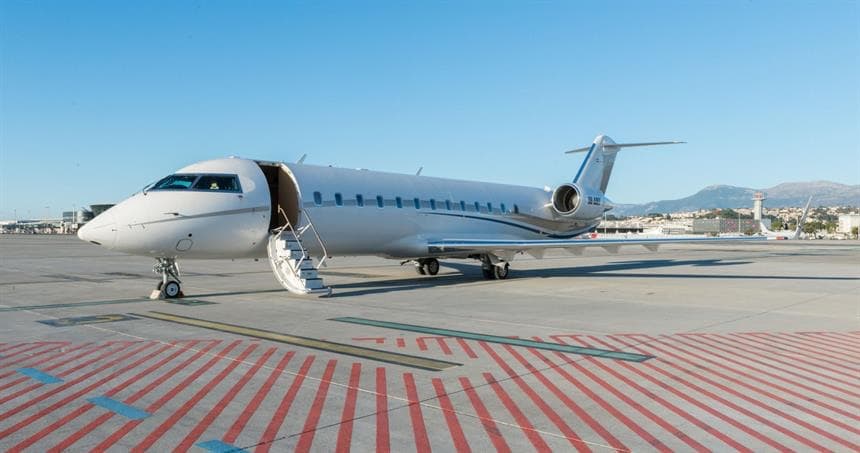
Estimated hourly rate — exact price on request.
- Passengers
- 14
- Range
- 5,200 km
- Cruise speed
- ≈ 850 km/h
- Max flight time
- ≈ 6.5 h
- Cabin length
- 14.76 m
- Cabin width
- 2.49 m
- Cabin height
- 1.85 m
- Aircraft length
- 26.77 m
Cruise speed is high-speed cruise. Manufacturers calculate range at the slower long-range cruise, with four passengers and NBAA IFR reserves — so a maximum-range leg takes longer than range ÷ speed, and a full cabin flies less far.
The Bombardier Challenger 850 is derived from a regional airliner, giving it one of the largest stand-up cabins in business aviation. Seating up to fourteen, it’s ideal for larger teams or families who want room to move, meet and relax in the air.
We don’t own the jets — we source them. With access to 4,500+ aircraft, we pick the exact tail that fits your route, your group and your budget. These are estimated from-prices per flight hour, to give you a sense of cost. Your exact quote depends on the aircraft, route and dates — just ask.
In detail
The Bombardier Challenger 850 in practice
The Challenger 850 is a converted 50-seat regional airliner, and every sensible decision about it follows from that one fact. Bombardier took a CRJ200, took the seats out and built a private cabin inside the tube: 14.76 m long, 2.49 m across, 1.85 m high, with three separate zones and two lavatories. That is a longer and wider cabin than a Global 6000 has, at two thirds of the hourly rate. The bill arrives as range. 5,200 km published against 7,400 km for a Challenger 605, which puts a fuel stop on every Europe–US sector. Fourteen seats, from around €7,200 per flight hour, exact quote on request. Avily Lux owns no aircraft; we charter the 850 through operators across Europe and the Gulf and name the tail we are quoting.
Where it came from
The Canadair Regional Jet programme was launched in early 1989, the prototype flew on 10 May 1991, and Lufthansa CityLine put the type into service on 19 October 1992. The CRJ200 followed with more efficient General Electric CF34-3B1 engines and flew its first revenue service with SkyWest on 15 February 1994. When the line closed in 2006 it had delivered 1,021 aircraft, 709 of them CRJ200s.
The corporate conversion started in 1996 as the Challenger SE, later called the Challenger 800. In May 2005 Bombardier relaunched the idea properly, announcing a family of three airliner-derived corporate shuttles at once: the Challenger 850 on the CRJ200, and the 870 and 890 on the larger CRJ700 and CRJ900. The first 850 was delivered in 2006 and the line closed in 2012 after 71 deliveries.
For a charter customer the airline parentage is the commercial point, not a piece of trivia. CF34 engines, CRJ spares and CRJ-rated engineers exist in quantity on every continent, so an airframe the size of a Global costs Challenger money to keep flying. That is the whole reason a fourteen-seat cabin with two lavatories is offered from about €7,200 an hour rather than €11,000. Most of the surviving fleet works in Europe and the Middle East, much of it in charter rather than private ownership.
Who charters a Challenger 850
Ten to fourteen people who need to travel as one group, on a trip that stays inside the 850's range: a board on a European roadshow, a squad and its staff, a family with three generations and the luggage that comes with them, a production unit with cases. The type moves the whole party in one hull, with room to hold a meeting at the table and put someone to bed at the back at the same time.
The neighbours each answer a different question. The Challenger 605 uses the same fuselage cross-section but 8.61 m of it, seats twelve, and flies 7,400 km — it is the one you take across the Atlantic. The Legacy 650 offers thirteen seats and an 8.1 m³ hold reachable in flight on 7,200 km. The 850 is the cabin-first answer, and it is only the right one when the sector is short enough. It sets the bottom of the heavy-jet range band at 5,200 km and the top of the class for cabin volume, which is what a cabin-first aircraft looks like: the class is defined by what you sit in, not by how far it goes.
What 5,200 km actually means
5,200 km is 2,811 nm at long-range cruise with NBAA IFR reserves. Put fourteen people and their baggage aboard and plan on 2,500–2,700 nm instead, which is 4,600–5,000 km. Our table publishes ≈850 km/h, which is high-speed cruise; the range is calculated at long-range cruise, nearer 790 km/h. You do not get both on the same flight.
Said plainly: every Europe–US sector needs a fuel stop, London–New York included. At about 3,000 nm the Atlantic is roughly 400 nm beyond a full-cabin 850, so the crew plans Keflavik, Shannon or Gander. London–Dubai at around 5,500 km sits on the edge and depends on the day's winds — we treat it as a tech stop unless the numbers work. Europe, the Mediterranean, Cyprus, North Africa and the Canaries are all comfortable nonstop.
Inside the cabin
14.76 m from the cockpit divider to the end of the pressurised compartment, 2.49 m across at the centreline and 2.19 m at the floor, 1.85 m of stand-up height, flat floor. Around 56 m³ of cabin volume, the largest in the heavy class. Three zones: a forward lounge, a conference and dining section, and a private aft stateroom behind a door. Two lavatories — nothing else in the class has a second one. Full galley with a wardrobe, seven sleeping positions in operator listings, no shower.
Baggage is 5.72 m³, around twenty cases, against 3.2–3.3 m³ on a Challenger 605. Whether the hold is reachable in flight depends on how the individual aircraft is configured, so we confirm that per tail rather than promise it for the type. Crew is two pilots and a flight attendant as standard. Wi-Fi is fitted to most charter 850s; again, tail-specific.
The corridors it flies
Realistic block times with all fourteen seats sold and no fuel stop: London–Geneva about 1 h 30 m, London–Nice 1 h 45 m, London–Barcelona 2 h 15 m, London–Ibiza 2 h 35 m, London–Larnaca 4 h 40 m. The working sector limit is around 6 h 30 m, which reaches Cyprus, the Canaries and the Gulf's near edge and leaves the Atlantic to a 605 or a Global.
The airliner heritage shows on the ground as well as in the air. Balanced field length is 1,922 m at maximum weight, the longest of the four heavy jets, and the aircraft is 26.77 m long with a 21.21 m span. Luton, Farnborough, Geneva, Nice, Ibiza, Barcelona and Larnaca take it without comment. Sion, Samedan and Cannes–Mandelieu do not — that is the Falcon 2000LXS's ground, and parking in peak season is worth booking early.
What moves the price
From around €7,200 per flight hour, quoted against a specific aircraft and specific dates. The hourly rate is the smaller half of the answer.
Positioning first. There are fewer 850s in Europe than 605s, so the nearest free one may be a longer empty leg away, and that leg is on your quote. A same-day return usually beats two one-ways.
Crew duty next. Fourteen passengers, a long day and a late return can push past what one crew may legally fly; a night stop or a second crew both show up in the number.
Then the airport. An aircraft this size pays airliner-scale handling and parking, and at Nice in August or Cannes in festival week the slot and the stand are the hard part, not the jet. Fuel stops, where the sector needs one, add landing and handling fees on top of the ground time.
What it does well
- 14.76 m of cabin, longer than a Global 6000's 13.18 m, and around 56 m³ of volume — the largest cabin in the heavy class.
- Three zones and two lavatories, including a private aft stateroom behind a door: nothing else in the class separates fourteen people like that.
- 5.72 m³ of baggage, roughly twenty cases, against 3.2–3.3 m³ on a Challenger 605.
- From about €7,200 per flight hour for a cabin that costs around €11,000 an hour on a Global 6000.
- Airline economics underneath: 709 CRJ200s were built, so engines, spares and rated engineers are everywhere and the hourly rate reflects it.
Where it gives ground
- 5,200 km published and 4,600–5,000 km with fourteen aboard: every Europe–US sector carries a fuel stop, London–New York included.
- 1,922 m of balanced field at maximum weight, the longest in the class — Sion, Samedan and Cannes–Mandelieu are out of reach.
- A Rockwell Collins Pro Line 4 flight deck and a 41,000 ft ceiling; the last aircraft was delivered in 2012, and Bombardier publishes no cabin-altitude figure we can verify, so we publish none.
The Bombardier Challenger 850 against the alternatives
- Bombardier Challenger 60512 · 7,400 km
When the trip crosses an ocean. Same 2.49 m cabin width but 8.61 m of it, twelve seats, and 7,400 km published — about 6,950 km with the cabin full, so London–New York and London–Dubai stay nonstop. Roughly €200 an hour less, and you give up more than half the cabin length and the second lavatory.
- Embraer Legacy 65013 · 7,200 km
The closest cabin rival: thirteen seats, a 12.90 m cabin and an 8.1 m³ hold that is accessible in flight, on 7,200 km. Take it when the group is large and the sector leaves Europe, or when the baggage list is the real constraint.
- Bombardier Global 600013 · 11,100 km
When thirteen or fourteen people must arrive nonstop from anywhere: 11,100 km against 5,200. A comparable cabin — 13.18 m long, 2.41 m wide, 1.88 m high — from about €11,000 an hour. You are paying for range, not for room.
Routes the Bombardier Challenger 850 flies
- London → Larnaca4h 30mfrom €22,000
- London → Nice1h 40mfrom €9,500
- London → Ibiza2h 30mfrom €12,400
- London → Barcelona2h 10mfrom €11,000
- London → Geneva1h 25mfrom €7,600
Flight times are typical for this type with a full cabin. Headwinds, payload and slot restrictions move them.
Bombardier Challenger 850 charter — frequently asked questions
- Can a Challenger 850 cross the Atlantic?
- Not nonstop from Europe to the US East Coast. London–New York is about 3,000 nm and a full fourteen-seat cabin leaves 2,500–2,700 nm, so the crew plans a fuel stop at Keflavik, Shannon or Gander. Eastbound is easier but still normally planned with a stop. Inside Europe, to Cyprus, North Africa and the Canaries it flies nonstop.
- Is it really as big inside as it looks?
- Yes. The cabin is 14.76 m long, 2.49 m across at the centreline and 1.85 m high with a flat floor, giving around 56 m³ — more volume than a Global 6000, which costs about €11,000 an hour. Three zones, two lavatories and a private aft stateroom. The one thing it does not have is a shower.
- Why is it cheaper per hour than a smaller jet with the same cabin?
- Because underneath it is an airliner. The CF34-3B1 engines, the spares and the engineers come from a fleet of 709 CRJ200s, so maintenance is priced like regional airline work rather than like large-cabin business aviation. The savings are real and so is the trade: less range and more runway than any other heavy jet here.
- Can we hold a meeting and sleep on board?
- Both, and not in the same seat. The cabin splits into a forward lounge, a conference and dining section and a private aft stateroom behind a door, with seven sleeping positions in operator listings and two lavatories. Layouts differ between aircraft, so we send the floorplan of the specific tail before you confirm.
Specifications
Full technical sheet
General
- Manufacturer
- Bombardier
- Category
- Heavy jet
- ICAO designator
- CRJ2
- Production
- 2006–2012
- Flight crew
- 2
Performance
- Range (IFR reserves)
- 5,200km
- Range (nautical miles)
- 2,811nm
- Cruise speed (high-speed)
- ≈ 850km/h
- Long-range cruise
- 787km/h
- Max operating Mach (MMO)
- M 0.85
- Max operating speed (VMO)
- 335KIAS
- Takeoff distance (balanced field)
- 1,922m
- Landing distance
- 887m
- Service ceiling
- 41,000ft
- Max flight time
- ≈ 6.5h
Powerplant and avionics
- Engine type
- Turbofan
- Engines
- 2 × General Electric CF34-3B1
- Thrust per engine
- 8,729lbf
- Avionics
- Rockwell Collins Pro Line 4
Dimensions and capacity
- Aircraft length
- 26.77m
- Aircraft height
- 6.22m
- Wing span
- 21.21m
- Cabin length
- 14.76m
- Cabin width
- 2.49m
- Cabin height
- 1.85m
- Baggage volume
- 5.72m³
- Seats (charter layout)
- 14
- Seats (max certified)
- 16
- Suitcases
- 20
- Max payload
- 4,256kg
- Max takeoff weight (MTOW)
- 24,040kg
- Max landing weight (MLW)
- 21,319kg
- Fuel capacity
- 10,323L
Manufacturer and type-certificate figures, verified field by field. A line we could not source is left out rather than filled with a plausible number.
Gallery