Heavy jet
Embraer Legacy 650
Three-zone intercontinental cabin
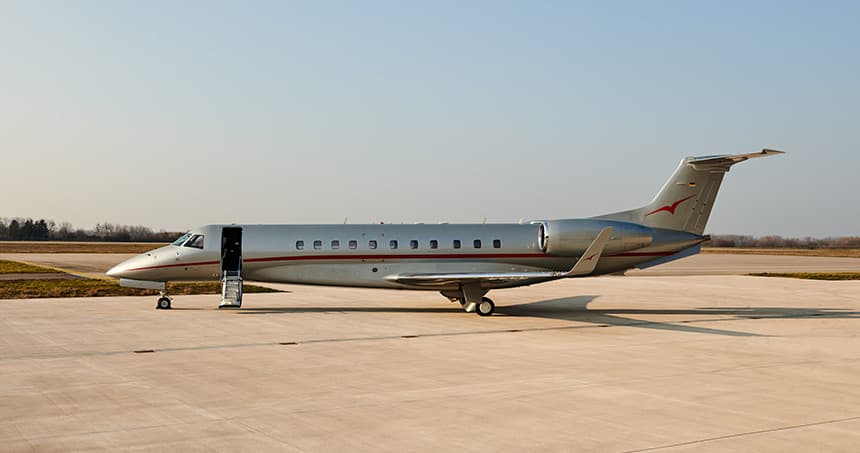
Estimated hourly rate — exact price on request.
- Passengers
- 13
- Range
- 7,200 km
- Cruise speed
- ≈ 850 km/h
- Max flight time
- ≈ 8 h
- Cabin length
- 12.90 m
- Cabin width
- 2.11 m
- Cabin height
- 1.83 m
- Aircraft length
- 26.33 m
Cruise speed is high-speed cruise. Manufacturers calculate range at the slower long-range cruise, with four passengers and NBAA IFR reserves — so a maximum-range leg takes longer than range ÷ speed, and a full cabin flies less far.
The Embraer Legacy 650 offers a large three-zone cabin with room to work, dine and sleep on long flights. Seating up to thirteen with generous baggage space, it’s a comfortable, cost-effective heavy jet for intercontinental family or team travel.
We don’t own the jets — we source them. With access to 4,500+ aircraft, we pick the exact tail that fits your route, your group and your budget. These are estimated from-prices per flight hour, to give you a sense of cost. Your exact quote depends on the aircraft, route and dates — just ask.
In detail
The Embraer Legacy 650 in practice
The Legacy 650 is the aircraft to charter when the luggage is part of the problem. It is a business conversion of Embraer's ERJ-135 regional jet: thirteen seats laid out in three separate cabin zones, a flat floor you walk down at 1.83 m, and 8.1 m³ of baggage — the largest hold of any heavy jet on this site, and reachable from the cabin in flight. That one fact settles most Legacy-versus-Challenger conversations. Ski parties, film crews and expedition loads that would otherwise need a second aircraft travel in one hull. The published 7,200 km is a four-passenger figure; with all thirteen seats sold, plan against about 6,780 km. From around €7,500 per flight hour, exact quote on request. Avily Lux owns no aircraft — we charter the type from operators in Europe, the Middle East and Asia, and we name the tail.
Where it came from
Embraer launched the aircraft as the Legacy 2000 at Farnborough in 2000: a business conversion of the ERJ-135 regional jet, keeping the airliner's systems, wing and support network and replacing the cabin. It first flew on 31 March 2001 and entered service in February 2002, taking the name Legacy 600 after 2005.
The 650 was the range answer. It first flew on 23 September 2009 at Embraer's flight-test field at Gavião Peixoto and was unveiled at NBAA in Orlando that October. Brazil's ANAC certified it on 30 September 2010, EASA on 7 October 2010 and the FAA on 24 February 2011. The changes were substantial for a derivative: more powerful Rolls-Royce AE 3007A2 engines at 9,020 lbf, more fuel, maximum takeoff weight up from 49,604 lb to 53,572 lb, and a lowered aisle that bought the cabin its stand-up height. Published range went from 3,400 nm to 3,900 nm.
The Legacy 650E, announced at NBAA in 2016, was the same airframe with a new interior, a longer warranty and synthetic vision and autothrottle as standard. Embraer closed the line in August 2020 to consolidate on the Praetor family; 289 Legacy 600s and 650s had been built by the end of that year. It is a charter and used-market aircraft now, strongest in Europe, the Middle East and Asia.
Who charters a Legacy 650
Ten to thirteen people with real luggage, on a sector between three and eight hours: ski groups to the Alps, film and camera crews, families moving for a season, corporate teams to the Gulf and Cyprus. The class neighbours make the case clearly enough.
Against the Challenger 605 you gain a seat and 8.1 m³ of baggage against 3.2–3.3 m³, and you give up 38 cm of cabin width — 2.11 m against 2.49 — and a little speed. Against the Challenger 850, which has the larger cabin of the two, you gain about 2,000 km of range. Against a Praetor 600 or another super-midsize you gain a cabin with three separate zones and a hold nothing in that class comes near. The Legacy is the answer when the constraint is people plus equipment rather than pure distance.
What 7,200 km actually means
7,200 km — 3,900 nm — is Embraer's figure with four passengers aboard and NBAA IFR reserves. Fill all thirteen seats and the honest number is about 6,780 km, roughly 3,660 nm. That still covers London–New York, Paris–New York, London–Dubai and Moscow–Beijing nonstop. Europe to the American west coast, to Johannesburg, the Maldives or Singapore needs a fuel stop.
One thing worth saying plainly, because two speeds appear on the same page. Our ≈850 km/h is high-speed cruise at the M 0.80 redline; the range figure is calculated at long-range cruise, nearer 787 km/h. You do not get both on one flight — on a long sector the crew trades speed for distance. And M 0.80 is a modest redline for the class: in typical cruise the Legacy gives away 20–30 km/h to its neighbours.
Three cabin zones, and a hold you can reach
12.90 m of passenger cabin, 2.11 m wide, 1.83 m high, flat floor, arranged as three zones: a forward club four, a mid section with a conference group and divan, and a private aft area. Seats and divan convert to four single beds plus one double. One lavatory aft, a forward crew lavatory as an option on some airframes, the largest galley in the class, no shower and no dedicated crew-rest compartment. You will see 15.19 m quoted for the cabin elsewhere; that figure counts the baggage compartment in, and what we publish is the 12.90 m passenger cabin.
Baggage is the headline. 8.1 m³ in total — a 6.8 m³ aft hold plus about 1.3 m³ of in-cabin stowage — and the aft hold is pressurised and reachable in flight. Skis, golf bags, camera cases and full luggage for thirteen go in one aircraft.
The corridors it flies
London–Larnaca is the sector the type is quoted on most: about 4 h 30 m with thirteen seats sold and baggage no object. London–Dubai runs a little over seven hours, inside the aircraft's working day, though at that load it is worth checking against the day's winds. The shorter legs are on this list for a different reason — London–Nice at about 1 h 45 m, London–Milan at 1 h 55 m, London–Ibiza at about 2 h 35 m are group-and-baggage trips, not range trips, and the Legacy takes the whole party and the ski bags in one hull instead of two.
Balanced field length is 1,750 m at maximum weight, sea level, standard conditions, with 866 m to land. Luton, Farnborough, Nice, Geneva, Milan and Larnaca are routine. Cannes–Mandelieu and the short alpine strips are not this aircraft's ground.
What moves the price
From around €7,500 per flight hour, quoted against a named aircraft and specific dates.
Positioning first. There are fewer Legacy 650s on the European charter market than Challenger 605s, so the nearest free airframe can be further away and the empty legs at each end are on your quote. That is the one place the type costs money the specification does not show.
Crew duty second. An eight-hour sector plus turnaround is a long day; Dubai with a same-day return means either a night stop or a second crew, and both appear in the number.
Then the geography — Gulf and eastern Mediterranean routings carry navigation and overflight charges that intra-European legs do not, and handling at the far end is not a European figure. Then the calendar: Larnaca in August, the Alps in February, Milan in fashion week. On those dates the slot and the parking are what you are really booking.
What it does well
- 8.1 m³ of baggage, the largest hold of any heavy jet on this site — pressurised, and reachable from the cabin in flight.
- Three separate cabin zones over a 12.90 m passenger cabin, with 1.83 m of stand-up height and a flat floor.
- Thirteen seats that convert into four single beds and one double for a night sector.
- ERJ-135 airliner heritage: Rolls-Royce AE 3007A2 engines at 9,020 lbf, 24,300 kg MTOW, and a support network built for a regional-jet fleet.
- From about €7,500 per flight hour — a thirteen-seat cabin at heavy-jet rather than ultra-long-range money.
Where it gives ground
- The 7,200 km headline is a four-passenger figure. With all thirteen seats sold it is about 6,780 km, and that is what a full-load trip must be planned against.
- M 0.80 is the redline. In typical cruise it gives away 20–30 km/h to its class neighbours, which is roughly twenty minutes on a seven-hour sector.
- 1,750 m of runway at maximum weight, so Cannes–Mandelieu and the short alpine strips are out; and Embraer publishes no cabin-altitude figure we can verify, so we publish none.
The Embraer Legacy 650 against the alternatives
- Bombardier Challenger 60512 · 7,400 km
When cabin width matters more than baggage. The 605 is 2.49 m across against the Legacy's 2.11 m, carries similar range, and is the most numerous heavy jet in Europe — usually a shorter positioning leg and a keener rate on your dates.
- Bombardier Challenger 85014 · 5,200 km
When the group is large and the flight is short. The 850 has the longest cabin in the heavy class at 14.76 m and takes fourteen, on the same airliner-derived logic — and it pays for it in range: about 5,200 km, which puts a fuel stop on anything transatlantic.
- Bombardier Global 600013 · 11,100 km
When the sector runs past the Legacy's eight hours — Europe to Singapore, the west coast of the United States, Johannesburg. The Global flies those nonstop with thirteen aboard, from about €11,000 an hour rather than €7,500.
Routes the Embraer Legacy 650 flies
- London → Larnaca4h 30mfrom €22,000
- London → Dubai6h 50mfrom €60,500
- London → Nice1h 40mfrom €9,500
- London → Milan1h 50mfrom €9,150
- London → Ibiza2h 30mfrom €12,400
Flight times are typical for this type with a full cabin. Headwinds, payload and slot restrictions move them.
Embraer Legacy 650 charter — frequently asked questions
- How much luggage really fits, and can we get to it in the air?
- 8.1 m³ in total — a 6.8 m³ aft hold plus about 1.3 m³ of in-cabin stowage — and the aft hold is pressurised and accessible in flight. It is the largest baggage volume of any heavy jet on this site and it is what most Legacy bookings are actually buying. Send us a piece count for skis, golf or camera loads and we confirm it against the specific aircraft.
- Will it fly London–New York nonstop with twelve or thirteen people?
- In normal conditions, yes. The sector is about 3,000 nm and a full cabin still leaves roughly 3,660 nm, so the margin is real rather than generous. Winter westbound headwinds are the variable, and on those days the crew carries a Shannon or Gander stop as a contingency. Eastbound is never in question. Embraer marketed the 650 as a transatlantic aircraft and it is one.
- Legacy 650 or Challenger 605?
- One more seat and more than twice the baggage on the Legacy, against 38 cm more cabin width and a little more speed on the Challenger. Published range is close and both do Dubai nonstop. If the trip is people plus equipment, take the Legacy. If it is twelve people who want the widest cabin in the class, take the 605.
- Is it slower than the other heavy jets?
- Yes. The redline is M 0.80 and typical cruise sits 20–30 km/h below its class neighbours — about twenty minutes on a seven-hour sector to Dubai, and a few minutes on a European leg. It is a real difference and a small one. The hold, the third cabin zone and the thirteenth seat are what you are trading it for.
Specifications
Full technical sheet
General
- Manufacturer
- Embraer
- Category
- Heavy jet
- ICAO designator
- E35L
- Production
- 2010–2020
- Flight crew
- 2
Performance
- Range (IFR reserves)
- 7,200km
- Range (nautical miles)
- 3,900nm
- Cruise speed (high-speed)
- ≈ 850km/h
- Long-range cruise
- 787km/h
- Max operating Mach (MMO)
- M 0.80
- Max operating speed (VMO)
- 320KIAS
- Takeoff distance (balanced field)
- 1,750m
- Landing distance
- 866m
- Service ceiling
- 41,000ft
- Max flight time
- ≈ 8h
Powerplant and avionics
- Engine type
- Turbofan
- Engines
- 2 × Rolls-Royce AE 3007A2
- Thrust per engine
- 9,020lbf
- Avionics
- Honeywell Primus Elite
Dimensions and capacity
- Aircraft length
- 26.33m
- Aircraft height
- 6.64m
- Wing span
- 21.17m
- Cabin length
- 12.90m
- Cabin width
- 2.11m
- Cabin height
- 1.83m
- Baggage volume
- 8.1m³
- Seats (charter layout)
- 13
- Seats (max certified)
- 19
- Max payload
- 2,240kg
- Max takeoff weight (MTOW)
- 24,300kg
- Max landing weight (MLW)
- 20,000kg
- Fuel capacity
- 11,681L
Manufacturer and type-certificate figures, verified field by field. A line we could not source is left out rather than filled with a plausible number.
Gallery