Turboprop
Pilatus PC-12
Single-engine all-rounder
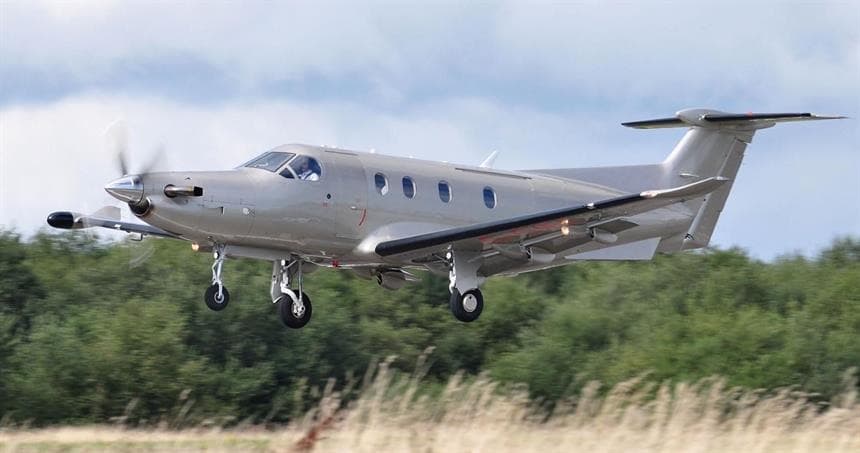
Estimated hourly rate — exact price on request.
- Passengers
- 6–8
- Range
- 3,340 km
- Cruise speed
- ≈ 530 km/h
- Max flight time
- ≈ 6 h
- Cabin length
- 5.16 m
- Cabin width
- 1.52 m
- Cabin height
- 1.45 m
- Aircraft length
- 14.4 m
Cruise speed is high-speed cruise. Manufacturers calculate range at the slower long-range cruise, with four passengers and NBAA IFR reserves — so a maximum-range leg takes longer than range ÷ speed, and a full cabin flies less far.
The Pilatus PC-12 is the world’s most popular single-engine turboprop, prized for its large cabin, big cargo door and short-field ability. It comfortably seats six to eight and reaches destinations others can’t, making it a favourite for both business and leisure regional flights.
We don’t own the jets — we source them. With access to 4,500+ aircraft, we pick the exact tail that fits your route, your group and your budget. These are estimated from-prices per flight hour, to give you a sense of cost. Your exact quote depends on the aircraft, route and dates — just ask.
In detail
The Pilatus PC-12 in practice
The PC-12 is a single-engine turboprop that carries six to eight people, needs 758 m of runway and is certified to use grass, gravel and dirt as well as tarmac. One feature settles most decisions about it: a cargo door 1.35 m by 1.32 m at the rear of the cabin. Skis, bikes, camera and survey kit, dog crates and awkward cases go aboard without a negotiation, and nothing else at this hourly rate takes them. It flies 3,340 km with four passengers and keeps most of that with the cabin full, which no light jet manages. The trade is speed and altitude — about 530 km/h, ceiling 30,000 ft. Avily does not own aircraft; we charter them from a large operator network. From ~€2,300 per flight hour, exact quote on request.
Where it came from
Pilatus announced the PC-12 at the NBAA convention in October 1989 with an unusual brief: match the cabin and the payload of a light twin turboprop using one engine instead of two, and give it a rear cargo door so it could earn its living when nobody had chartered it. The prototype flew on 31 May 1991. Swiss certification followed on 30 March 1994, the FAA approved the type on 15 July 1994, and deliveries began that September.
The aircraft grew steadily rather than dramatically. Higher weights were certified in 1996 and again in 2005; the 2008 version brought the 1,200 shp PT6A-67P and the Honeywell Primus Apex flight deck, which is what most European charter aircraft have. The NGX was announced in October 2019, and the PC-12 PRO, announced in March 2025, moved the type to a Garmin flight deck and is built for emergency autoland.
The 2,000th PC-12 was handed over on 12 May 2023, by which point the fleet had flown more than 10 million hours and made 9.3 million landings. It is still in production at Stans. For a charter client that record is the substance behind the single-engine question, and the reason the type is found on Alpine, Nordic and island ramps where nothing else in its class operates.
Who charters a PC-12
Three groups book it. Families and friends going to an Alpine or island destination with skis, boards or bikes; corporate teams heading for a regional field the jets do not serve; and clients who want six to eight seats and two hours of range without paying jet money for either. It also does the work behind the scenes — air ambulance, government and survey flying — which is why the European fleet is large and spread out.
Against the King Air 200 the case is straightforward: a wider cabin, the cargo door, and several times the usable range with a full load, for roughly €300 more per hour. What you give up is the second engine. Against the very light jets at similar money — the Citation Mustang, the Citation CJ1 — they are 100 to 170 km/h faster and fly above more weather; the PC-12 takes more people, far more luggage, and lands where they cannot.
The honest limits
The 3,340 km headline is a four-passenger figure, and Pilatus says so, which is unusually candid. With six aboard it is about 2,900 km. The real constraint appears with full tanks: payload then falls to roughly 493 kg, about five adults with light bags. A genuinely full eight-seat cabin therefore means carrying less fuel — plan 2,200 to 2,500 km and the arithmetic works.
The rest is the price of a propeller. About 530 km/h against 700 to 800 for a jet costs thirty to forty minutes on a 1,000 km leg. The ceiling is 30,000 ft, so more weather is flown through rather than over, and the cabin sits at 10,000 ft up there against the 8,000 ft a jet holds at 41,000 — noticeable at the end of a long day, irrelevant on a one-hour hop. The cabin is 1.45 m high: nobody stands up.
The cabin and the cargo door
The cabin is 5.16 m long excluding the cockpit, 1.52 m wide and 1.45 m high, on a flat floor 1.30 m across. That flat floor is what makes it feel bigger than a light jet with the same numbers — no dropped aisle to straddle, no tapering sidewall at your shoulder. Charter fits run from a six-seat executive club to eight seats.
Baggage is 0.97 m³ in an aft compartment inside the pressurised cabin, so it is reachable in flight, and it loads through the cargo door rather than a hatch: 1.35 m by 1.32 m, roughly the size of a domestic doorway. Five full-size cases and three carry-ons is a routine load. The newest aircraft have an enclosed lavatory with a door in the forward cabin; older airframes may have a curtained aft unit instead, so we confirm it on the specific tail before quoting.
The corridors it actually flies
Realistic block times with the cabin full and no fuel stop: Geneva to Nice about 1h, Paris to Nice about 1h 35m, London to Geneva about 1h 45m, Geneva to Ibiza about 1h 50m, London to Nice about 2h 20m. Add to those the destinations that do not appear on a jet's map at all — short Alpine strips, Nordic and Mediterranean island fields, farm and estate runways — because 758 m to take off, 661 m to land and certified unpaved operation open them.
What it does not do is cross a continent. London to Dubai, or anything transatlantic, is a heavy jet's job. Past roughly 1,500 km a jet arrives so much earlier that the difference in hourly rate starts to argue for itself, and that is the line where we normally stop recommending this aircraft.
What moves the price
Charter starts from around €2,300 per flight hour. Positioning is usually the biggest single variable, and the PC-12 is better placed than most: the European fleet is large and based at regional airfields rather than concentrated at the main business-aviation airports, so the empty leg to collect you is often short or already priced into an operator's day.
Weight helps too. Landing and handling fees across Europe scale with maximum take-off weight, and at 4,740 kg this aircraft is charged well below any jet carrying the same eight people — at Nice or Geneva in season that is a real line on the invoice. Then the usual levers: crew duty, because a six-hour sector capability can outlast a legal crew day once you add the return; season, with the Alpine peaks and the summer Riviera tightening slots and parking; and the airfield itself, which for this type is often the cheap one rather than the expensive one.
What it does well
- A 1.35 × 1.32 m rear cargo door: skis, bikes, film and survey kit load without an argument.
- 758 m to take off and 661 m to land, on paved or unpaved surfaces — grass, gravel and dirt are certified, not merely tolerated.
- 0.97 m³ of baggage inside the pressurised cabin, reachable in flight.
- Keeps its range with the cabin full: about 2,900 km with six aboard against a 3,340 km headline.
- 1.52 m of cabin width on a flat 1.30 m floor, so eight seats do not mean eight people wedged along a dropped aisle.
Where it gives ground
- One engine. Regulators and operators accept the risk on stated conditions, but if a passenger will not fly behind a single engine, this is the wrong aircraft.
- About 530 km/h and a 30,000 ft ceiling: past roughly 1,000 km a light jet arrives meaningfully earlier and flies over more of the weather.
- A 1.45 m cabin, and a cabin altitude of 10,000 ft at the ceiling against the 8,000 ft a jet holds — you feel it at the end of a long day.
The Pilatus PC-12 against the alternatives
- Beechcraft King Air 2007–8 · 2,600 km
Cheaper per hour and it has two engines, which for some passengers ends the discussion. You give up the cargo door, most of the range and some cabin width, so it suits sectors under about an hour.
- Cessna Citation Mustang4 · 1,900 km
Better when four people want to arrive sooner and both airfields are paved — around 630 km/h against 530, at 41,000 ft. Fewer seats, a much smaller hold you cannot open in flight, and no unpaved capability.
- Pilatus PC-248 · 3,700 km
The same idea with two jet engines: cargo door and unpaved certification kept, plus 815 km/h, 3,700 km and a taller 1.55 m cabin. It costs roughly 60% more per hour.
Routes the Pilatus PC-12 flies
- Geneva → Nice0h 55mfrom €6,000
- Paris → Nice1h 20mfrom €8,500
- London → Geneva1h 25mfrom €7,600
- Geneva → Ibiza1h 40mfrom €9,500
- London → Nice1h 40mfrom €9,500
Flight times are typical for this type with a full cabin. Headwinds, payload and slot restrictions move them.
Pilatus PC-12 charter — frequently asked questions
- It has only one engine. Is that safe?
- Every PC-12 client asks. Since 1 March 2017 EU rules have allowed single-engine turbine aircraft to fly commercial passengers at night and in cloud, conditional on demonstrated engine reliability, additional equipment, route planning and crew training. The fleet had flown over 10 million hours by May 2023. A turbine failure is rare rather than impossible, and route planning assumes it can happen.
- Why choose this over a Citation Mustang for the same money?
- Cabin, luggage and airfields. The PC-12 seats six to eight against the Mustang's four, has a cargo door and 0.97 m³ of hold you can reach in flight, and is certified for grass and gravel. The Mustang is about 100 km/h faster and flies at 41,000 ft. Pick the jet for speed, the PC-12 for everything else.
- Is there a proper lavatory?
- On the newest aircraft, yes — an enclosed compartment with a door in the forward cabin. Older airframes still working the charter market may have a curtained unit at the rear instead. It varies by tail rather than by type, so we check the specific aircraft before quoting rather than promise you one up front.
- How much luggage will it really take?
- Five full-size cases and three carry-ons is a normal load, in 0.97 m³ of hold inside the cabin, loaded through a 1.35 × 1.32 m cargo door. The binding limit is weight, not volume: with full fuel the aircraft lifts about 493 kg of people and bags, so a full cabin on a long leg becomes a fuel-versus-luggage conversation.
Specifications
Full technical sheet
General
- Manufacturer
- Pilatus Aircraft
- Category
- Turboprop
- ICAO designator
- PC12
- Production
- 1994–present
- Flight crew
- 1–2
Performance
- Range (IFR reserves)
- 3,340km
- Range (nautical miles)
- 1,803nm
- Cruise speed (high-speed)
- ≈ 530km/h
- Max operating Mach (MMO)
- M 0.48
- Max operating speed (VMO)
- 240KIAS
- Takeoff distance (balanced field)
- 758m
- Landing distance
- 661m
- Service ceiling
- 30,000ft
- Cabin altitude
- 10,000ft
- Max flight time
- ≈ 6h
Powerplant and avionics
- Engine type
- Turboprop
- Engines
- 1 × Pratt & Whitney Canada PT6A-67P
- Power per engine
- 1,200shp
- Avionics
- Honeywell Primus Apex
Dimensions and capacity
- Aircraft length
- 14.4m
- Aircraft height
- 4.26m
- Wing span
- 16.28m
- Cabin length
- 5.16m
- Cabin width
- 1.52m
- Cabin height
- 1.45m
- Baggage volume
- 0.97m³
- Seats (charter layout)
- 6–8
- Seats (max certified)
- 9
- Suitcases
- 5
- Carry-on bags
- 3
- Max payload
- 1,060kg
- Max takeoff weight (MTOW)
- 4,740kg
- Max landing weight (MLW)
- 4,500kg
- Fuel capacity
- 1,522L
Manufacturer and type-certificate figures, verified field by field. A line we could not source is left out rather than filled with a plausible number.
Gallery