Class overview
Turboprop
Turboprops are the economical choice for shorter trips, and they reach small runways that jets can’t touch. Ideal for a one-to-three-hour hop with a few passengers.

- Passengers
- 6–9
- Range
- 2,600–3,350 km
- Cruise speed
- ≈ 540 km/h
- Best for
- Short regional hops and small airfields
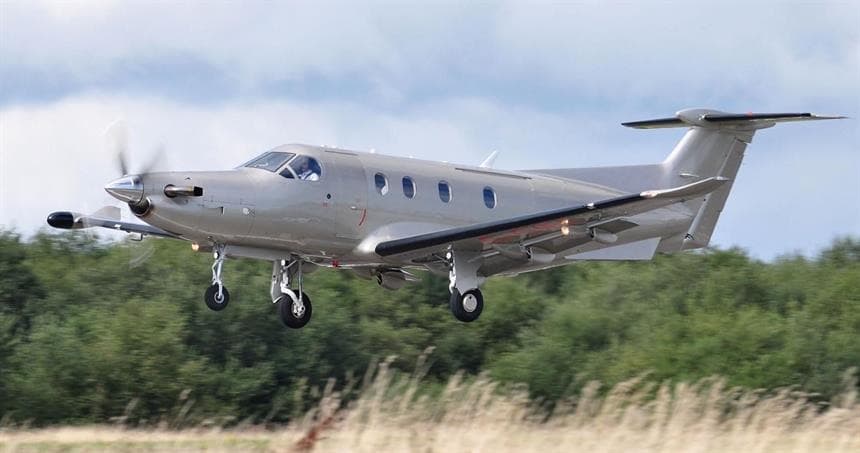
The economical way to reach places jets can’t. A turboprop like the Pilatus PC-12 carries up to 8–9 passengers into short and unpaved runways, ideal for regional hops of one to three hours — mountain resorts, islands and smaller towns.
We don’t own the jets — we source them. With access to 4,500+ aircraft, we pick the exact tail that fits your route, your group and your budget. These are estimated from-prices per flight hour, to give you a sense of cost. Your exact quote depends on the aircraft, route and dates — just ask.
The aircraft
Aircraft in this class
Pick a model to see its cabin, range and indicative hourly rate. We source the exact tail that fits your trip.
In detail
In practice
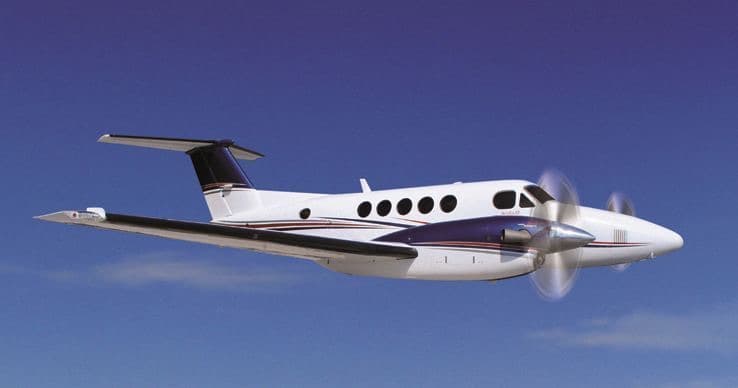
A turboprop is a turbine engine turning a propeller, and in charter it is the rung you take when the destination matters more than the clock. Six to nine seats, 2,600 to 3,350 km, around 540 km/h, from about €2,200 per flight hour — the lowest rate on this site. Two types carry the class in Europe, the Beechcraft King Air 200 and the Pilatus PC-12, and both do what no jet here can: get airborne in under 800 m and use grass and gravel. The trade is speed. Against a very light jet you give up about 140 km/h on the class figures and fly lower, through the weather rather than above it. Avily Lux owns no aircraft — we charter these from operators across Europe. You will also see the class written as turboprop aircraft, or loosely as prop jets — same aircraft, different shorthand.
Who charters a turboprop
Three trips account for most bookings. Seven or eight people going to a regional field with no jet-length runway — a plant, a site, a shoot, an estate. A family heading for an Alpine or island strip with skis, boards or bikes, where the load is as awkward as the airfield. And the short leg, 300 to 500 km, where a jet's speed never gets used because taxi, climb and descent eat it.
On that last one the turboprop competes with the car rather than with an airline: three hours on the autoroute against forty minutes in the air. It is also often the aircraft already nearby. The European fleet is large and based at regional airfields rather than the big business-aviation airports, so the empty leg to collect you is usually shorter than a jet's.
Against the class above
There is no rung below this one: beneath a turboprop the honest alternatives are a piston aircraft or the road. The only comparison that matters is upward, to the very light jets at about €2,800 per flight hour — €600 more.
That €600 buys altitude and speed. A Citation Mustang, a CJ1 or a Phenom 100 cruises at 630 to 720 km/h at 41,000 ft with an 8,000 ft cabin; the turboprops fly lower, with a cabin nearer 10,000 ft at their ceilings. What it costs is capacity: four or five seats against six to nine, less luggage, paved runways only. On a 500 km sector the jet is fifteen to twenty minutes better door to door, and a turboprop gives that back by using an airfield closer to where you are going. Past roughly 1,000 km the arithmetic reverses.
What 2,600 to 3,350 km actually means
The band is measured at four passengers with IFR reserves, and it moves hard with load. The King Air 200 shows 2,600 km on that basis. Fill it — seven or eight people with bags — and the manufacturer's own figure falls to about 750 km: the type runs out of payload long before it runs out of fuel. Plan a full King Air cabin at 600 to 750 km, and anything longer as a four- or five-seat trip.
The PC-12 holds up better at the other end of the band: 3,340 km with four aboard, about 2,900 km with six. With full tanks it lifts roughly 493 kg, so a genuinely full eight-seat cabin means less fuel — plan 2,200 to 2,500 km. Read the class as two aircraft rather than one number: with everyone aboard, a 700 km aeroplane or a 2,500 km one.
What moves the price
From about €2,200 per flight hour, and on sectors this short the hour is the smaller part of the total. Positioning usually decides it: with tails spread across regional fields, the flight to collect you is often already inside an operator's day.
Weight is the lever specific to this class. European landing, parking and handling fees scale with maximum take-off weight, and at 5,670 kg for a King Air and 4,740 kg for a PC-12 both sit in a lighter bracket than any jet carrying the same people — at Nice or Geneva in season, a visible line on the invoice. Then the usual: crew duty, which an early start with a late return can exhaust; the calendar, with the Alps at half-term and the Riviera in August; and the destination field, which for this class is frequently the cheap one. Every trip is quoted individually.
Frequently asked questions
- Is a turboprop as safe as a jet?
- A turboprop is not a piston aircraft. The engine is a turbine — the propeller is simply what it drives instead of a fan — and the aircraft are flown by the same commercially licensed crews under the same operating rules as the jets on this site. The King Air 200 has two engines. The PC-12 has one, which is a separate conversation worth having.
- Turboprop or very light jet?
- About €2,200 an hour against €2,800. Take the turboprop when six or more people are flying, when the luggage is awkward, when the airfield is short or unpaved, or when the leg is under an hour. Take the jet when four people want to arrive sooner, both airfields are paved, and the sector runs past roughly 1,000 km.
- Can it use my local airfield?
- Probably. A King Air 200 needs 792 m to take off at maximum weight and 867 m to land; a PC-12 needs 758 m and 661 m. Both are certified for grass, gravel and dirt as well as tarmac, and that capability is the whole argument for the class. Alpine altiports of the Courchevel class are the exception. Send us the airfield and we check it against the specific aircraft.
- Is there a lavatory, and can we bring skis?
- Yes to skis. The King Air carries 1.57 m³ in a heated, pressurised aft hold you can reach in flight; the PC-12 loads 0.97 m³ through a 1.35 × 1.32 m cargo door. Lavatories vary: the King Air has a belted seat behind a curtain, the newest PC-12s an enclosed forward compartment with a door, and we confirm it per tail. Nobody stands up — both cabins are 1.45 m high.