Turboprop
Beechcraft King Air 200
Rugged regional workhorse
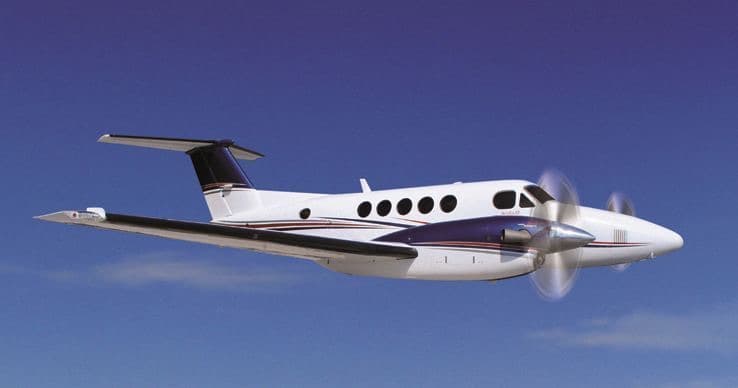
Estimated hourly rate — exact price on request.
- Passengers
- 7–8
- Range
- 2,600 km
- Cruise speed
- ≈ 540 km/h
- Max flight time
- ≈ 5 h
- Cabin length
- 5.08 m
- Cabin width
- 1.37 m
- Cabin height
- 1.45 m
- Aircraft length
- 13.4 m
Cruise speed is high-speed cruise. Manufacturers calculate range at the slower long-range cruise, with four passengers and NBAA IFR reserves — so a maximum-range leg takes longer than range ÷ speed, and a full cabin flies less far.
The Beechcraft King Air 200 is the classic twin-turboprop for short regional hops, reaching short and unpaved runways that jets can’t use. It carries up to eight passengers at a low hourly cost — ideal for one-to-three-hour trips to smaller towns, islands and mountain airfields.
We don’t own the jets — we source them. With access to 4,500+ aircraft, we pick the exact tail that fits your route, your group and your budget. These are estimated from-prices per flight hour, to give you a sense of cost. Your exact quote depends on the aircraft, route and dates — just ask.
In detail
The Beechcraft King Air 200 in practice
The King Air 200 is the least expensive way to move seven or eight people privately in Europe, and on a short sector it gives up very little to do it. Two Pratt & Whitney PT6A-42 turboprops of 850 shp, 792 m of runway at maximum weight, and a heated hold you can reach in flight. One fact settles most decisions about it: it goes to airfields the jets cannot use, including grass and gravel strips. What it is not is a long-range machine. The 2,600 km in the table is a four-passenger figure, and with every seat sold the honest leg is 600 to 750 km. Avily does not own aircraft — we charter them from a large operator network. From ~€2,000 per flight hour, exact quote on request.
Where it came from
Beechcraft began the aircraft in 1969 as a development of the Model 100, and the change that defined it was the T-tail — 375 hours of wind-tunnel work went into getting the airflow off the propellers and away from the tailplane. The first prototype flew on 27 October 1972, the second on 15 December 1972, civil certification came in December 1973, and the first customer aircraft was delivered in February 1974. It was sold as the Super King Air; Raytheon dropped the "Super" from the marketing in 1996, which is why the same aeroplane appears under two names in old listings.
From 1981 the line was built with PT6A-42 engines rated at 850 shp, a higher pressurisation differential and a revised cockpit. That is the aircraft the European charter market supplies and the one the figures on this page describe. The next step came on 21 May 2007 at the Geneva show, with PT6A-52 engines and better altitude performance.
Nearly 7,600 King Airs of all models had been delivered by December 2020, which makes the family the most-produced business turboprop ever built. Today the 200 does air ambulance, survey, government and calibration work as well as charter — which is precisely why there is one parked at a regional field near most European cities.
Who charters a King Air 200
Most King Air trips are one of three things: six to eight people going somewhere under ninety minutes away, a group heading for an airfield with no jet-capable runway, or a client for whom the arithmetic of a light jet stopped making sense on a 300 km leg. It is also the aircraft that competes with driving rather than with flying — three hours on the autoroute against forty minutes in the air.
Against the very light jets — the Citation Mustang, the Citation CJ1 — it carries more people, takes more luggage, reaches unpaved fields and costs less per hour. It is also 100 to 165 km/h slower, which on a short sector matters less than most people assume. Against the Pilatus PC-12 the trade is sharper: the PC-12 has a bigger cabin, a cargo door and several times the range with a full load; the King Air has a second engine and a cheaper hour.
The honest limits
Range is where this type is most often oversold. The published 2,600 km assumes four passengers and IFR reserves. Load it to maximum payload — seven or eight people and their bags — and the manufacturer's own figure falls to about 750 km. It is payload-limited long before it is fuel-limited, so plan a full cabin around 600 to 750 km and treat anything longer as a four- or five-seat trip.
The rest is easier. Take-off at maximum weight is 792 m and landing 867 m, and the type is routinely operated from grass and gravel with the unpaved-strip kit; alpine altiports of the Courchevel class are still out. Baggage is 1.57 m³ for about 250 kg, in the aft cabin, heated, pressurised and reachable in flight — best in its size class. The lavatory is an aft belted seat behind a privacy curtain, emptied by the crew rather than serviced externally. The cabin is 1.45 m high: nobody stands up.
What the cabin is really like
The published 5.08 m of cabin length runs from the cockpit bulkhead all the way back, so it includes the lavatory and the baggage area — the seating section is shorter than the number suggests. Width is 1.37 m, the narrowest cabin on this site, and height is 1.45 m. The usual charter fit is a four-seat club with a pair of forward seats, boarding through an airstair door at the back.
It is a working cabin rather than a showroom one. Two propellers turning a few feet from the windows make it audibly louder than any jet here, and noise-cancelling headphones are worth bringing on anything over an hour. In exchange you get a hold you can open in flight and a door that swallows ski bags. On a forty-minute leg none of the compromises register.
The corridors it actually flies
Realistic block times with a full cabin: Milan to Nice about 40 minutes, Geneva to Nice about 1h, London to Paris about 1h 05m, Zurich to Nice about 1h 20m. Paris to Nice, at roughly 675 km, sits right at the edge of a full-cabin leg and is comfortable with four or five aboard at about 1h 40m. That is the type's honest map: corners of Europe, not crossings of it.
The speed penalty is smaller than the brochure comparison implies. At around 540 km/h against roughly 700 for a very light jet, a 500 km sector costs you fifteen to twenty minutes door to door — and the King Air often wins it back by using an airfield twenty minutes closer to where you are going. Past about 1,000 km the arithmetic reverses and a jet is worth the money.
What moves the price
Charter starts from around €2,000 per flight hour, the lowest rate on this site, and the hour itself is only part of the number. Positioning is usually the largest variable, and here the King Air has a structural advantage: there are many of them, based at regional fields rather than concentrated at the big business-aviation airports, so the empty leg to collect you is often shorter than a jet's would be.
Airport and handling fees are the second lever, and they favour it too. Most European fees scale with weight, and at 5,670 kg the King Air sits in a different bracket from any jet that seats seven or eight — on a forty-minute sector that difference is a visible share of the invoice. After that it is the usual: crew duty limits on a long day with a late return, and the season. Nice and Geneva in summer, the Alps at half-term, Grand Prix weekend. Every trip is quoted individually.
What it does well
- 792 m to take off at maximum weight and 867 m to land, and the type is routinely flown from grass and gravel strips.
- A 1.57 m³ heated, pressurised hold in the aft cabin — skis and golf bags go, and you can reach them in flight.
- Seven or eight seats from around €2,000 per flight hour, the lowest hourly rate on this site.
- Two engines, which for passengers weighing it against the single-engine PC-12 is the whole conversation.
- At 5,670 kg it is charged in a lighter airport-fee bracket than any jet that seats the same number of people.
Where it gives ground
- Range collapses under load: 2,600 km is a four-passenger figure, and with seven or eight aboard the honest leg is 600 to 750 km.
- Around 540 km/h. Past roughly 1,000 km a light jet arrives meaningfully earlier and is worth the difference.
- Audibly louder than a jet, 1.37 m across, 1.45 m high, and the lavatory is a curtained belted seat rather than a room.
The Beechcraft King Air 200 against the alternatives
- Pilatus PC-126–8 · 3,340 km
The direct comparison, and the better answer whenever the trip is longer than about an hour or the load is awkward. One engine instead of two, but a wider cabin, a cargo door and several times the range with a full load, for roughly €300 more per hour.
- Cessna Citation Mustang4 · 1,900 km
Pick it when four people want to arrive sooner and both airfields are paved: around 630 km/h against 540. Fewer seats, a smaller hold you cannot open in flight, and no unpaved capability.
- Cessna Citation CJ26 · 2,990 km
The step up when six people need to cross Europe rather than a corner of it — 2,990 km and 765 km/h. It costs about half as much again per hour and needs a paved runway.
Routes the Beechcraft King Air 200 flies
- Geneva → Nice0h 55mfrom €6,000
- Milan → Nice0h 50mfrom €5,950
- Zurich → Nice1h 05mfrom €6,600
- London → Paris1h 10mfrom €6,400
Flight times are typical for this type with a full cabin. Headwinds, payload and slot restrictions move them.
Beechcraft King Air 200 charter — frequently asked questions
- Is a turboprop as safe as a jet?
- It has two turbine engines, is flown by the same commercially licensed crews under the same operating rules as the jets on this site, and the PT6A is one of the most-produced turbine engines ever built. A turboprop is not a piston aircraft: the engine is a turbine, and the propeller is simply what it drives instead of a fan.
- How much slower is it really?
- It cruises at about 540 km/h against roughly 700 for a very light jet. On a 500 km sector that is fifteen to twenty minutes door to door, and a King Air can give it back by using a closer airfield. On anything past about 1,000 km the gap opens quickly and a jet becomes the better buy.
- Can it use my local airfield?
- Probably. It needs 792 m to take off at maximum weight and 867 m to land, and with the unpaved-strip kit it operates from grass and gravel — that capability is the type's whole argument. Alpine altiports of the Courchevel class are the exception. Send us the airfield and we will check it against the specific aircraft.
- Is there a lavatory, and can I bring skis?
- Yes to both. The lavatory is a belted seat at the rear behind a privacy curtain — private enough, but not a room with a door. Baggage is 1.57 m³ and about 250 kg in the aft cabin, heated and pressurised, and unlike almost every jet in this bracket you can reach it in flight.
Specifications
Full technical sheet
General
- Manufacturer
- Beechcraft
- Category
- Turboprop
- ICAO designator
- BE20
- Production
- 1981–2007
- Flight crew
- 1–2
Performance
- Range (IFR reserves)
- 2,600km
- Range (nautical miles)
- 1,407nm
- Ferry range
- 3,106km
- Cruise speed (high-speed)
- ≈ 540km/h
- Long-range cruise
- 422km/h
- Max operating Mach (MMO)
- M 0.52
- Max operating speed (VMO)
- 260KIAS
- Approach speed
- 103kts
- Takeoff distance (balanced field)
- 792m
- Landing distance
- 867m
- Service ceiling
- 35,000ft
- Max flight time
- ≈ 5h
Powerplant and avionics
- Engine type
- Turboprop
- Engines
- 2 × Pratt & Whitney Canada PT6A-42
- Power per engine
- 850shp
- Avionics
- Collins Pro Line 21
Dimensions and capacity
- Aircraft length
- 13.4m
- Aircraft height
- 4.52m
- Wing span
- 16.61m
- Cabin length
- 5.08m
- Cabin width
- 1.37m
- Cabin height
- 1.45m
- Baggage volume
- 1.57m³
- Seats (charter layout)
- 7–8
- Seats (max certified)
- 15
- Suitcases
- 2
- Carry-on bags
- 2
- Max payload
- 1,120kg
- Max takeoff weight (MTOW)
- 5,670kg
- Max landing weight (MLW)
- 5,670kg
- Fuel capacity
- 2,059L
Manufacturer and type-certificate figures, verified field by field. A line we could not source is left out rather than filled with a plausible number.
Gallery