Very light jet
Cessna Citation Mustang
The pocket jet
Estimated hourly rate — exact price on request.
- Passengers
- 4
- Range
- 1,900 km
- Cruise speed
- ≈ 630 km/h
- Max flight time
- ≈ 3 h
- Cabin length
- 2.97 m
- Cabin width
- 1.40 m
- Cabin height
- 1.37 m
- Aircraft length
- 12.37 m
Cruise speed is high-speed cruise. Manufacturers calculate range at the slower long-range cruise, with four passengers and NBAA IFR reserves — so a maximum-range leg takes longer than range ÷ speed, and a full cabin flies less far.
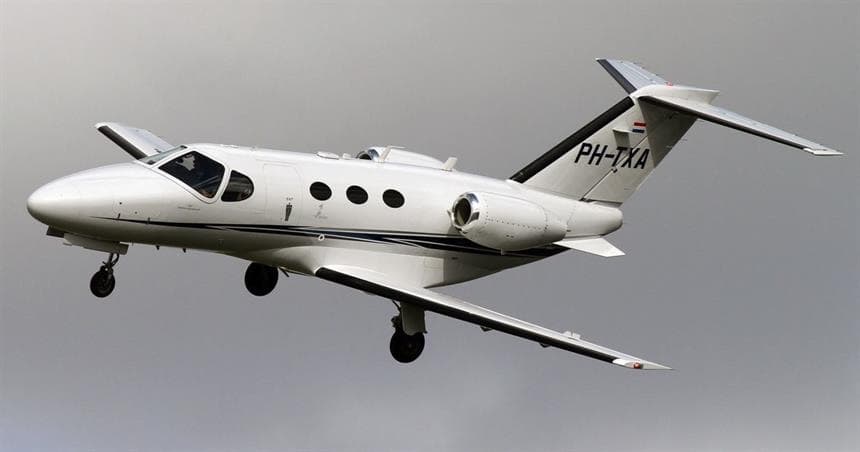
The Cessna Citation Mustang is a very light jet that seats four in comfort for short trips. Simple, economical and able to use small airports, it’s a favourite first step from turboprop into pure jet travel.
We don’t own the jets — we source them. With access to 4,500+ aircraft, we pick the exact tail that fits your route, your group and your budget. These are estimated from-prices per flight hour, to give you a sense of cost. Your exact quote depends on the aircraft, route and dates — just ask.
In detail
The Cessna Citation Mustang in practice
The Citation Mustang is the smallest jet on this site and the lowest jet hourly rate we quote — from about €2,400 per flight hour, with the exact figure set against a specific tail and specific dates. Four seats, around 630 km/h, 1,900 km on paper and a practical sector near three hours. It is a real jet: two turbofans, 41,000 ft, an 8,000 ft cabin at that altitude, and 948 m of runway at maximum weight, the shortest field length of anything with a jet engine that we operate. The honest framing is four seats and four people — not four seats plus a fifth passenger perched on the lavatory seat, and not four adults with ski bags heading to Ibiza. Inside that limit it does short European legs better and cheaper than anything else. Avily Lux owns no aircraft; we charter the Mustang from operators across Europe.
Where it came from
Cessna announced the Mustang at the NBAA convention in 2002, at the height of the very light jet boom, when a dozen programmes were promising a jet for the price of a turboprop. Most of them never delivered an aircraft. Cessna's did. The prototype flew on 23 April 2005, the FAA certified the type on 8 September 2006 — the first very light jet to be certified — cleared it for flight into known icing on 9 November, and the first customer aircraft was handed over on 22 November 2006.
The design is deliberately conservative. A straight wing, a T-tail and the Citation family's structural tradition, two Pratt & Whitney Canada PW615F engines of 1,460 lbf each, and a Garmin G1000 glass flight deck as standard equipment. It was certified for single-pilot operation and aimed at owner-pilots as much as at charter operators, which is the reason its systems are as simple as they are.
Production ran until May 2017 and 479 aircraft were built, at which point the entry-level slot in Cessna's range passed to the M2. The Mustang being out of production is worth knowing rather than worrying about: 479 airframes is a large enough fleet that European operators, crews and parts are ordinary rather than specialist, and the type's simplicity is a large part of why it stays on the charter market.
Who charters a Mustang
Two to four people, one short leg, and a day that an airline schedule would ruin. A pair of executives to a plant visit, a family of four to the coast, a couple to a wedding two countries away. This is the aircraft that turns a five-hour door-to-door day into a two-hour one for something close to turboprop money.
The comparison usually runs three ways. Against a King Air 200 or a PC-12, the Mustang is a jet: roughly 95 km/h faster, at 41,000 ft above the weather rather than in it, with an 8,000 ft cabin where the turboprops sit nearer 10,000. It gives up their cabin volume, their cargo doors and their unpaved runways. Against the CJ1 above it you save on the hour and give up a seat, about 70 km/h and a slice of usable range. Against a Phenom 100 at the same four seats, you save again on the hour and give up cabin size, baggage and a better lavatory.
Four seats and a real four-person load
Our published 1,900 km sits between two honest calculations: Cessna's 2,130 km with four passengers and a pilot, full fuel and a 100 nm alternate, and Conklin's 1,784 km on a 200 nm alternate. Neither assumes what a charter actually looks like. Four adults with proper suitcases and sensible reserves gives a planning range of 1,300–1,650 km, and that is the number to build a trip around.
This is the type most likely to hand a client a fuel stop they did not expect, so plainly: London–Geneva at 750 km, Paris–Nice at 690 km and London–Nice at just over 1,000 km all go nonstop with four aboard. London–Ibiza at 1,450 km is at or past the honest limit and depends on the day's winds and the real weight of the bags. Geneva–Lisbon does not work. For those the answer is a CJ1 or a Phenom 100, not a longer Mustang day.
The cabin, the hold and the lavatory
2.97 m long, 1.40 m wide, 1.37 m high — the lowest cabin of any aircraft we quote. Four seats in a club, facing in pairs, plus a small refreshment area. You do not stand up: you come up the airstair and slide into a seat. For an hour that is genuinely fine, and for three hours it is the trade you have made for the price. The compensation is the same as on any 525-series jet — an 8,000 ft cabin at 41,000 ft, which is a calmer hour than a turboprop at half the altitude.
The lavatory, since nobody asks until they are on board: it is an aft belted seat with a self-contained toilet under it and a privacy curtain. Not a compartment, not externally serviced. It works if it is needed, and on a typical 60–90 minute Mustang leg it usually is not. Baggage is about 1.78 m³, generous on paper for four people, but roughly nine tenths of it is in the external tailcone hold, which is sealed once the door closes. Only a small in-cabin space is reachable in flight.
The corridors it actually flies
Realistic block times, four aboard, no fuel stop: Milan–Nice about 50 minutes, Geneva–Nice an hour, London–Paris 1 h 10, Paris–Nice 1 h 30, London–Geneva 1 h 40. At around 630 km/h the Mustang gives a little of the sector back on the longer legs — perhaps ten minutes to Geneva against a CJ1, and half an hour to Nice — while on the 200–400 km hops the difference disappears into taxi, climb and descent.
That is the shape of the type's working day: one or two short legs and home the same evening. It is the aircraft for the Riviera–Alps triangle, for the London–Paris–Geneva corner of Europe, and for the trips where four people and a schedule matter more than range. What it is not is a Mediterranean-crossing aircraft with the cabin full, and any broker who quotes it as one has not done the weight sheet.
What moves the price
From about €2,400 per flight hour, the lowest jet rate we quote. On sectors this short, almost everything except the hourly rate decides the total.
Positioning comes first. A 50-minute Milan–Nice trip flown by an aircraft based in Munich carries two empty legs longer than the flight you booked. Ask where the aircraft is, not only what the hour costs — a same-day return, or a departure from an airport where a Mustang is already parked, moves the quote further than any negotiation on the rate.
Then crew duty: two pilots, and a long day with a late return can trigger a night stop. Then the calendar — Nice, Geneva and Olbia in season, the Alps at half-term, Cannes in May. Landing, parking and handling fees are a much larger share of a Mustang quote than of a heavy jet's, simply because there are fewer flight hours to spread them across. Every trip is priced individually.
What it does well
- 948 m to take off at maximum weight and 728 m to land — the shortest field length of any jet on this site.
- A jet cabin environment at the lowest jet hourly rate we quote: 41,000 ft and an 8,000 ft cabin from about €2,400 per flight hour.
- Roughly 95 km/h faster than a King Air 200 or a PC-12, and flying above the weather rather than through it.
- 479 built and a Garmin G1000 flight deck, so European operators, crews and spares are ordinary rather than specialist.
- A three-hour practical sector still covers London, Paris, Geneva, Milan and Nice from any one of them — most European business trips fit inside it.
Where it gives ground
- A 1.37 m cabin, the lowest of any aircraft we quote. Nobody stands, and on a three-hour leg you notice it.
- The lavatory is a curtained belted seat with a self-contained toilet, and the tailcone hold that carries most of the luggage cannot be reached in flight.
- 1,900 km on paper becomes a 1,300–1,650 km planning range with four adults and real luggage — this is the type most likely to need a fuel stop the client did not budget for.
The Cessna Citation Mustang against the alternatives
- Cessna Citation CJ15 · 2,000 km
The next step up, and usually a small step in price: a fifth seat, about 70 km/h more speed and a longer usable leg. Worth taking as soon as the sector passes 1,300 km or the fifth passenger is real rather than hypothetical.
- Embraer Phenom 1004 · 2,180 km
The same four seats in a bigger cabin — 1.50 m high and 1.55 m wide against 1.37 and 1.40 — with more baggage, a proper rear lavatory that is externally serviced, and roughly 90 km/h more speed. It costs more per hour and needs slightly more runway.
- Pilatus PC-126–8 · 3,340 km
When the strip is grass or gravel, the load is awkward or the group is six to eight. The PC-12 has a large cargo door and far more cabin volume for similar money; it is about 95 km/h slower and flies in the weather rather than above it.
Routes the Cessna Citation Mustang flies
- Milan → Nice0h 50mfrom €5,950
- Geneva → Nice0h 55mfrom €6,000
- London → Paris1h 10mfrom €6,400
- Paris → Nice1h 20mfrom €8,500
- London → Geneva1h 25mfrom €7,600
Flight times are typical for this type with a full cabin. Headwinds, payload and slot restrictions move them.
Cessna Citation Mustang charter — frequently asked questions
- Is a Mustang big enough for four adults with luggage?
- Volume is fine — about 1.78 m³ of hold for four people. Weight is the binding constraint. Four adults, four suitcases and full fuel sits close to the limit, which is why the honest planning range is 1,300–1,650 km rather than the published 1,900. Send us the piece count and rough weights and we check them against the specific aircraft before quoting.
- Will we need a fuel stop?
- Under about 1,500 km with four aboard, no. London–Geneva, Paris–Nice, Milan–Nice and London–Nice all go nonstop. London–Ibiza at 1,450 km sits at the honest limit and depends on the day. Anything beyond that — Lisbon, Athens, the Canaries — means a stop on a Mustang, or a CJ1 or Phenom 100 nonstop instead.
- Is there a lavatory?
- Yes: a belted seat at the back with a self-contained toilet under it and a privacy curtain, rather than a compartment with a door, and it is not externally serviced. It works, and on a typical 60–90 minute Mustang leg almost nobody uses it. If a real lavatory matters, the Phenom 100 has a proper rear unit and a fully enclosed one starts a class higher.
- Is it flown by one pilot?
- The Mustang is certified for single-pilot operation, which is part of why it is the cheapest jet hour we quote. On European commercial charter the operators we work with roster two pilots as standard, which is why our spec sheet reads one to two rather than one. If a competing quote is unusually cheap, crewing is the first thing to ask about.
Specifications
Full technical sheet
General
- Manufacturer
- Cessna (Textron Aviation)
- Category
- Very light jet
- ICAO designator
- C510
- Production
- 2006–2017
- Flight crew
- 1–2
Performance
- Range (IFR reserves)
- 1,900km
- Cruise speed (high-speed)
- ≈ 630km/h
- Long-range cruise
- 591km/h
- Max operating Mach (MMO)
- M 0.63
- Max operating speed (VMO)
- 250KIAS
- Approach speed
- 88kts
- Takeoff distance (balanced field)
- 948m
- Landing distance
- 728m
- Service ceiling
- 41,000ft
- Cabin altitude
- 8,000ft
- Max flight time
- ≈ 3h
Powerplant and avionics
- Engine type
- Turbofan
- Engines
- 2 × Pratt & Whitney Canada PW615F-A
- Thrust per engine
- 1,460lbf
- Avionics
- Garmin G1000
Dimensions and capacity
- Aircraft length
- 12.37m
- Aircraft height
- 4.09m
- Wing span
- 13.16m
- Cabin length
- 2.97m
- Cabin width
- 1.40m
- Cabin height
- 1.37m
- Baggage volume
- 1.78m³
- Seats (charter layout)
- 4
- Seats (max certified)
- 4
- Suitcases
- 4
- Carry-on bags
- 4
- Max takeoff weight (MTOW)
- 3,921kg
- Max landing weight (MLW)
- 3,629kg
- Fuel capacity
- 1,451L
Manufacturer and type-certificate figures, verified field by field. A line we could not source is left out rather than filled with a plausible number.
Gallery