Very light jet
Cessna Citation CJ1
Easy entry to jet travel
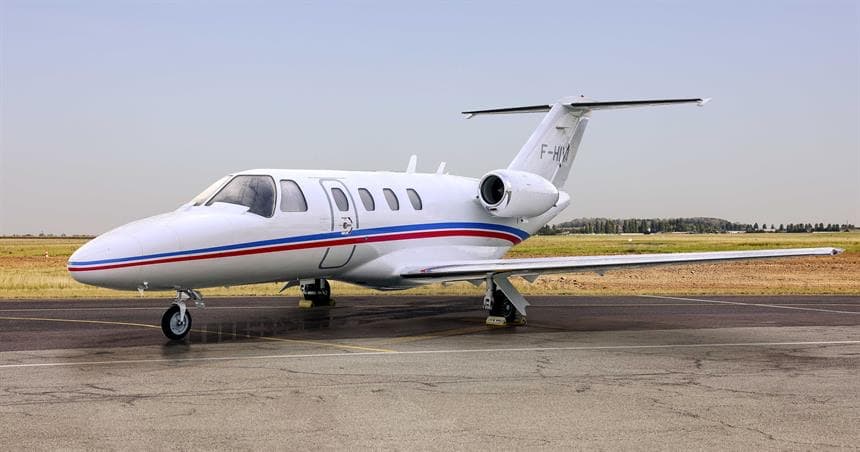
Estimated hourly rate — exact price on request.
- Passengers
- 5
- Range
- 2,000 km
- Cruise speed
- ≈ 700 km/h
- Max flight time
- ≈ 3 h
- Cabin length
- 3.35 m
- Cabin width
- 1.47 m
- Cabin height
- 1.45 m
- Aircraft length
- 12.98 m
Cruise speed is high-speed cruise. Manufacturers calculate range at the slower long-range cruise, with four passengers and NBAA IFR reserves — so a maximum-range leg takes longer than range ÷ speed, and a full cabin flies less far.
The Cessna Citation CJ1 is a light, efficient entry-level jet built for quick city-to-city trips. It seats up to five in a bright cabin, flies from short runways and keeps running costs among the lowest of any jet — perfect for hops of up to two and a half hours.
We don’t own the jets — we source them. With access to 4,500+ aircraft, we pick the exact tail that fits your route, your group and your budget. These are estimated from-prices per flight hour, to give you a sense of cost. Your exact quote depends on the aircraft, route and dates — just ask.
In detail
The Cessna Citation CJ1 in practice
The Citation CJ1 is where jet charter starts. Five seats, around 700 km/h, 2,000 km on paper and a practical sector near three hours — London to Nice, and not a great deal beyond. It is a jet by every measure that matters: two turbofans, 41,000 ft, an 8,000 ft cabin at that altitude, and 1,000 m of paved runway at maximum weight. What it is not is a cabin you can stand up in. At 1.45 m high and 1.47 m wide, the CJ1 is an aircraft five people sit in for two hours, and the lavatory is a curtained belted seat rather than a room. Charter starts from around €2,600 per flight hour, with the exact quote made against a specific tail and dates. Avily Lux owns no aircraft — we charter the CJ1 through operators across Europe.
Where it came from
Cessna launched the Model 525 CitationJet at the NBAA convention in October 1989 to replace the Citation I, which had been out of production since 1985 and had grown expensive to run. The 525 was largely a new aeroplane: a laminar-flow supercritical wing developed with NASA and Boeing, a T-tail, and two Williams FJ44 turbofans in place of the older, thirstier engines. It first flew on 29 April 1991, the FAA certified it on 16 October 1992, and the first aircraft was delivered on 30 March 1993.
The CJ1 is the second step in that line. Cessna raised the maximum take-off, ramp and landing weights to buy back range and payload, and fitted Collins Pro Line 21 in place of the original flight deck; the airframe and the FJ44-1A engines were otherwise carried over. The FAA certified the CJ1 on 16 February 2000 and the first aircraft went to a customer in New York on 31 March 2000. The 500th airframe of the whole 525 series, itself a CJ1, rolled out in June 2002, and 175 CJ1s had been delivered by the end of September 2003. Production ran to 2005.
The family kept going long after that: 2,000 deliveries across all 525 variants and five million flight hours by June 2017. For a charter client that volume is the practical point — CJ1s sit on ramps all over Europe, crews fly the type every week, and spares are not the constraint they are on a rarer aircraft.
Who charters a CJ1
Two to five people, one or two short European legs, and a schedule that an airline connection would break. A pair of directors to a site visit, a family to the Riviera, four colleagues to Milan and back the same evening. It is the smallest aircraft that still feels like the jet the client had in mind.
The decision is usually a three-way one. Against a King Air 200 or a Pilatus PC-12, the CJ1 is faster by about 165 km/h, flies at 41,000 ft rather than in the weather, and holds an 8,000 ft cabin where the turboprops sit nearer 10,000; it gives up their cabin volume, their cargo doors and their ability to use grass and gravel. Against a Citation Mustang it adds a seat, about 70 km/h and a useful slice of range. Against a CJ2 or a Phenom 300 above it, the CJ1 is simply the cheaper hour — and on a 90-minute leg with four aboard, nothing the bigger aircraft offer comes into play.
What 2,000 km means with five aboard
The published 2,000 km is a four-passenger figure with NBAA reserves and a 200 nm alternate, which is a conservative basis; on the 100 nm alternate manufacturers normally quote, the same aircraft shows about 2,220 km. Either way the number moves once the fifth seat is sold. With five adults and their luggage the CJ1 runs out of payload before it runs out of fuel, and the honest planning range is 1,500–1,800 km. Some layouts fit a sixth seat; the constraint on those is payload with full fuel, not seat count, and for six on a real sector the answer is a CJ2.
Runways are the easy part. 1,000 m to take off at maximum weight at sea level and 841 m to land, which opens Cannes–Mandelieu, Lugano and most European regional fields. It is a paved-surface aircraft only — no grass, no gravel. For those the answer is a King Air or a PC-12.
The cabin, the hold and the lavatory
The cabin is 3.35 m long, 1.47 m wide and 1.45 m high: four seats in a club with a fifth opposite the door. You do not stand up in it. You come up the airstair, move to your seat bent at the waist, and stay there. On a 90-minute leg that is a non-issue; on a three-hour one it is the thing you notice. Pressurisation is the compensation — 8.5 psi holds an 8,000 ft cabin at 41,000 ft, which makes for a meaningfully easier three hours than a turboprop in the mid-twenties.
The lavatory is the question people are too polite to ask, so plainly: it is a belted seat at the aft left of the cabin with a self-contained chemical toilet under it and a roll-up privacy curtain. Not a compartment with a door, and not externally serviced as built. Baggage is about 1.55 m³ across a nose hold, a tailcone hold and a small in-cabin space, and only the in-cabin space can be reached in flight. Everything else is sealed the moment the doors close.
The corridors it actually flies
Realistic block times with the cabin full and no fuel stop: Geneva–Nice about 55 minutes, London–Paris 1 h 05, Paris–Nice 1 h 25, London–Geneva 1 h 30, London–Milan 1 h 45, London–Nice 1 h 50. The practical ceiling is around three hours, which is most of western Europe from a UK or Swiss base and the whole Mediterranean from a French or Italian one.
Past that the arithmetic starts to bite. London–Barcelona at 1,150 km still fits with five aboard. London–Ibiza at 1,450 km sits at the top of the five-passenger band and is worth checking against the day's winds and the actual bag weight rather than assuming. Cyprus, Morocco and the Gulf are a different aircraft, not a longer CJ1 day. Where the CJ1 earns its rate is the leg a turboprop would take 25 minutes longer to fly at a higher cabin altitude — and the leg where a light jet's extra seats would fly empty.
What moves the price
From about €2,600 per flight hour, and on an aircraft this size the hourly rate is a smaller share of the total than people expect. A CJ1 day is usually one or two short legs, so the positioning flight can easily be longer than the trip you booked. If the nearest available aircraft is in Munich and you are leaving from Farnborough, those empty legs are on the quote — which is why a same-day return often prices better than two one-ways, and why we ask where you are flying from before we ask where you are going.
Crew duty is the second lever. Two pilots, an early start and a late return can push a day past the legal limit and add a night stop or a second crew. Then the calendar: Nice and Geneva through the summer, the Alps at February half-term, Cannes in May. Landing, parking and handling at the airports these routes use vary more than the fuel does, and on a short sector they are a large share of the number. Every trip is quoted individually.
What it does well
- A jet rather than a turboprop: 41,000 ft, an 8,000 ft cabin at that altitude and about 700 km/h in the cruise, against roughly 535 km/h for a King Air 200.
- 1,000 m to take off at maximum weight and 841 m to land, which puts Cannes-Mandelieu, Lugano and most European regional fields within reach.
- Five seats — one more than a Citation Mustang or a Phenom 100 — from about €2,600 per flight hour.
- About 1.55 m³ of baggage across three holds, which is a full set of cases for five people rather than hand luggage.
- One of the most common jets on the European ramp: 2,000 deliveries across the 525 family by 2017, so positioning legs are short and crews fly the type weekly.
Where it gives ground
- A 1.45 m cabin. Nobody stands up in it, and no interior refit changes that.
- The lavatory is a belted seat behind a curtain with a self-contained toilet, not a compartment with a door.
- Sell the fifth seat and the 2,000 km headline becomes a 1,500–1,800 km planning figure — payload runs out before fuel does.
The Cessna Citation CJ1 against the alternatives
- Embraer Phenom 1004 · 2,180 km
The better cabin at the same size: 1.50 m high and 1.55 m wide against 1.45 and 1.47, and a rear lavatory that is externally serviced rather than a curtained seat. Roughly the same speed, a slightly higher hourly rate, one seat fewer.
- Pilatus PC-126–8 · 3,340 km
When the destination has a grass or gravel strip, when six to eight people are flying, or when the load is awkward — the PC-12 has a large cargo door and far more cabin volume. You give up about 165 km/h and fly lower, in the weather rather than above it.
- Cessna Citation CJ26 · 2,990 km
The step up when the sixth passenger is real or the leg passes two and a half hours. A longer cabin and more range that survives a full load, at a higher hourly rate — pointless on a Geneva–Nice hop, worth it to Ibiza or Lisbon.
Routes the Cessna Citation CJ1 flies
- Geneva → Nice0h 55mfrom €6,000
- London → Paris1h 10mfrom €6,400
- Paris → Nice1h 20mfrom €8,500
- London → Geneva1h 25mfrom €7,600
- London → Milan1h 50mfrom €9,150
- London → Nice1h 40mfrom €9,500
Flight times are typical for this type with a full cabin. Headwinds, payload and slot restrictions move them.
Cessna Citation CJ1 charter — frequently asked questions
- Is a CJ1 a real jet or a very light jet?
- Both, and the label matters less than the numbers. It is a very light jet by class and a jet by every practical measure: two Williams FJ44 turbofans, 41,000 ft, an 8,000 ft cabin at that altitude and about 700 km/h in the cruise. Against a King Air on a 700 km leg it saves roughly 25 minutes and flies the whole sector above the weather.
- Where does the luggage go, and can we reach it in flight?
- Mostly you cannot. Of about 1.55 m³ total, the nose and tailcone holds are sealed once the doors close, and only a small in-cabin space is reachable in the air. Put laptops, coats and anything else you want aloft into a cabin bag. If you are carrying skis or golf clubs, send us the piece count and we check it against the specific aircraft.
- Is there a lavatory on board?
- Yes, and it is worth knowing exactly what it is before you fly. It is a belted seat at the aft left of the cabin with a self-contained chemical toilet under it and a roll-up privacy curtain — usable, private enough at a pinch, not a room with a door. On a typical 90-minute CJ1 leg most passengers never use it.
- Is it flown by one pilot?
- The CJ1 is certified for single-pilot operation, which is part of why its hourly rate sits where it does. On European commercial charter the operators we work with roster two pilots as standard, which is why our spec sheet reads one to two rather than one. If a quote you are comparing looks unusually cheap, crewing is the first thing worth asking about.
Specifications
Full technical sheet
General
- Manufacturer
- Cessna (Textron Aviation)
- Category
- Very light jet
- ICAO designator
- C525
- Production
- 2000–2005
- Flight crew
- 1–2
Performance
- Range (IFR reserves)
- 2,000km
- Cruise speed (high-speed)
- ≈ 700km/h
- Long-range cruise
- 609km/h
- Max operating Mach (MMO)
- M 0.71
- Max operating speed (VMO)
- 263KIAS
- Approach speed
- 109kts
- Takeoff distance (balanced field)
- 1,000m
- Landing distance
- 841m
- Service ceiling
- 41,000ft
- Cabin altitude
- 8,000ft
- Max flight time
- ≈ 3h
Powerplant and avionics
- Engine type
- Turbofan
- Engines
- 2 × Williams International FJ44-1A
- Thrust per engine
- 1,900lbf
- Avionics
- Collins Pro Line 21
Dimensions and capacity
- Aircraft length
- 12.98m
- Aircraft height
- 4.19m
- Wing span
- 14.20m
- Cabin length
- 3.35m
- Cabin width
- 1.47m
- Cabin height
- 1.45m
- Baggage volume
- 1.55m³
- Seats (charter layout)
- 5
- Seats (max certified)
- 6
- Suitcases
- 3
- Carry-on bags
- 4
- Max takeoff weight (MTOW)
- 4,808kg
- Max landing weight (MLW)
- 4,445kg
- Fuel capacity
- 1,806L
Manufacturer and type-certificate figures, verified field by field. A line we could not source is left out rather than filled with a plausible number.
Gallery