Very light jet
Embraer Phenom 100
Modern and refined
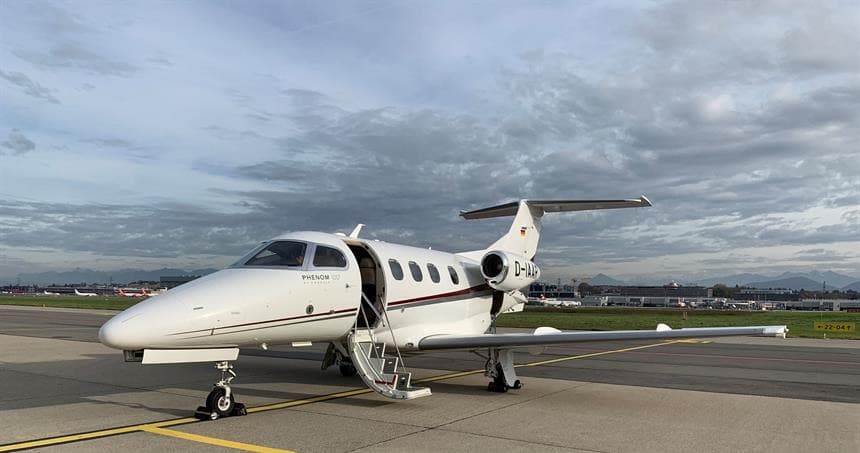
Estimated hourly rate — exact price on request.
- Passengers
- 4
- Range
- 2,180 km
- Cruise speed
- ≈ 720 km/h
- Max flight time
- ≈ 3 h
- Cabin length
- 3.35 m
- Cabin width
- 1.55 m
- Cabin height
- 1.50 m
- Aircraft length
- 12.82 m
Cruise speed is high-speed cruise. Manufacturers calculate range at the slower long-range cruise, with four passengers and NBAA IFR reserves — so a maximum-range leg takes longer than range ÷ speed, and a full cabin flies less far.
The Embraer Phenom 100 brings a fresh, spacious feel to the entry-level class, with an Oval Lite cabin designed for headroom and light. It seats four comfortably and flies faster than most rivals — a refined choice for short business or leisure hops.
We don’t own the jets — we source them. With access to 4,500+ aircraft, we pick the exact tail that fits your route, your group and your budget. These are estimated from-prices per flight hour, to give you a sense of cost. Your exact quote depends on the aircraft, route and dates — just ask.
In detail
The Embraer Phenom 100 in practice
The Phenom 100 is the very light jet to book when four people want the best cabin in the smallest class. It has the widest and tallest cabin among the very light jets — 1.55 m across and 1.50 m high, on the Oval Lite cross-section Embraer developed with BMW Group DesignworksUSA — with 2,180 km of range, around 720 km/h and a practical sector near three hours. That one fact settles most of the comparisons inside the class: against a Citation Mustang or a CJ1 you are buying room, baggage and a proper rear lavatory rather than speed. What you are not buying is standing height. Charter starts from around €2,700 per flight hour, exact quote on request against a specific tail and dates. Avily Lux owns no aircraft — we charter the Phenom 100 through operators across Europe.
Where it came from
Embraer had built regional airliners and military aircraft for forty years before it went after business aviation, and the Phenom 100 was the smaller half of that move. The company gave the aircraft its name at the NBAA convention on 9 November 2005, completed the digital definition phase of the design in March 2006, and had 50 orders on the books by EBACE that May. The target was stated openly: 30 per cent of the very light jet market, which the Eclipse 500 and the Citation Mustang were then fighting over.
The prototype made its first flight from São José dos Campos on 26 July 2007. Brazil's ANAC and the American FAA both issued type certificates during December 2008, the first aircraft was handed over on 24 December 2008, and EASA certified the type on 23 April 2009 — the first business jet of its size taken through certification end to end under the European agency's own responsibility.
The Eclipse programme collapsed; the Phenom did not. 439 had been delivered by the first half of 2026 and the line is still open. For a charter client that matters more than the history. A type with that many airframes has operators on most large European ramps, crews who fly it every week, and enough tails in the region to keep positioning legs short.
Who charters a Phenom 100
Two to four people, one or two short European legs, and a diary a scheduled connection would ruin: a pair of directors to a plant, a family to the Riviera for a long weekend, four colleagues to Zurich and back the same evening.
The comparison that comes up is with the Citation Mustang and the CJ1, and it is settled on the cabin rather than on performance. The Phenom is 1.55 m wide and 1.50 m high against the Mustang's 1.40 and 1.37, it carries the largest hold in the class, and the lavatory at the back is a serviced installation rather than a chemical toilet under a curtained seat. The CJ1 answers with a fifth seat and a lower hourly rate, and on four people over 90 minutes that is the whole argument. Where the Phenom earns its rate is the two- to three-hour leg, where the extra 8 cm of width and 5 cm of height stop being a specification and start being the flight.
What 2,180 km means once the cabin fills
The published 2,180 km is a genuine four-occupant figure with NBAA reserves, so for the seats we sell it is honest — which is not true of every headline in this class. The catch sits in the payload sheet. Maximum payload is 805 kg, but with full tanks the aircraft carries about 290 kg, which is three adults with bags. Some layouts fit a fifth and a sixth seat; put five or six people aboard and you are trading fuel for weight, and the planning range becomes 1,600–1,900 km.
Runways are the easy part: 972 m to take off at maximum weight at sea level and 741 m to land. Cannes–Mandelieu, Lugano and Sion sit inside that comfortably. It is a paved-surface aircraft only — no grass, no gravel; for those the answer is a King Air 200 or a Pilatus PC-12. London City needs a steep-approach approval held by the type and by the operator, so we confirm it against the specific aircraft rather than assume it.
The cabin, the hold and the lavatory
3.35 m long, 1.55 m wide and 1.50 m high, laid out as four club seats. Nobody stands up in it. The oval cross-section is why the height understates the aircraft: it puts the width at shoulder and head level rather than at the floor, and the windows are large for the class. Against a round-tube very light jet the difference is obvious the moment you sit down, and on a three-hour leg it is what makes the leg tolerable.
Baggage is about 1.80 m³, the largest in the very light jet class and roughly 15 per cent more than a CJ1 carries, but it is split across three places. The rear hold takes the bulk of it, is unpressurised and is sealed in flight; only the small forward space and the stowage by the lavatory can be reached aloft. The lavatory itself is at the rear, externally serviced, and can be specified with a belted seat certified for taxi, take-off and landing. Whether it is screened by a door or a curtain varies by aircraft, and we confirm that on the tail we quote.
The corridors it actually flies
Realistic block times with four aboard and no fuel stop: Geneva–Nice about 55 minutes, London–Paris 1 h 05, Paris–Nice 1 h 20, London–Geneva 1 h 25, London–Zurich 1 h 30, London–Nice 1 h 45. The practical ceiling is around three hours, which is most of western Europe from a London or Swiss base and the whole northern Mediterranean from a French or Italian one.
Past that the arithmetic turns conditional. Geneva–Ibiza and Munich–Barcelona fit with four aboard and ordinary luggage. London–Ibiza at 1,450 km is worth checking against the day's winds and the real bag weight rather than assuming. Athens, Cyprus, Morocco and the Gulf are a different aircraft rather than a longer Phenom day — for those, start with a Citation CJ2 for the shorter end and a Phenom 300 or a midsize cabin for the rest.
What moves the price
From about €2,700 per flight hour, and on an aircraft this size the hourly rate is the smaller half of the answer. A Phenom day is usually one or two short legs, so the positioning flight is often longer than the trip you booked. If the nearest available aircraft is in Vienna and you are leaving from Farnborough, those empty legs are in the quote — which is why we ask where you are flying from before we ask where you are going.
Crew duty is the second lever. Two pilots, an early departure and a late return can push a day past what one crew may legally fly, and a night stop or a second crew changes the number. Then the calendar: Nice and Geneva through the summer, the Alps at February half-term, Cannes in May. Landing, parking and handling at the fields these routes use vary more than the fuel does, and on a 90-minute sector they are a large share of the total. Every trip is quoted individually.
What it does well
- The widest and tallest cabin in the very light jet class at 1.55 m by 1.50 m, on the Oval Lite cross-section Embraer developed with BMW Group DesignworksUSA.
- About 1.80 m³ of baggage, the largest hold in the class and roughly 15 per cent more than a Citation CJ1 carries.
- A rear lavatory that is externally serviced, with an optional belted seat certified for taxi, take-off and landing.
- 972 m to take off at maximum weight and 741 m to land, which puts Cannes-Mandelieu, Lugano and Sion within reach.
- Around 720 km/h at 41,000 ft, roughly 90 km/h faster than a Citation Mustang, and 439 built with the line still open — tails are easy to find in Europe.
Where it gives ground
- A 1.50 m cabin. It is the tallest in the class and still nobody stands up in it.
- Four seats is the honest number: with full tanks the aircraft lifts about 290 kg, so a fifth and sixth passenger cost fuel and cut the planning range to 1,600–1,900 km.
- The main hold is external, unpressurised and sealed once the doors close; only the small forward space and the stowage by the lavatory are reachable in flight.
The Embraer Phenom 100 against the alternatives
- Cessna Citation CJ15 · 2,000 km
The fifth seat, at a lower hourly rate and much the same speed. Take the CJ1 when the head count matters more than the cabin — you give up 8 cm of width, 5 cm of height and about 0.25 m³ of hold volume, and the lavatory becomes a belted seat behind a curtain.
- Cessna Citation CJ26 · 2,990 km
The step up when the sixth passenger is real or the leg passes two and a half hours: 4.14 m of cabin, 2,990 km and 765 km/h for about €300 more an hour. It is a narrower tube than the Phenom, so what you are buying is reach rather than room.
- Embraer Phenom 3008 · 3,650 km
The answer when the cabin is full and the sector is long. 3,650 km that barely moves with eight aboard, a 2.38 m³ hold and around €3,500 per flight hour — worth the money the moment payload with full fuel becomes the binding constraint.
Routes the Embraer Phenom 100 flies
- Geneva → Nice0h 55mfrom €6,000
- London → Paris1h 10mfrom €6,400
- Paris → Nice1h 20mfrom €8,500
- London → Geneva1h 25mfrom €7,600
- London → Zurich1h 30mfrom €8,650
- London → Nice1h 40mfrom €9,500
Flight times are typical for this type with a full cabin. Headwinds, payload and slot restrictions move them.
Embraer Phenom 100 charter — frequently asked questions
- How is a Phenom 100 different from a Citation Mustang?
- Mostly the cabin. The Phenom is 1.55 m wide and 1.50 m high against the Mustang's 1.40 and 1.37, which is the difference between sitting in a small jet and being wedged into one. It is also about 90 km/h faster and flies roughly 280 km further. Hold volume is close; space, speed and the rear lavatory are what the extra buys.
- Can I stand up in the cabin?
- No. At 1.50 m it is the tallest cabin in the very light jet class and still not a standing one — you move to your seat stooped and stay there. The oval cross-section puts the width at shoulder and head level, so seated space is better than the figure suggests. If standing up is the priority, the Citation XLS+ at 1.73 m is the smallest aircraft that offers it.
- Is there a proper lavatory on board?
- Yes, at the rear, and it is externally serviced rather than a self-contained toilet under a passenger seat, which is what this class usually offers. It can be specified with a belted seat certified for taxi, take-off and landing, so it counts as a seat as well. Screening is a door or a curtain depending on the aircraft, and we confirm it before quoting.
- Can six people fly on it?
- Some layouts have six seats, but the aircraft will not carry six adults, their luggage and full fuel: with full tanks the payload is about 290 kg. Five or six aboard means less fuel and a planning range of 1,600–1,900 km rather than 2,180. For six people on a real sector the answer is a Citation CJ2 or a Phenom 300.
Specifications
Full technical sheet
General
- Manufacturer
- Embraer
- Category
- Very light jet
- ICAO designator
- E50P
- Production
- 2008–present
- Flight crew
- 1–2
Performance
- Range (IFR reserves)
- 2,180km
- Range (nautical miles)
- 1,178nm
- Ferry range
- 2,445km
- Cruise speed (high-speed)
- ≈ 720km/h
- Long-range cruise
- 628km/h
- Max operating Mach (MMO)
- M 0.70
- Max operating speed (VMO)
- 275KIAS
- Approach speed
- 100kts
- Takeoff distance (balanced field)
- 972m
- Landing distance
- 741m
- Service ceiling
- 41,000ft
- Max flight time
- ≈ 3h
Powerplant and avionics
- Engine type
- Turbofan
- Engines
- 2 × Pratt & Whitney Canada PW617F-E
- Thrust per engine
- 1,695lbf
- Avionics
- Garmin G1000 (Embraer Prodigy)
Dimensions and capacity
- Aircraft length
- 12.82m
- Aircraft height
- 4.35m
- Wing span
- 12.30m
- Cabin length
- 3.35m
- Cabin width
- 1.55m
- Cabin height
- 1.50m
- Baggage volume
- 1.80m³
- Seats (charter layout)
- 4
- Seats (max certified)
- 6
- Suitcases
- 4
- Carry-on bags
- 4
- Max payload
- 805kg
- Max takeoff weight (MTOW)
- 4,750kg
- Max landing weight (MLW)
- 4,430kg
- Fuel capacity
- 1,585L
Manufacturer and type-certificate figures, verified field by field. A line we could not source is left out rather than filled with a plausible number.
Gallery