Super-light jet
Embraer Phenom 300
The world’s most-delivered light jet
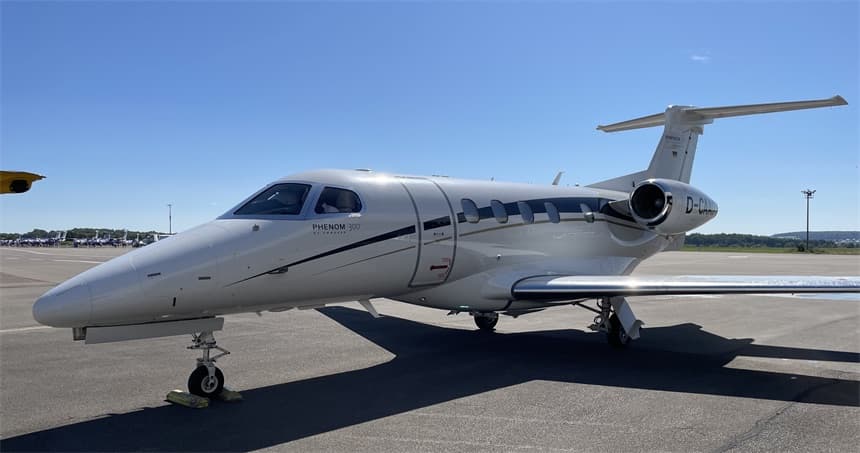
Estimated hourly rate — exact price on request.
- Passengers
- 8
- Range
- 3,650 km
- Cruise speed
- ≈ 840 km/h
- Max flight time
- ≈ 4.5 h
- Cabin length
- 5.23 m
- Cabin width
- 1.55 m
- Cabin height
- 1.50 m
- Aircraft length
- 15.64 m
Cruise speed is high-speed cruise. Manufacturers calculate range at the slower long-range cruise, with four passengers and NBAA IFR reserves — so a maximum-range leg takes longer than range ÷ speed, and a full cabin flies less far.
The Embraer Phenom 300 has been the best-selling light jet for years, thanks to its speed, class-leading cabin and low running costs. It seats up to eight, flies fast and far for its class, and offers a genuinely refined interior for sectors of up to about four and a half hours.
We don’t own the jets — we source them. With access to 4,500+ aircraft, we pick the exact tail that fits your route, your group and your budget. These are estimated from-prices per flight hour, to give you a sense of cost. Your exact quote depends on the aircraft, route and dates — just ask.
In detail
The Embraer Phenom 300 in practice
The Phenom 300 is the aircraft most brokers reach for first when six or seven people need to cross Europe in one hop. It is a super-light jet: light-jet running costs, with range, speed and a hold that belong to the class above. Eight seats, 3,650 km, around 840 km/h, and a practical sector limit near 4.5 hours — enough for London to Ibiza or Geneva to Ibiza without a fuel stop. What it does not have is a cabin you can stand up in. That one fact settles most Phenom-versus-XLS+ conversations, and it is worth settling first. Avily does not own aircraft; we charter from operators across Europe, so the individual tail on offer matters as much as the type.
Where it came from
Embraer began design work in 2004, after Phenom 100 customers asked for something larger. The answer was a clean-sheet aircraft rather than a stretch of the smaller jet, and the brief was to beat the established light jets on range, speed and hourly cost at the same time. The prototype flew on 29 April 2008, the FAA certified the type on 3 December 2009, and the first aircraft was handed over on 29 December 2009 — a little over five years from the first drawings to service entry.
The market answered quickly. In 2013 the Phenom 300 was the most-delivered business jet of any size, not merely the most-delivered light jet, and it has led its own class every year since: GAMA's figures made it the best-selling light jet for a fourteenth consecutive year in February 2026. The 500th aircraft was delivered in March 2019, the 700th in February 2023, and 941 had been built by the first half of 2026. Production continues in Brazil and at Melbourne, Florida.
For a charter customer that volume is the point. A type with that many airframes in service has operators on every major European ramp, crews who fly it every week, spares where they are needed, and enough tails bidding for the same trip to keep the hourly rate in check.
Who charters a Phenom 300
Most Phenom bookings are four to seven people going somewhere in Europe for one or two nights: a board flying to a site visit, a family to the Riviera in August, a group to the Alps in February. The type sits between two neighbours, and one question usually settles the choice.
Against the Citation XLS+, the Phenom trades cabin for capability. The XLS+ is wider — 1.68 m against 1.55 — and at 1.73 m tall enough to walk upright if you are under about 5 ft 8 in; the Phenom is roughly 25 km/h quicker and holds its range better once every seat is sold. Against the light jets below it, the Citation CJ2 and the Hawker 400XP, the Phenom wins whenever the cabin is genuinely full. A CJ2 with six adults and their luggage becomes a 2,000 km aircraft. The Phenom barely notices the load.
Range with a full cabin
The published 3,650 km comes from a five-occupant calculation. With every seat taken, plan on about 3,350 km instead — a penalty of roughly 300 km, and by a wide margin the smallest full-load haircut in this class. With full tanks the Phenom still lifts about 670 kg, which is eight people and real suitcases rather than eight people and hand baggage.
What the cabin is really like
The cabin is 5.23 m long, 1.55 m wide and 1.50 m high. That last number matters: this is not a stand-up cabin. You move around it stooped. The oval cross-section gives more shoulder and head room at the seat than 1.50 m suggests, so a two-hour leg seated is comfortable — it is the walk to the lavatory that reminds you. If standing up matters more than range, book a Citation XLS+.
The lavatory is at the rear behind a solid door, externally serviced, with a belted seat: a real lavatory, not a curtained seat. Baggage is 2.38 m³, the largest hold in the light-jet class — skis, golf bags and a full set of cases fit — but the main compartment is external and cannot be reached in flight. Only the small forward closet can. Pack a cabin bag for anything you want aloft.
The corridors it actually flies
Realistic block times, all with eight seats sold and none needing a fuel stop: London–Nice about 1h 40m, London–Geneva 1h 25m, Paris–Nice 1h 20m, Geneva–Ibiza 1h 40m, London–Barcelona 2h 10m, London–Ibiza 2h 30m. The practical ceiling is around 4.5 hours, which covers most of the Mediterranean and reaches Morocco, and leaves the Gulf and anything transatlantic to a larger cabin.
Field performance opens the airports these routes need: 978 m to take off at maximum weight at sea level, 674 m to land. Cannes–Mandelieu, Sion and Samedan are all within reach, and the Phenom 300 is a certified steep-approach type for London City — subject to the operator holding the approval, which we confirm per aircraft. What it cannot use is grass or gravel; for unpaved strips the aircraft is the Pilatus PC-24.
What moves the price
Charter starts from around €3,500 per flight hour, and the hourly rate is the smallest part of the answer. Aircraft are not parked where you want them. If the nearest Phenom is in Milan and you are leaving from Luton, that positioning leg is on your quote — which is why a same-day return often costs less than two one-ways.
Crew duty is the second lever. An early departure with a late return can push the day past what one crew may legally fly, and a second crew or a night stop changes the number. Then the calendar: Cannes in May, Grand Prix weekend, February half-term in the Alps, August on the Riviera. Slots and handling at Nice, Geneva and Sion price accordingly, and airport fees vary more than people expect — London City is not Farnborough. Every trip is quoted individually.
What it does well
- Gives up only about 300 km of range when every seat is sold — the smallest full-cabin penalty in the class.
- A 2.38 m³ hold, the largest in the light-jet class: skis, golf bags and a full set of cases go without negotiation.
- 978 m to take off at maximum weight and 674 m to land, which puts Cannes-Mandelieu, Sion and Samedan within reach.
- Cabin altitude of 6,600 ft at 45,000 ft, the best pressurisation in the class and the reason a four-hour leg leaves you less tired.
- Around 840 km/h in the cruise, roughly 25 km/h faster than a Citation XLS+ over the same route.
Where it gives ground
- A 1.50 m cabin. You move about it stooped, and no interior refit changes that.
- 1.55 m of cabin width against the XLS+'s 1.68 m — with eight aboard, shoulder room is the trade you are making.
- The main hold is external and sealed once the door closes; only the small forward closet is reachable in flight.
The Embraer Phenom 300 against the alternatives
- Cessna Citation XLS+8 · 3,400 km
Pick the XLS+ when the group will spend the flight moving about the cabin rather than sitting in it. Its 1.73 m ceiling and 1.68 m width beat the Phenom on room, and you pay for it in range with a full cabin.
- Pilatus PC-248 · 3,700 km
The answer when the destination has a grass, gravel or very short runway, or when the load is awkward — the PC-24 has a cargo door and a bigger hold, and the Phenom is a paved-runway aircraft only.
- Cessna Citation CJ26 · 2,990 km
Worth quoting when four or five people are flying under two hours. The CJ2 costs less per hour and the Phenom's range and payload advantages never come into play on that trip.
Routes the Embraer Phenom 300 flies
- London → Nice1h 40mfrom €9,500
- London → Geneva1h 25mfrom €7,600
- Paris → Nice1h 20mfrom €8,500
- Geneva → Ibiza1h 40mfrom €9,500
- London → Barcelona2h 10mfrom €11,000
- London → Ibiza2h 30mfrom €12,400
Flight times are typical for this type with a full cabin. Headwinds, payload and slot restrictions move them.
Embraer Phenom 300 charter — frequently asked questions
- Can eight people and their luggage really fly on a Phenom 300?
- Yes, and this is the type’s strongest card. The hold is 2.38 m³, the largest in the light-jet class, and with full tanks the aircraft still carries about 670 kg of people and bags. Skis and golf bags are routine. The limit is bulk rather than weight, so send us a luggage list for anything unusual.
- Can I stand up in the cabin?
- No. The cabin is 1.50 m high, so you move about stooped and stand only in the doorway area. Seated space is generous for the class because of the oval cross-section, and cabin altitude is 6,600 ft at 45,000 ft — the best in the class. If standing up is the priority, the Citation XLS+ has a 1.73 m cabin and less range.
- Is it flown by one pilot?
- The Phenom 300 is certified for single-pilot operation, which is one reason its hourly cost sits below the midsize class. On commercial charter the operators we work with roster two pilots as standard. If a quote you are comparing is unusually cheap, crewing is one of the first things worth asking about.
- Will it get into Cannes or London City?
- Cannes–Mandelieu, Sion and Samedan are all comfortably within its field performance — 978 m to take off at maximum weight, 674 m to land. London City needs steep-approach approval: the Phenom 300 is an approved type, but the operator must hold the approval, so we confirm it on the specific aircraft before quoting.
Specifications
Full technical sheet
General
- Manufacturer
- Embraer
- Category
- Super-light jet
- ICAO designator
- E55P
- Production
- 2009–…
- Flight crew
- 1–2
Performance
- Range (IFR reserves)
- 3,650km
- Range (nautical miles)
- 1,971nm
- Cruise speed (high-speed)
- ≈ 840km/h
- Long-range cruise
- 709km/h
- Max operating Mach (MMO)
- M 0.78
- Max operating speed (VMO)
- 320KIAS
- Approach speed
- 106kts
- Takeoff distance (balanced field)
- 956m
- Landing distance
- 674m
- Service ceiling
- 45,000ft
- Cabin altitude
- 6,600ft
- Max flight time
- ≈ 4.5h
Powerplant and avionics
- Engine type
- Turbofan
- Engines
- 2 × Pratt & Whitney Canada PW535E
- Thrust per engine
- 3,360lbf
- Avionics
- Embraer Prodigy Flight Deck 300 (Garmin G1000); Prodigy Touch (Garmin G3000) from 2014
Dimensions and capacity
- Aircraft length
- 15.64m
- Aircraft height
- 5.10m
- Wing span
- 15.91m
- Cabin length
- 5.23m
- Cabin width
- 1.55m
- Cabin height
- 1.50m
- Baggage volume
- 2.38m³
- Seats (charter layout)
- 8
- Seats (max certified)
- 9
- Suitcases
- 6
- Carry-on bags
- 6
- Max payload
- 1,096kg
- Max takeoff weight (MTOW)
- 8,150kg
- Max landing weight (MLW)
- 7,650kg
- Fuel capacity
- 3,024L
Manufacturer and type-certificate figures, verified field by field. A line we could not source is left out rather than filled with a plausible number.
Gallery