Super-light jet
Cessna Citation XLS+
The best-selling super-light
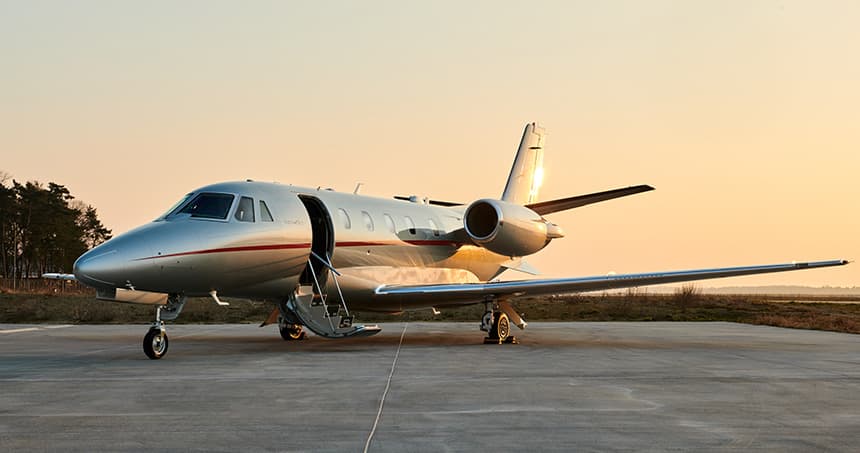
Estimated hourly rate — exact price on request.
- Passengers
- 8
- Range
- 3,400 km
- Cruise speed
- ≈ 815 km/h
- Max flight time
- ≈ 4 h
- Cabin length
- 5.64 m
- Cabin width
- 1.68 m
- Cabin height
- 1.73 m
- Aircraft length
- 16.07 m
Cruise speed is high-speed cruise. Manufacturers calculate range at the slower long-range cruise, with four passengers and NBAA IFR reserves — so a maximum-range leg takes longer than range ÷ speed, and a full cabin flies less far.
The Cessna Citation XLS+ is one of the most popular business jets ever built, combining the widest and tallest cabin in the super-light class with light-jet economy. It seats up to eight, flies routes of around four hours and handles shorter runways with ease — a superb all-rounder.
We don’t own the jets — we source them. With access to 4,500+ aircraft, we pick the exact tail that fits your route, your group and your budget. These are estimated from-prices per flight hour, to give you a sense of cost. Your exact quote depends on the aircraft, route and dates — just ask.
In detail
The Cessna Citation XLS+ in practice
The Citation XLS+ is the aircraft people book when the cabin matters more than the last few knots of speed. It seats eight, flies sectors of up to about four hours, and cruises at around 815 km/h. Within the super-light class it has the widest and tallest cabin — 1.68 m across, 1.73 m floor to ceiling — and it boards through its own airstair door rather than a folding step. Overall length is 16.00 m. The published cabin length of 5.64 m includes the lavatory and closet at the back, which is worth knowing before you compare that number against a rival's. Avily does not own aircraft: we charter them from a large operator network and match the tail to the trip. From ~€3,600 per flight hour, exact quote on request.
Where it came from
Cessna announced the Citation Excel at the NBAA convention in October 1994 and assembled it from parts it already owned: the wide Citation X fuselage cross-section, shortened, married to a straight supercritical wing and the tail of the Citation V. The aim was a mid-size cabin on light-jet running costs, and the customers it was chasing were flying twin turboprops. The prototype flew on 29 February 1996, certification came in April 1998, and 308 Excels were built.
The XLS replaced it from 2004 with more powerful PW545B engines and ran to 330 airframes. The XLS+ followed: FAA certification on 30 May 2008, FADEC-controlled PW545C engines and a redesigned, longer nose — which is why its overall length of 16.00 m does not match the earlier aircraft, a detail worth knowing when you compare broker listings. Production ran until 2022, when the XLS Gen2 took over the line. The Citation Ascend, announced in May 2023 and in service from December 2025, sits on the same fuselage again.
The family passed 1,000 deliveries in March 2021, which makes it one of the most-produced business jets ever built. On the charter market that shows up as choice: on most European dates more than one XLS+ is available for the same trip.
Who charters an XLS+, and when
Eight-seat XLS+ trips are usually one of three things: a board or a deal team moving together, a family with real luggage, or a group facing two to four hours in the cabin who want to arrive able to work. The two neighbouring types make the choice fairly clear. The Phenom 300 is a little quicker and carries a full cabin further — around 3,350 km against the XLS+'s 2,850 — but its cabin is 1.55 m wide and 1.50 m tall, and you feel that from the first minute. The PC-24 has a bigger hold, a proper cargo door and certification for grass and gravel strips. If none of that is in play, the XLS+ wins on room.
What 1.73 m actually means
1.73 m is 5 ft 8 in, measured down the dropped centre aisle. If you are that height or under, you walk the cabin upright. At 1.85 m you will carry a slight stoop between your seat and the lavatory — noticeable, but nothing like the head-down shuffle of a light jet with a 1.45 m ceiling. The cabin is 1.68 m across, the widest in the class, so eight people are not sitting shoulder to shoulder.
The seating section on its own measures 4.67 m; the 5.64 m figure adds the lavatory and closet behind it. That lavatory is a full one — at the rear, behind a solid door, externally serviced, and on many aircraft fitted with a belted seat.
Range, runway and bags: the honest limits
The 3,400 km headline is an NBAA figure with four passengers aboard. Fill all eight seats and the practical sector drops to roughly 2,850 km. That 550 km haircut is the single most common misunderstanding about this aircraft, so plan a full cabin around four hours and 2,800 km rather than the brochure number.
Balanced field length is about 1,192 m at maximum weight. Cannes–Mandelieu and Sion are straightforward; Samedan is operable but performance-limited on a hot day, which costs either fuel or a seat. The type appears on London City's approved list, but the individual aircraft must carry the steep-approach modification and the operator must hold LCY approval — we check that per tail rather than promise it up front. The hold is 2.27 m³, loaded externally and sealed in flight; only the 0.28 m³ cabin closet is reachable once airborne.
The corridors it actually flies
London to Nice is the XLS+'s home run: about 1h 40m nonstop with all eight seats taken and the bags aboard. London to Geneva runs about 1h 25m, Paris to Nice about 1h 20m, Geneva to Ibiza about 1h 40m. The far edge of its comfortable range is London to Barcelona at roughly 2h 10m and London to Ibiza at roughly 2h 30m — both fine with a full cabin. Past that the arithmetic changes. London to Larnaca is 3,260 km: inside the four-passenger figure, outside a full one, so it becomes a fuel stop or a larger aircraft. Block times here are typical; wind and slot timing move them ten or fifteen minutes either way.
What moves the price
Charter starts from around €3,600 per flight hour, and the hourly rate is only part of the invoice. The largest variable is positioning: an aircraft already sitting at Luton on your date costs far less than one flown in empty from Milan. Crew duty is next — a long day, a late return or an overnight can force a second crew or a night stop, both of which land on the quote. Then season. Cannes in May, the Grand Prix weekend, August on the Riviera and the winter Alpine peaks all tighten slots and ramp parking, and handling and landing fees at Nice, Ibiza and Geneva swing by thousands of euros across the year. We price the specific dates, not an average.
What it does well
- 1.73 m of cabin height, the tallest in the super-light class and genuinely stand-up for most adults.
- 1.68 m of cabin width, also the widest in the class — eight people are not sitting shoulder to shoulder.
- A balanced field length of about 1,192 m at maximum weight, so Cannes-Mandelieu and Sion ask nothing unusual of it.
- A 2.27 m³ external hold — eight people with golf clubs is a routine load rather than a conversation.
- More than 1,000 of the family delivered, so a European trip usually has several tails to choose between rather than one.
Where it gives ground
- The steepest full-cabin range penalty in the class: roughly 2,850 km with eight aboard against a 3,400 km headline.
- Out of production since 2022, and charter airframes span more than a decade — cabin condition and fit vary between operators, so the tail matters more than the type.
- The main hold is loaded from outside and sealed in flight; only the 0.28 m³ cabin closet is reachable once airborne.
The Cessna Citation XLS+ against the alternatives
- Embraer Phenom 3008 · 3,650 km
Better whenever the leg is long or the cabin is full: it holds roughly 3,350 km with every seat sold, against the XLS+'s 2,850, and it is a little quicker. You give up the stand-up cabin to get it.
- Pilatus PC-248 · 3,700 km
The one to ask for when the runway is unpaved or the load is bulky. Its cargo door and larger hold suit ski and equipment trips, and it reaches airfields the XLS+ cannot use.
- Cessna Citation Latitude8 · 5,000 km
The step up when you want a flat floor and a cabin that is stand-up for everyone, not just for people under 5 ft 8 in. It costs more per hour and it flies further with the seats full.
Routes the Cessna Citation XLS+ flies
- London → Nice1h 40mfrom €9,500
- London → Geneva1h 25mfrom €7,600
- Paris → Nice1h 20mfrom €8,500
- Geneva → Ibiza1h 40mfrom €9,500
- London → Barcelona2h 10mfrom €11,000
- London → Ibiza2h 30mfrom €12,400
Flight times are typical for this type with a full cabin. Headwinds, payload and slot restrictions move them.
Cessna Citation XLS+ charter — frequently asked questions
- Can I stand up in a Citation XLS+?
- Almost. The cabin is 1.73 m tall down the centre aisle, so anyone up to about 5 ft 8 in stands fully upright. At 1.85 m you will carry a slight stoop moving between your seat and the lavatory. It is the tallest cabin in the super-light class by a clear margin, but calling it a full stand-up cabin depends entirely on your height.
- How far can it really fly with eight people on board?
- About 2,850 km, or roughly four hours. The 3,400 km figure in the spec table — ours included — assumes four passengers and NBAA reserves. With every seat taken and real luggage, plan against the shorter number: London to Ibiza or Barcelona is comfortable, London to Larnaca is not a nonstop.
- Is there a proper toilet, and can I reach my bags in flight?
- Yes to the first. The lavatory is at the rear, behind a solid door, externally serviced, and on many aircraft it has a belted seat. The main 2.27 m³ hold is loaded from outside and is not reachable once you are airborne. Only the cabin closet, about 0.28 m³, is accessible in flight, so keep what you need during the trip in the cabin with you.
- XLS+ or Phenom 300?
- Phenom if the leg is long, if the extra speed matters, or if a full cabin has to go beyond 3,000 km. XLS+ if the eight of you will genuinely be in the cabin together and want the width and the height. Both seat eight, and they feel different from the door onward. We quote whichever is actually available on your dates.
Specifications
Full technical sheet
General
- Manufacturer
- Cessna (Textron Aviation)
- Category
- Super-light jet
- ICAO designator
- C56X
- Production
- 2008–2022
- Flight crew
- 2
Performance
- Range (IFR reserves)
- 3,400km
- Range (nautical miles)
- 1,853nm
- Ferry range
- 3,684km
- Cruise speed (high-speed)
- ≈ 815km/h
- Long-range cruise
- 654km/h
- Max operating Mach (MMO)
- M 0.75
- Max operating speed (VMO)
- 305KIAS
- Approach speed
- 107kts
- Takeoff distance (balanced field)
- 1,085m
- Landing distance
- 969m
- Service ceiling
- 45,000ft
- Max flight time
- ≈ 4h
Powerplant and avionics
- Engine type
- Turbofan
- Engines
- 2 × Pratt & Whitney Canada PW545C
- Thrust per engine
- 4,119lbf
- Avionics
- Rockwell Collins Pro Line 21
Dimensions and capacity
- Aircraft length
- 16.07m
- Aircraft height
- 5.23m
- Wing span
- 16.97m
- Cabin length
- 5.64m
- Cabin width
- 1.68m
- Cabin height
- 1.73m
- Baggage volume
- 2.27m³
- Seats (charter layout)
- 8
- Seats (max certified)
- 12
- Suitcases
- 7
- Carry-on bags
- 8
- Max payload
- 1,016kg
- Max takeoff weight (MTOW)
- 9,163kg
- Max landing weight (MLW)
- 8,482kg
- Fuel capacity
- 3,808L
Manufacturer and type-certificate figures, verified field by field. A line we could not source is left out rather than filled with a plausible number.
Gallery