Southern Europe
Private jet charter to Madrid
Spain's capital, its corporate centre and the European end of the Latin American axis.
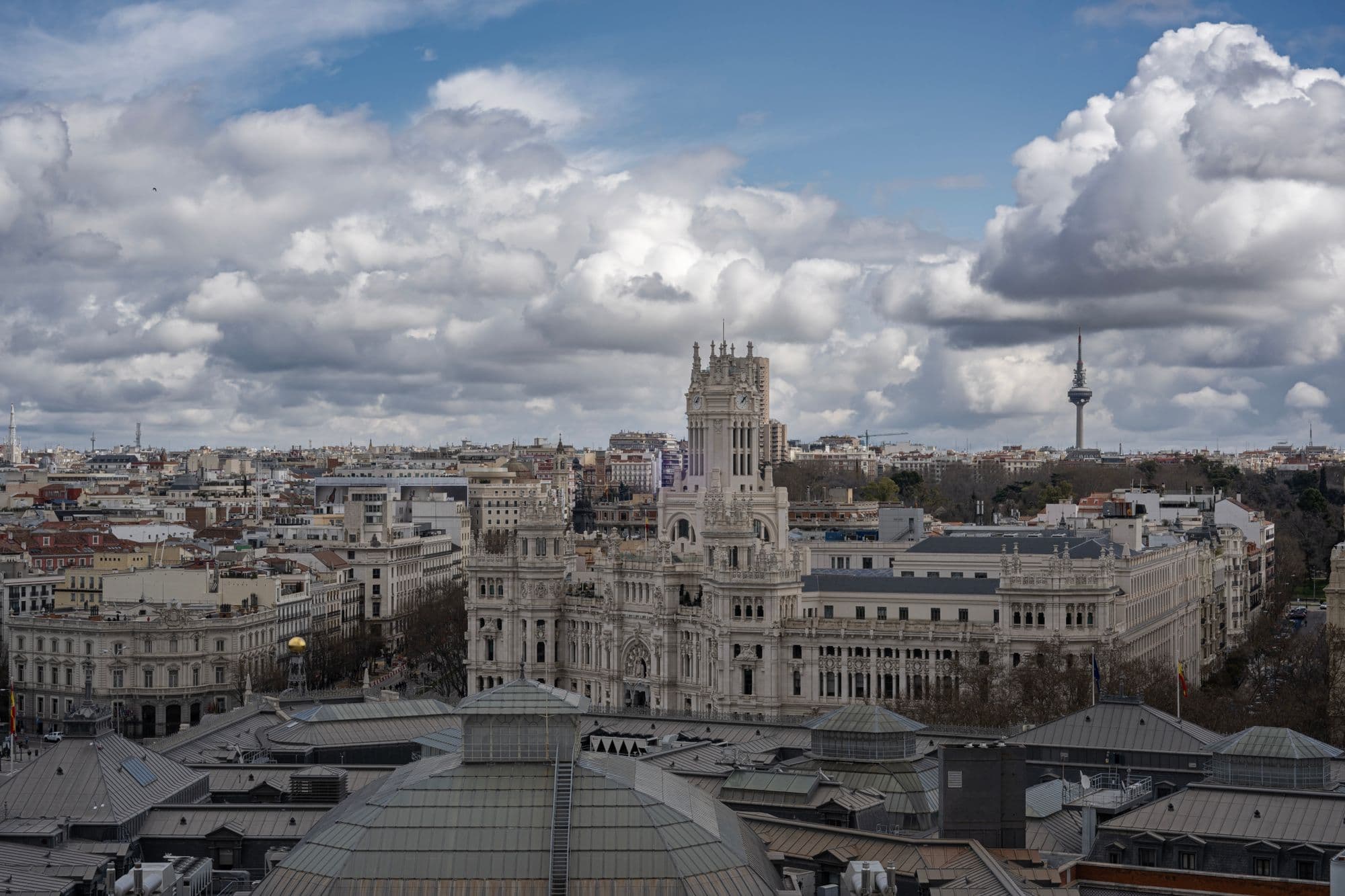
Madrid is a working capital rather than a resort, and its private-aviation traffic behaves accordingly: steady from September to July, built around a corporate and trade-fair calendar, and almost absent in August when the city empties to the coast. Two airports serve it, and the choice between them is the single most useful thing to understand before booking — one takes anything at any hour, the other is closer to the city but closes at sunset.
How much does a private jet to Madrid cost?
A private charter to Madrid starts from around ~€7,950, depending on your departure point, the aircraft and the season.
- London Madrid
- from ~€12,750
- Barcelona Madrid
- from ~€7,950
- Paris Madrid
- from ~€10,800
- Nice Madrid
- from ~€10,200
Estimated one-way charter for the whole aircraft. The exact price depends on the aircraft and date, and is always quoted on request.
Popular routes from Madrid
Where our clients fly from Madrid — each corridor has its own guide to airports, flight time and cost.
Best airports for Madrid
- MAD · Adolfo Suárez Madrid–BarajasExecutive terminal on the south side; customs and immigration 24 hours
- 13 km
- LECU · Madrid–Cuatro VientosSouth-west of the city; VFR only, 1,500 m runway, 09:00 to sunset
- 9 km
Which aircraft suit flights to Madrid?
A few aircraft we regularly arrange for this route — your advisor will match the best option to your group and range.
| Aircraft | Passengers | Range | Cruise speed |
|---|---|---|---|
| Cessna Citation XLS+ | 8 | 3,400 km | ≈ 815 km/h |
| Embraer Phenom 300 | 8 | 3,650 km | ≈ 840 km/h |
| Bombardier Challenger 350 | 9 | 5,900 km | ≈ 850 km/h |
What it costs to fly privately to Madrid
Indicatively, from about €7,950 one way from Barcelona, €10,200 from Nice, €10,800 from Paris and €12,750 from London. The order is not purely a matter of distance. The European charter fleet is based in the north and west — around London, Paris, Geneva and Zurich — so a flight that starts where the aircraft already is costs less than one of the same length that begins with a positioning leg. That is also why the return journey from Madrid is usually the dearer half, and why a same-day or overnight round trip prices better than two separate one-ways: one aircraft, one positioning flight, one crew. Every trip is quoted individually and these are indicative from-figures rather than live prices. Avily Lux is a broker with access to a large operator network and owns no aircraft.
Which airport a private arrival uses
Adolfo Suárez Madrid–Barajas is the default and, for most flights, the only sensible answer. It sits 13 km north-east of the centre, has four runways between 3,500 m and 4,179 m, and runs air traffic services and its border post 24 hours a day. Nothing about aircraft size, weather or hour of arrival is a question there. Madrid–Cuatro Vientos is the alternative, 8.5 km south-west of the centre, and its appeal is entirely geographic: it is on the other side of the city, and the side many arrivals are actually heading for. Its published limits decide whether it is usable. The runway is 1,500 m, the approved traffic is visual flight rules with no instrument approach published at all, and the aerodrome runs from nine in the morning to sunset — engines may not be started before it opens. The AIP makes it available to light civil aircraft, with medium wake-turbulence types admitted only on a prior application and a clearance from both air traffic control and the airport management, and the published aprons cap wingspan at eighteen metres. Two further things are true and rarely mentioned. It is not slot-coordinated, so nothing has to be requested. And it sits at 692 m above sea level, some 83 m higher than Barajas, on a 1,500 m runway — which on a hot afternoon is a payload calculation rather than a formality.
The executive terminal and the real time to a car
Business aviation at Barajas uses a dedicated executive terminal on the south side of the field, well away from T1 to T4 — you do not enter the passenger terminals at any point, and the car is brought to the aircraft. The choice of handler is narrower than at most European airports because the airport publishes it: aircraft below 10,000 kg or with fewer than 20 seats must have engaged one of the two general and business aviation managers authorised at Barajas. The one handling your flight is named on your confirmation rather than left to chance. Clearance itself is quick. Customs and immigration are on site around the clock, and a Schengen arrival has nothing to clear at all. What is not quick is Madrid, and we do not publish a drive time for it, because neither the airport operator nor the aviation authority publishes one and the real answer is decided by the hour of day rather than by the 13 km. What we do is book the car against your actual landing time and tell you at the quote stage if the timing is optimistic. IFEMA, the trade-fair complex, is the exception that needs no planning: it sits beside the airport, so a fair arrival often never meets the city's traffic at all.
The weeks that set the price
Madrid's demand curve is a business calendar, which makes it the opposite of the Mediterranean cities on this site. The trade-fair weeks at IFEMA are the tightest — FITUR in January and ARCO in February among them — along with the run-up to Easter and the early-December bridge, when 6 and 8 December are both public holidays and the working year effectively stops between them. Easter week itself moves each year and takes a week of nationwide travel wherever it lands. August is the inversion and it is worth planning around. The city empties, its own traffic falls away, and the coast and the Balearics take everything. Madrid in August is the easy arrival in an otherwise impossible month: apron available, handlers unhurried, prices soft. If the trip can move, that is the month it is cheapest to come here and the month it is dearest to go almost anywhere else in Spain.
Slots, curfews and where the aircraft sleeps
Barajas is a fully coordinated Level 3 airport all year, so every private movement, arrival and departure alike, needs an airport slot. Your handling agent requests it through the Spanish coordinator; the operator does not. Same-day requests go to the airport operations centre, and the real-time period opens at midday on the working day before the flight. The rule that gives this teeth is a quiet one: the airport will not accept a flight plan whose off-blocks or arrival time does not match the slot it allocated. That is the practical reason a departure cannot simply be moved forward on the morning. There is no blanket night curfew. What the airport prohibits between 23:00 and 06:59 local is take-off and landing by aircraft in noise category CR-4 and above — a test applied to the individual type rather than to business aviation as a class, and one we check against the actual aircraft before confirming a late arrival. Around it sit the smaller night rules: reverse thrust above idle is prohibited in the same window, APU use is restricted on parts of the apron, and in south configuration the night period runs to nine in the morning on Saturdays and Sundays. Parking is the easy part. The airport publishes no maximum stay for business aviation and, unlike the island airports, Madrid can generally keep your aircraft for the length of the trip — so the repositioning flights that inflate an Ibiza quote do not usually apply here. It is metered rather than free: the clock runs from chocks-on, and it pauses between midnight and six in the morning.
Ground, luggage and animals
The car goes to the aircraft and the road does the rest. We do not publish a drive time into the city, because none of the official sources do and the number is decided by the hour rather than by the 13 km. Onward by air is the part Madrid is good at: it sits in the middle of its own country, and Seville is about an hour, Ibiza and Malaga about an hour and five minutes, Palma about an hour and a half. That is why a Madrid arrival is so often the first stop of a trip rather than the last. Golf bags, ski gear and art cases are a question of hold volume as much as weight, so send the list with the enquiry. For a dog, cat or ferret what applies depends entirely on where you leave from. Inside the EU the European non-commercial movement rules cover it: an ISO microchip, a rabies vaccination given after the chip and at least twenty-one days before the flight, and an EU pet passport. From outside the EU the animal has to arrive at a point of entry designated for the purpose, where the chip and the documents are checked — and Cuatro Vientos is published as not being one, which is a second reason an arrival with an animal from outside the EU is a Barajas question. At Barajas that check sits in the air cargo centre rather than in the executive terminal, and it keeps its own working hours, so it is arranged around the arrival rather than absorbed into it. Whether the animal travels in the cabin is separately the operator's decision. Tell us at the quote stage, with the weight.
What Madrid is for
It is the seat of government, the headquarters city for most of Spain's large companies and its banks, and the European end of the Latin American axis — which is the reason a large share of the traffic here is corporate rather than leisure, and why the season runs September to July rather than June to September. IFEMA, next to the airport, adds a trade-fair calendar of its own. What clients come for beyond work is compact and unusually concentrated: the Prado, the Thyssen-Bornemisza and the Reina Sofía within a fifteen-minute walk of each other, two football clubs that draw their own traffic, and a restaurant city that starts late even by Spanish standards. Madrid sits on a plateau at roughly 650 m, which makes winter genuinely cold and July and August genuinely hot — well into the thirties by afternoon. Spring and autumn are the months the city is most comfortable, and they are also the months it is busiest.
Frequently asked questions
- Which airport serves Madrid for private jets?
- Adolfo Suárez Madrid–Barajas, 13 km north-east of the centre, through a dedicated executive terminal with customs and immigration 24 hours a day and four runways between 3,500 m and 4,179 m. Cuatro Vientos, 8.5 km south-west, is closer but takes light aircraft between nine in the morning and sunset only.
- How much is a private jet to Madrid?
- Indicatively from about €7,950 one way from Barcelona, €10,200 from Nice, €10,800 from Paris and €12,750 from London. The order reflects where the charter fleet is based as much as the distance. Every trip is quoted individually.
- Can I land at Cuatro Vientos instead of Barajas?
- Only within its published limits: a 1,500 m runway, visual flight rules with no instrument approach at all, and hours from nine in the morning to sunset. It is available to light civil aircraft, with medium wake-turbulence types needing a prior application and a clearance from air traffic control and the airport, and the aprons cap wingspan at eighteen metres. We confirm it before quoting, not after.
- Is there a curfew at Madrid–Barajas?
- Not a blanket one. Between 23:00 and 06:59 local the airport prohibits take-off and landing by aircraft in noise category CR-4 and above — a test applied to the individual type rather than to business aviation as a class. We check it against the actual aircraft before confirming a late arrival.
- When is Madrid cheapest to fly to?
- August. The city empties, its own traffic falls away and the demand moves to the coast and the Balearics, leaving apron available and prices soft. The tight weeks are the IFEMA trade fairs in January and February, the run-up to Easter and the early-December bridge.
From the journal
Southern Europe