Light jet
Hawker 400XP
Wide-cabin light jet
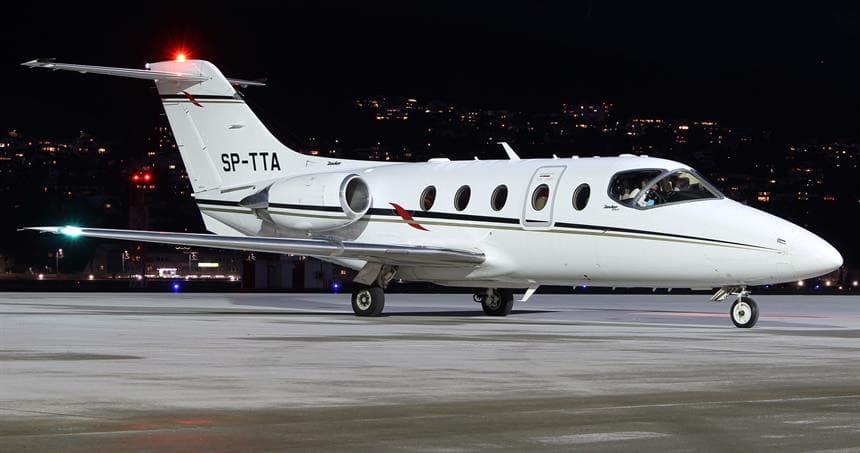
Estimated hourly rate — exact price on request.
- Passengers
- 7
- Range
- 2,400 km
- Cruise speed
- ≈ 780 km/h
- Max flight time
- ≈ 3 h
- Cabin length
- 4.75 m
- Cabin width
- 1.49 m
- Cabin height
- 1.45 m
- Aircraft length
- 14.76 m
Cruise speed is high-speed cruise. Manufacturers calculate range at the slower long-range cruise, with four passengers and NBAA IFR reserves — so a maximum-range leg takes longer than range ÷ speed, and a full cabin flies less far.
The Hawker 400XP stands out among light jets for its notably wide, flat-floor cabin and strong performance. Seating up to seven, it’s a comfortable, quick option for regional trips where a little extra shoulder room matters.
We don’t own the jets — we source them. With access to 4,500+ aircraft, we pick the exact tail that fits your route, your group and your budget. These are estimated from-prices per flight hour, to give you a sense of cost. Your exact quote depends on the aircraft, route and dates — just ask.
In detail
The Hawker 400XP in practice
The Hawker 400XP buys cabin width. At 1.49 m across and 4.75 m long it has the roomiest cabin you can charter at this price, and at around 780 km/h it is the quickest thing in the light-jet class. What it costs you is runway and range: about 1,430 m of tarmac to get airborne at maximum weight, 2,400 km published, and a practical sector of roughly three hours. That trade settles most 400XP decisions. Seven seats, a lavatory behind a door, and part of the baggage reachable in flight. Charter starts from around €3,100 per flight hour, with an exact quote on request. Avily does not own aircraft — we charter from operators across Europe, so the individual tail matters as much as the type.
Where it came from
The aircraft began as a Japanese project. Mitsubishi flew the MU-300 Diamond on 29 August 1978 and had it certified on 6 November 1981, then sold the programme to Beech Aircraft in 1985 rather than fight for the American market from Nagoya. Beech certified it as the Beechjet 400 in May 1986, and in 1990 the 400A brought a glass cockpit, more range and the cabin still flying today. Raytheon bought the Hawker line in 1993 and eventually put that name on the Beechjet: the Hawker 400XP badge covers the final production run from 2003, adding a weight increase, thrust reversers, TCAS II and a nine-seat option.
The type's real volume came from a customer who never chartered it. The US Air Force took 180 T-1A Jayhawks between 1992 and 1997 to train tanker and transport crews, and Japan bought thirteen more. Across every badge more than 900 airframes were built — 92 as Mitsubishis, the rest by Beech and Raytheon.
Nothing replaced it. Production ended, Hawker Beechcraft filed for Chapter 11 in 2012, and the survivors moved onto charter fleets, where the 400XP became the cheap route to a wide light-jet cabin. Its Rockwell Collins Pro Line 4 flight deck is 1990s equipment: well supported, thoroughly proven, not modern.
Who charters a Hawker 400XP
Most 400XP trips are four to six people on a European leg of two hours or less, and the type is chosen on price. It is usually quoted against a Citation CJ2, and the two split cleanly. The Hawker is wider at 1.49 m against the CJ2's 1.47, which sounds trivial and is not — at these dimensions every centimetre is shoulder room — longer in the cabin, and about 15 km/h quicker in the cruise. The CJ2 flies further, burns less, and gets into airports the Hawker cannot.
Against a Phenom 300 the argument is simply money. The Phenom is better on range, payload, field performance and pressurisation, and its hourly rate says so. If the trip is short, the group is five, and both airports have a normal runway, the 400XP does the same job for less.
Runway and range — the honest limits
Start with the runway, because it is the type's defining weakness. The 400XP needs about 1,430 m to take off at maximum weight, and published balanced-field figures sit near 1,400 m — the longest requirement of anything in this class. Cannes-Mandelieu has 1,610 m of runway. London City has less, plus a 5.5° approach. Published landing figures for the type range from the 919 m in our table to about 1,530 m in the broker spec libraries, and that spread is exactly the problem. So we do not tell clients the 400XP will get into Cannes or London City. We ask the operator — that tail, that weight, that day — and pass the answer on unedited. Sion at 2,000 m is not in question; Samedan is out.
Range is the second limit. The published 2,400 km is a four-passenger figure. With seven aboard the aircraft has only a few hundred kilograms of payload left at full fuel, so a genuinely full cabin is a five-to-six-passenger aircraft once luggage is real, and the sector shortens with it. London to Athens or Marrakech needs a fuel stop with the cabin full.
What the cabin is really like
The cabin is 4.75 m long, 1.49 m wide and 1.45 m high, and the length figure includes the aft baggage area rather than the seating section alone — do not read it as half a metre more legroom than a CJ2. What you do get is the widest floor and the widest shoulder line in the light class, in a round cross-section that has aged better than the avionics behind it. Nobody stands up: 1.45 m means you move about stooped.
The usual charter layout is a four-seat club facing across a table, a pair or divan behind it, and the belted lavatory seat making seven. The lavatory is enclosed at the rear and not externally serviced. Baggage is about 1.50 m³, split between an external locker and an aft area inside the cabin — and that inner part you can reach in flight, which a CJ2 passenger cannot. Catering is loaded cold into a forward refreshment centre; there is no galley in any real sense.
The corridors it actually flies
Realistic block times with the cabin sold and no fuel stop: London–Nice about 1h 35m, London–Geneva about 1h 20m, Zurich–Nice about 1 hour, Geneva–Nice about 45 minutes, London–Ibiza about 2h 25m. The practical ceiling is around three hours, which covers the Alps, the Riviera and the Balearics comfortably and stops well short of Cyprus, Morocco or the Gulf.
The airports on those corridors are the ones that suit it. Nice, Geneva, Zurich, Ibiza and the London fields all have runway to spare, and the 400XP's speed advantage is real over a two-hour leg. Where the type stops working is the short-field end of the same map — the Côte d'Azur trip that wants Cannes rather than Nice, or a February week that wants Samedan rather than Zurich. If the itinerary contains one of those, we quote a different aircraft rather than argue about margins.
What moves the price
Charter starts from around €3,100 per flight hour. That sits close to a Citation CJ2's indicative rate rather than well below it, which surprises people who expect an out-of-production airframe to be the cheap option: the JT15D turbofans are an older generation and burn more per hour, and fuel is on your quote either way.
Positioning is usually the largest single line. Aircraft are not parked where you want them, so if the nearest 400XP is in Vienna and you leave from Luton, that empty leg is priced in — which is why a same-day return frequently costs less than two one-ways. Crew duty is next: an early departure with a late return can exceed what one crew may legally fly, and a second crew or a night stop changes the number. Then the calendar — Cannes in May, the Alps at half-term, August on the Riviera — and airport fees, which vary more than people expect.
What it does well
- A 1.49 m cabin width, the widest in the light-jet class and measurably more shoulder room than a Citation CJ2.
- Around 780 km/h in the cruise — the quickest light jet, and roughly 15 km/h up on a CJ2 over the same corridor.
- Part of the 1.50 m³ baggage allowance sits inside the cabin and can be reached in flight.
- An enclosed aft lavatory with a door that also counts as a belted seat, taking the cabin to seven.
- From around €3,100 per flight hour — the cheapest way to charter a cabin of this width.
Where it gives ground
- About 1,430 m of runway at maximum weight, the longest requirement in the class: Cannes and London City are not something we will promise, and Samedan is out.
- The published 2,400 km is a four-passenger figure. With seven aboard and real luggage it is a five-to-six-seat aircraft on a shorter leg.
- Older JT15D engines and a Pro Line 4 flight deck: proven and well supported, but thirstier and noisier than anything designed since.
The Hawker 400XP against the alternatives
- Cessna Citation CJ26 · 2,990 km
The better answer whenever the itinerary includes a short runway. The CJ2 needs roughly 1,164 m of balanced field against the Hawker's ~1,400, which puts Cannes-Mandelieu and London City back on the table, and it flies further on less fuel. You give up cabin width and about 15 km/h.
- Embraer Phenom 3008 · 3,650 km
Worth the extra hourly rate when the cabin is genuinely full or the leg is over two hours. It holds around 3,350 km with every seat sold, lands in 674 m, carries 2.38 m³ of luggage and has the best pressurisation in the class.
- Cessna Citation XLS+8 · 3,400 km
The one to book when people will move about the cabin rather than sit in it. At 1.73 m it is the only aircraft near this price you can stand up in, it is 1.68 m wide, and it flies about 1,000 km further.
Routes the Hawker 400XP flies
- London → Nice1h 40mfrom €9,500
- London → Geneva1h 25mfrom €7,600
- Geneva → Nice0h 55mfrom €6,000
- Zurich → Nice1h 05mfrom €6,600
- London → Ibiza2h 30mfrom €12,400
Flight times are typical for this type with a full cabin. Headwinds, payload and slot restrictions move them.
Hawker 400XP charter — frequently asked questions
- Will a Hawker 400XP get into Cannes or London City?
- We will not answer that from a spec sheet. The type needs about 1,430 m to take off at maximum weight and published landing figures for it range from 919 m to roughly 1,530 m, against 1,610 m of runway at Cannes-Mandelieu and less at London City. It depends on weight, conditions and the operator's own approvals, so we ask the operator for the specific aircraft.
- How many people can it really take with luggage?
- Five or six. The cabin seats seven including the lavatory seat, but with full fuel there are only a few hundred kilograms of payload left, so seven adults with proper suitcases means less fuel and a shorter leg. Send us the passenger count and a luggage list and we will tell you which of the two gives way.
- Is a Hawker 400XP cheaper than a Citation CJ2?
- Not by much, and not always. Our indicative rates are around €3,100 an hour for the 400XP against €3,000 for the CJ2, and the Hawker's older JT15D engines burn more fuel per hour. What the extra buys is a wider cabin, about 15 km/h more cruise speed and baggage you can reach in flight. What it costs is runway and range.
- Can I get to my bags in flight?
- Partly, and it is one of the type's genuine advantages. Total baggage is about 1.50 m³, split between an external locker loaded before departure and an aft area inside the cabin that stays reachable once airborne. Pack anything you want during the flight into the inner section — the crew will show you the split at loading.
Specifications
Full technical sheet
General
- Manufacturer
- Hawker Beechcraft
- Category
- Light jet
- ICAO designator
- BE40
- Production
- 2003–2010
- Flight crew
- 2
Performance
- Range (IFR reserves)
- 2,400km
- Range (nautical miles)
- 1,300nm
- Ferry range
- 2,813km
- Cruise speed (high-speed)
- ≈ 780km/h
- Long-range cruise
- 759km/h
- Max operating Mach (MMO)
- M 0.78
- Approach speed
- 119kts
- Takeoff distance (balanced field)
- 1,430m
- Landing distance
- 919m
- Service ceiling
- 45,000ft
- Max flight time
- ≈ 3h
Powerplant and avionics
- Engine type
- Turbofan
- Engines
- 2 × Pratt & Whitney Canada JT15D-5
- Thrust per engine
- 2,965lbf
- Avionics
- Rockwell Collins Pro Line 4
Dimensions and capacity
- Aircraft length
- 14.76m
- Aircraft height
- 4.24m
- Wing span
- 13.26m
- Cabin length
- 4.75m
- Cabin width
- 1.49m
- Cabin height
- 1.45m
- Baggage volume
- 1.50m³
- Seats (charter layout)
- 7
- Seats (max certified)
- 9
- Suitcases
- 5
- Carry-on bags
- 5
- Max payload
- 900kg
- Max takeoff weight (MTOW)
- 7,394kg
- Max landing weight (MLW)
- 7,121kg
- Fuel capacity
- 2,800L
Manufacturer and type-certificate figures, verified field by field. A line we could not source is left out rather than filled with a plausible number.
Gallery