Class overview
Light jet
The everyday workhorse of private aviation. A good balance of range, cabin space and cost for domestic and short international trips.

- Passengers
- 6–8
- Range
- 2,400–3,000 km
- Cruise speed
- ≈ 770 km/h
- Best for
- Regional business travel up to about 4 hours
The most popular choice for European travel. A light jet like the Phenom 300 seats six to eight in a proper cabin with luggage room and comfortably covers routes up to three to four hours — London to Nice, Paris to Ibiza and the like.
We don’t own the jets — we source them. With access to 4,500+ aircraft, we pick the exact tail that fits your route, your group and your budget. These are estimated from-prices per flight hour, to give you a sense of cost. Your exact quote depends on the aircraft, route and dates — just ask.
The aircraft
Aircraft in this class
Pick a model to see its cabin, range and indicative hourly rate. We source the exact tail that fits your trip.
In detail
In practice
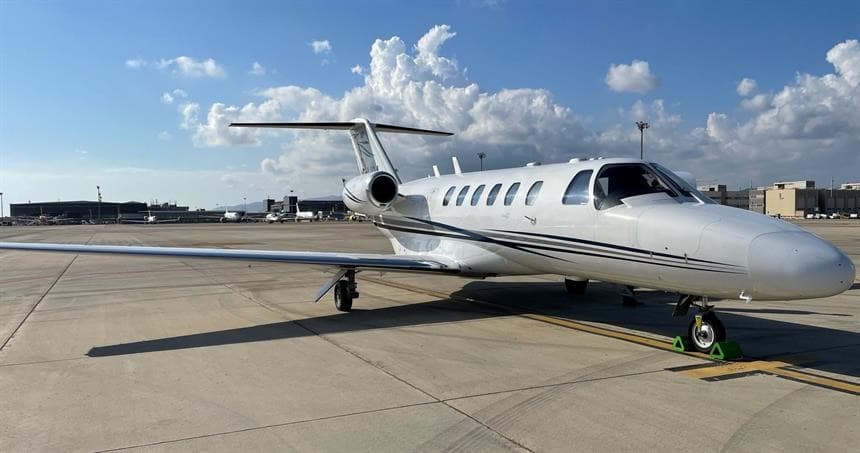
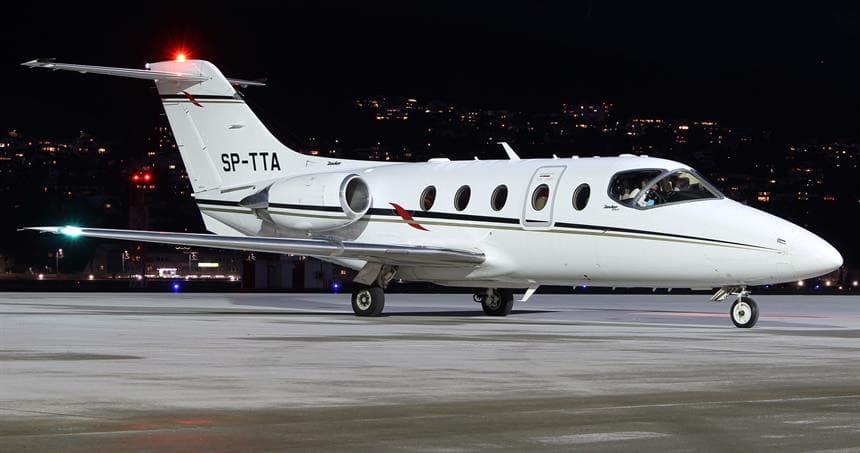
The light jet is squeezed from both sides: the class below is cheaper, the class above is taller. Six to eight seats, 2,400 to 3,000 km, around 770 km/h, from about €3,300 per flight hour, in two types — the Citation CJ2 and the Hawker 400XP. The case for the rung is specific: the CJ2's 2,990 km is the most range you can charter before the price steps up, and the 400XP's 1.49 m cabin is the widest at this money. What neither gives you is height: 1.45 m, the same as a very light jet, so nobody stands up. Book this class for reach and shoulder room, not for room to move. Avily Lux owns no aircraft — we charter both types through operators across Europe. Elsewhere the same class is called a small jet, or an entry-level light jet charter — the aircraft do not change with the label.
Who charters a light jet
Four to six people, a European leg of one to three and a half hours, and luggage that is cases rather than laptops. It gets booked when a very light jet runs out of seats, or when the destination moves from Geneva to Ibiza — London–Nice, Paris–Ibiza, Milan–Palma and Munich–Rome are the shape of the working week.
Inside the class the two aircraft answer different questions. The CJ2 is the one with range and airports: 2,990 km, certified to 45,000 ft, and field figures that open Cannes–Mandelieu and Sion. The 400XP is the one with width and speed: 1.49 m across, 4.75 m long, about 780 km/h, and part of its hold reachable in flight. Ask which tail is being quoted: the gap between them is wider than the gap to either neighbouring class.
Against the very light jets below and the super-lights above
Downward, a very light jet starts at about €2,800 — €500 less. That buys a sixth seat, a CJ2's 2,990 km against a CJ1's 2,000, about 90 km/h and a cabin nearly a metre longer. With four people under two hours none of it gets used, and we will say so.
Upward, the super-light class lists from €3,500 — only €200 more, and that flatters it. On specific tails our indicative rates run €3,000–3,100 for a CJ2 or a 400XP against €3,500–3,700 for a Citation XLS+, Phenom 300 or Pilatus PC-24: a real gap of €400 to €600 an hour. What it buys is range that survives a full cabin — a Phenom 300 gives up about 300 km with eight aboard, a CJ2 a third with six — and, on the XLS+, a 1.73 m cabin you can walk down. When the cabin will be full, that money is well spent.
What 2,400 to 3,000 km actually means
The band is measured at four passengers with IFR reserves, and this class loses more to a full cabin than any other. Cessna publishes a seats-full figure for the CJ2 of about 1,990 km against the 2,990 km headline: six adults with real luggage take a third off the brochure, because maximum payload is 669 kg and weight binds before volume.
The 400XP's 2,400 km behaves the same way. With seven aboard only a few hundred kilograms of payload remain at full fuel, so once the bags are real it is honestly a five- or six-seat aeroplane, and the sector shortens well inside 2,000 km. Read the class as a 2,900 km aircraft for four or five and a 2,000 km one for six: western Europe and the Mediterranean from a northern base, but not London–Athens with every seat sold.
What moves the price
From about €3,300 per flight hour. The lever specific to this class is which tail turns up: airport access varies more inside it than between neighbours. A CJ2 needs 1,024 m to take off at maximum weight and 908 m to land: Cannes–Mandelieu and Sion are comfortable, Samedan works with a summer density-altitude restriction, and the Citation CJ family is on London City's approved-type list, subject to the operator holding the approval. A 400XP needs about 1,430 m — Cannes and London City we will not promise from a spec sheet, and Samedan is out.
The rest is usual: positioning, normally the largest single line — if the nearest aircraft is in Milan and you leave from Luton, that empty leg is on the quote — crew duty on a long day, and the season at Nice, Ibiza and in the Alps. The 400XP's older JT15D engines also burn more, which is why an out-of-production airframe is not the cheap option.
Frequently asked questions
- Light jet or very light jet?
- About €3,300 an hour against €2,800. Stay below when four or five people fly under two hours with ordinary cases — a CJ1 does that trip and the extra never gets used. Step up when the sixth passenger is real, when the leg passes two and a half hours, or when you want Ibiza and Palma nonstop rather than at the edge of the fuel plan.
- Light jet or super-light?
- Two things separate them. Range with the cabin full: a Phenom 300 loses about 300 km with eight aboard, where a CJ2 loses a third of its headline with six. And height: the Citation XLS+ at 1.73 m is the first cabin you can stand up in. On specific aircraft the gap is €400 to €600 an hour, and if the cabin will be full it is worth it.
- Can six of us fly with skis or golf bags?
- The volume is there — about 1.98 m³ in a CJ2's nose and aft lockers — but the weight sheet is the real test, and with six adults plus full luggage the CJ2 becomes a 2,000 km aircraft. A 400XP is realistically five or six people once the bags are real, though part of its hold stays reachable in flight. Send the piece count and rough weights.
- Can I stand up, and is there a lavatory with a door?
- You cannot stand up: both cabins are 1.45 m high. Lavatories differ. The Hawker 400XP has an enclosed aft compartment with a door that also counts as a belted seat, taking the cabin to seven. The CJ2's sits at the aft end of the cabin and is usually screened by a curtain — it varies by serial number, so we confirm it on the aircraft we quote.