VIP airliner
Boeing BBJ
The flying private residence
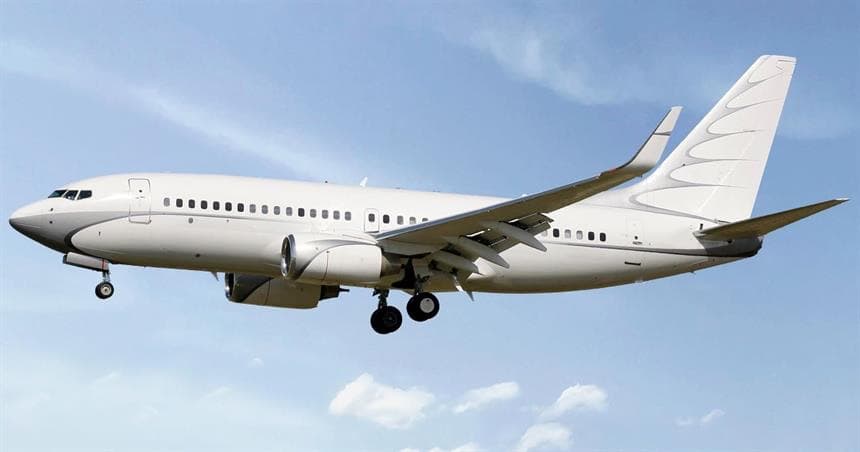
Estimated hourly rate — exact price on request.
- Passengers
- 19–50
- Range
- 11,100 km
- Cruise speed
- ≈ 870 km/h
- Max flight time
- ≈ 12 h
- Cabin length
- 24.1 m
- Cabin width
- 3.53 m
- Cabin height
- 2.16 m
- Aircraft length
- 33.63 m
Cruise speed is high-speed cruise. Manufacturers calculate range at the slower long-range cruise, with four passengers and NBAA IFR reserves — so a maximum-range leg takes longer than range ÷ speed, and a full cabin flies less far.
The Boeing Business Jet (BBJ) is built on the 737 and offers one of the largest private cabins available, fully customisable into bedrooms, dining and lounge areas. Seating around twenty-five in VIP comfort, it carries a large party intercontinentally with room to spare.
We don’t own the jets — we source them. With access to 4,500+ aircraft, we pick the exact tail that fits your route, your group and your budget. These are estimated from-prices per flight hour, to give you a sense of cost. Your exact quote depends on the aircraft, route and dates — just ask.
In detail
The Boeing BBJ in practice
The Boeing BBJ is a 737-700 fuselage carrying the wing, centre section and landing gear of the heavier 737-800, plus a row of auxiliary tanks in the belly where an airline would put cargo. That last detail settles most decisions about the type. The tank count is chosen once, at completion, and it fixes both the range and the baggage: our published 11,100 km is the nine-tank aircraft, and the same aircraft is left with 4.6 m³ of hold. Nineteen to fifty seats, 24.1 m of cabin, around 870 km/h, up to about twelve hours aloft. Charter starts from around €18,000 per flight hour, with the exact quote made against a named tail. Avily Lux owns no aircraft; we charter BBJs through operators in Europe and the Gulf.
Where it came from
Boeing and General Electric formed Boeing Business Jets as a joint venture in July 1996, at the instigation of Phil Condit and Jack Welch, with Borge Boeskov running the programme. The design idea was simple and is still the whole point of the aircraft: take the 737-700, the shortest of the Next Generation family, and give it the strengthened wing, centre section and landing gear of the 737-800, so that it can carry a very large fuel load a very long way instead of a full passenger load a short one. The first aircraft flew on 4 September 1998. Blended winglets from Aviation Partners became standard early in the run and added about 5% to range.
The variants follow the fuselage. The BBJ2 is the longer 737-800 at 39.5 m against this aircraft's 33.63 m, the BBJ3 is the 737-900ER, and current production is MAX-based. The original 737-700 aircraft — the one this page describes, and still what most European charter tails are — accounts for 113 deliveries. Boeing had taken 198 orders for 737-based BBJs of all variants and delivered 190 of them through December 2022.
One practical consequence of how they are built: a BBJ leaves Renton green and goes to a completion centre, where the interior takes a year or more. No two are the same inside. The floorplan is a question about the tail, never about the type.
Who charters a BBJ
Four profiles recur. Sports teams, where twenty-five or thirty people travel with kit and the kit is the difficult part. Corporate roadshows, where principals, deal team and equipment cover five cities in a week on one aircraft. Government and official delegations. And very large or multi-generational families who want a bedroom on a ten-hour sector.
None of them is buying range. A Global 6000 flies the same 11,100 km with thirteen seats from about €11,000 an hour, and a Global 7500 flies 14,260 km. What the BBJ sells is that the whole party fits in one hull, which is why the comparison a client actually makes is against two business jets on the same trip. Two aircraft mean two positioning legs at each end, two crews and two arrival times, and above about nineteen passengers the arithmetic stops being close. Between ten and sixteen it is genuinely worth pricing both ways, and we will.
The tank count is the aircraft
A BBJ can be fitted with three to ten auxiliary belly tanks, and the number is settled at completion and never changed afterwards. It is the first thing to establish about any tail you are quoted, because it decides two things at once.
Our published 11,100 km is the nine-tank aircraft: roughly 6,000 nm, about twelve hours, London to Los Angeles or Tokyo without stopping. That aircraft has 4.6 m³ of hold left, twenty to twenty-five cases, because the tanks are occupying the space the bags would use.
The commoner fit is five tanks. That aircraft flies roughly 10,000 km — still Europe to the Gulf, to most of the United States, to southern Africa — and keeps about 11.7 m³ of hold. For a team or a touring party the five-tank aircraft is usually the right answer, and the range given up is range the trip was never going to use. What you must not do is read the two fits as one aircraft.
Inside the cabin
24.1 m long, 3.53 m across and 2.16 m high, with around 75 m² of floor — more usable floor than anything else on this fleet. You walk it upright, and at that width it is laid out as rooms rather than as an aisle: forward galley and crew area, main lounge, a conference and dining zone, a private office, and an aft master bedroom with an en-suite shower. Operators market day and night floorplans for the same aircraft.
Two cabin attendants fly alongside the two pilots as standard; at this size meal service, cabin safety and turning the bedroom down all need someone. Cabin altitude is 8,000 ft in the cruise, an airliner figure rather than a business-jet one — a Global 7500 or a G650ER holds a much lower cabin, and after ten hours you notice. The BBJ's case is floor area and rooms, not pressurisation.
The corridors it flies, and the airports it cannot use
London–Dubai is about 6 h 45 m and the natural long sector for a full cabin. London–Larnaca is around 4 h 30 m. The short European legs — London–Nice at roughly 1 h 50 m, London–Barcelona about 2 h, London–Ibiza about 2 h 20 m — are flown on a BBJ for group size alone, never for range.
Airport choice is where an airliner costs you. This is a 737: it needs a scheduled-airliner runway, and its 35.79 m span puts it in ICAO Code C, so at a busy business-aviation field the binding constraint is often the stand rather than the pavement. Farnborough, Luton, Le Bourget, Geneva, Zurich, Nice, Istanbul and Dubai Al Maktoum are routine. London City is not: its 1,508 m runway and 5.5° approach admit only steep-approach-certified types, and no airliner qualifies. Cannes, Sion and the short island strips are out for the same reason, and handling, parking and landing fees are airline-scale throughout.
What moves the price
From around €18,000 per flight hour, and on an airliner the hourly rate is a smaller share of the total than it is on a business jet.
Positioning is the largest variable. A few dozen BBJs are on the charter market worldwide, most based in the Gulf or at a handful of European fields, so the empty leg to reach you can run several hours — and unlike a Challenger, there is rarely a nearer tail to substitute.
Crew duty is the second: two pilots and two attendants have to be rostered, and a long sector with a same-day return needs either a night stop or an augmented crew.
Then the ground. Airliner handling, parking and landing fees are not business-jet fees, Gulf routings carry overflight charges that intra-European legs do not, and at Nice in August the ramp space for a 737 is itself the scarce item. Every trip is quoted individually.
What it does well
- Around 75 m² of cabin floor across 24.1 m, laid out as separate rooms — the largest floor area of anything on this fleet.
- A 737-800 wing, centre section and landing gear under a 737-700 fuselage: with the nine-tank fit, 11,100 km and about twelve hours.
- A five-tank aircraft keeps about 11.7 m³ of hold — the answer when a team's kit rather than the distance is the reason for chartering.
- An aft master bedroom with an en-suite shower and two cabin attendants, so a ten-hour night sector is spent in a bed rather than a seat.
- Nineteen to fifty seats in one hull: one departure, one arrival, one party — against two business jets and two of everything.
Where it gives ground
- Range and baggage are the same decision. The 11,100 km aircraft has 4.6 m³ of hold, twenty to twenty-five cases, because the belly tanks are sitting in it.
- Cabin altitude is 8,000 ft, an airliner figure. A Global 7500 or a G650ER holds a far lower cabin, and after ten hours that is the difference you feel.
- It needs airliner runways and airliner stands. London City, Cannes, Sion and the short island strips are out, and handling costs are airline-scale.
The Boeing BBJ against the alternatives
- Airbus ACJ31919–50 · 8,150–9,630 km
The direct rival: the same nineteen-seat charter layouts, the same 35.8 m span and Code C handling, the same airport list. The Airbus's range is set by its centre tanks exactly as the BBJ's is set by belly tanks, so compare the two specific aircraft on offer rather than the badges.
- Bombardier Global 750017 · 14,260 km
When the group turns out to be twelve rather than twenty-five. 14,260 km against 11,100, seventeen seats, about €14,000 an hour, a far lower cabin altitude and an airport list that includes fields no 737 can use. You give up the floor area and the rooms.
- Gulfstream G650ER16 · 13,890 km
The choice for a smaller party on a long sector where the clock matters: 13,890 km at around 900 km/h with sixteen seats. No BBJ-style bedroom suite or shower, but business-jet airports, business-jet handling and a lower hourly rate.
Routes the Boeing BBJ flies
- London → Dubai6h 50mfrom €60,500
- London → Larnaca4h 30mfrom €22,000
- London → Nice1h 40mfrom €9,500
- London → Ibiza2h 30mfrom €12,400
- London → Barcelona2h 10mfrom €11,000
Flight times are typical for this type with a full cabin. Headwinds, payload and slot restrictions move them.
Boeing BBJ charter — frequently asked questions
- How many passengers does a BBJ actually take?
- Charter tails run from about sixteen to fifty, and nineteen is the commonest VIP layout — nineteen seats leave floor area for a master suite and an office. The certified maximum is far higher but nobody charters one configured that way. The floorplan is set per aircraft at completion, so we send you the layout of the specific tail.
- Why is the baggage figure so small for such a large aircraft?
- Because the auxiliary fuel tanks are in the hold. The nine-tank aircraft that flies 11,100 km has 4.6 m³ left, roughly twenty to twenty-five cases. A five-tank aircraft keeps about 11.7 m³ and flies roughly 10,000 km. If the luggage is the reason you are chartering an airliner, tell us and we will find the tail with the tanks out.
- Is one BBJ cheaper than two business jets?
- Above about nineteen passengers, usually yes, once you count two positioning legs at each end, two crews and two sets of handling. Between ten and sixteen it is genuinely close, and a Global 7500 or G650ER may win on hourly rate and airport access. We price both and show you the two quotes side by side.
- Can it land at Nice, or at London City?
- Nice, Geneva, Zurich, Farnborough, Luton, Le Bourget and Dubai Al Maktoum all handle a BBJ as routine, though parking in peak season needs booking early. London City cannot: its 1,508 m runway and 5.5° approach are restricted to steep-approach-certified types, and no airliner is one. Cannes and Sion are out for the same reason.
Specifications
Full technical sheet
General
- Manufacturer
- Boeing
- Category
- VIP airliner
- ICAO designator
- B737
- Flight crew
- 2
Performance
- Range (IFR reserves)
- 11,100km
- Range (nautical miles)
- 6,000nm
- Cruise speed (high-speed)
- ≈ 870km/h
- Max operating Mach (MMO)
- M 0.82
- Max operating speed (VMO)
- 340KIAS
- Service ceiling
- 41,000ft
- Cabin altitude
- 8,000ft
- Max flight time
- ≈ 12h
Powerplant and avionics
- Engine type
- Turbofan
- Engines
- 2 × CFM International CFM56-7B27
- Thrust per engine
- 27,300lbf
Dimensions and capacity
- Aircraft length
- 33.63m
- Aircraft height
- 12.57m
- Wing span
- 35.79m
- Cabin length
- 24.1m
- Cabin width
- 3.53m
- Cabin height
- 2.16m
- Baggage volume
- 4.6m³
- Seats (charter layout)
- 19–50
- Suitcases
- 20–25
- Max payload
- 14,256kg
- Max takeoff weight (MTOW)
- 77,564kg
- Max landing weight (MLW)
- 60,781kg
- Fuel capacity
- 40,482L
Manufacturer and type-certificate figures, verified field by field. A line we could not source is left out rather than filled with a plausible number.
Gallery