VIP airliner
Airbus ACJ319
Airliner space, private cabin
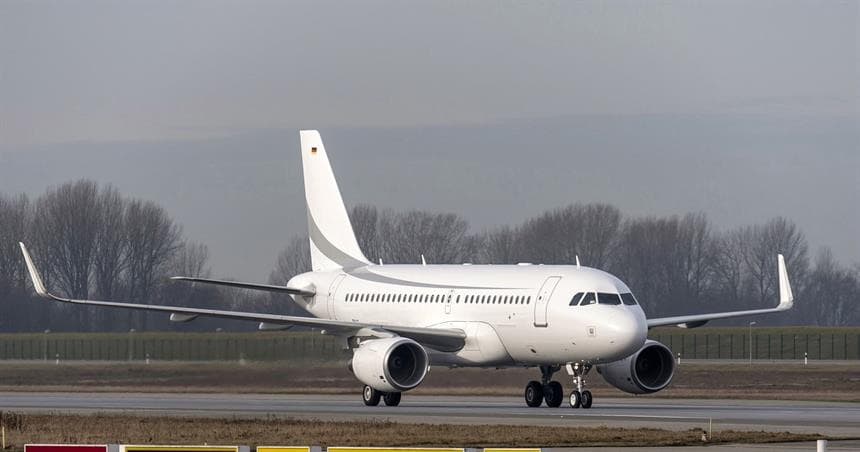
Estimated hourly rate — exact price on request.
- Passengers
- 19–50
- Range
- 8,150–9,630 km
- Cruise speed
- ≈ 870 km/h
- Max flight time
- ≈ 11 h
- Cabin length
- 23.8 m
- Cabin width
- 3.70 m
- Cabin height
- 2.25 m
- Aircraft length
- 33.84 m
Cruise speed is high-speed cruise. Manufacturers calculate range at the slower long-range cruise, with four passengers and NBAA IFR reserves — so a maximum-range leg takes longer than range ÷ speed, and a full cabin flies less far.
The Airbus ACJ319 is a corporate jet built on the A319 airliner, offering a huge stand-up cabin that can be configured with a bedroom, office and lounge. Typically seating around nineteen VIP passengers, it delivers intercontinental range with the space of a small home.
We don’t own the jets — we source them. With access to 4,500+ aircraft, we pick the exact tail that fits your route, your group and your budget. These are estimated from-prices per flight hour, to give you a sense of cost. Your exact quote depends on the aircraft, route and dates — just ask.
In detail
The Airbus ACJ319 in practice
The ACJ319 is a corporate Airbus A319 — an airliner fuselage with a private interior — and it is chartered when the size of the party, not the distance, is the problem. Nineteen seats across the European charter fleet, a cabin 23.8 m long, 3.70 m wide and 2.25 m tall, about 870 km/h, and a range published here as a band: 8,150 to 9,630 km. The band is the fact to understand first. An ACJ319's range is set by how many auxiliary centre tanks its owner specified when the aircraft was completed, and Airbus publishes the figure tail by tail rather than as one number. From around €16,000 per flight hour, exact quote on request. Avily is a broker and owns no aircraft, which on this type matters more than usual: you are choosing a tail, not a model.
Where it came from
The A319 first flew from Hamburg on 25 August 1995, was type-certified in April 1996 and entered service with Swissair that same month — a shortened A320 built for thinner routes. Airbus launched the corporate version, then called the A319CJ, at the 1997 Paris Air Show. The first airframe rolled out of Hamburg in October 1998 and the first aircraft was delivered in November 1999.
The premise has not changed since. Take an airliner that is already in production and already certified, add removable auxiliary centre tanks to turn a short-haul aeroplane into an eleven-hour one, and let a completion centre build whatever interior the customer wants inside a fuselage 3.70 m wide. Because the conversion is deliberately minimal, an ACJ can be returned to airline configuration, which is part of why the type holds its value and why so many airframes have had more than one life. By 2019 a little over 200 Airbus corporate jets were in service worldwide.
The re-engined ACJ319neo came later, with the first completed example handed over in 2020. It is a genuinely different aircraft: Airbus quotes 6,750 nm / 12,500 km for it with eight passengers, which is where the 12,500 km figure attached to ACJ319 listings comes from. The aircraft on the European charter market are ceo airframes, and this page describes those.
Who charters an ACJ319, and against what
Four profiles recur: sports teams, corporate roadshows where the kit and the working party travel with the principals, government and delegation flying, and large or multi-generational families. Touring productions are the fifth. What they have in common is that nineteen people, their crew and a genuine quantity of baggage have to arrive together.
The honest alternative is not another airliner — it is two ultra-long-range jets flying in parallel, which usually costs more, splits the party across two cabins and gives you two arrival times. Against a Boeing BBJ the envelope is nearly identical and the choice comes down to the individual aircraft. Against an Embraer Lineage 1000E you get a wider cabin and more floor area for a higher hourly rate. Against a G650ER the airliner wins only on floor area and baggage: below about twelve passengers the jet is faster, cheaper per hour, longer-legged and welcome at more airports.
The tank trade: why the range is a band
An ACJ319 takes up to six additional centre tanks, and each one is fitted at completion and stays for the life of the interior. Airbus's own tail pages show what that does. One charter ACJ319 is published at 4,400 nm / 8,150 km and up to ten hours; another at 4,600 nm / 8,520 km; a third at 5,200 nm / 9,630 km and eleven hours plus. Same type, same photograph, a fifth more range.
The tanks are paid for out of the hold, so the trade runs the other way too: Airbus lists 21 suitcases for one of those aircraft and 80 to 100 for another. That is why our spec sheet publishes no single baggage figure for this type — any number would be wrong for most tails. If you have seen 12,500 km quoted for an ACJ319, that is the re-engined ACJ319neo's figure, quoted by Airbus at eight passengers. It is a different aircraft.
The cabin: rooms, not zones
23.8 m of cabin, 3.70 m wide and 2.25 m tall. The height is the part a business-jet passenger notices first: everyone stands upright everywhere, including in the doorways and the lavatories, and nothing about the cabin is a compromise around a fuselage that was drawn for eight people.
A full-specification ACJ319 is laid out as rooms — a forward lounge, a conference and dining area with a table you can genuinely work at, a private office, and an aft master bedroom with an en-suite shower, plus two or three lavatories. Day and night configurations are usually offered on the same aircraft. Two pilots fly it and two or three cabin crew work the cabin. The 19–50 span on the spec table is a certification range rather than a menu: the European charter fleet is uniformly nineteen, because above that count the crewing and regulatory treatment change and the floor area a master suite needs disappears.
Airports: what an airliner does to the choice
The wingspan is 35.80 m and the maximum takeoff weight 75,500 kg, which puts the aircraft in ICAO Code C and into airliner handling. Farnborough, Luton, Stansted, Le Bourget, Geneva, Zurich, Nice, Vienna, Barcelona, Larnaca, Istanbul and Dubai Al Maktoum all work. London City does not: 1,508 m of runway and a 5.5° glidepath, the steepest in the UK, restrict it to steep-approach types, and no airliner qualifies. Alpine and island short strips are out for the same reason.
At busy business-aviation airports the binding constraint is usually stand availability rather than runway length — an aircraft this size needs a stand that exists and is free, which is a booking question we handle early. Block times on this site: London–Dubai a little over seven hours, London–Larnaca about 4h 30m, London–Nice around 1h 45m, London–Geneva 1h 30m, London–Barcelona about 2h 15m.
What moves the price
From around €16,000 per flight hour, and on this type the hourly rate is a smaller part of the answer than usual. There are few ACJ319s in Europe, so positioning can mean a genuine ferry rather than a short hop, and it is on the quote at both ends.
Everything on the ground is priced as an airliner. Landing, parking and handling scale with a 75,500 kg maximum takeoff weight, and parking a Code C aircraft for a week at a Riviera airport in August is a line item people do not expect. Crew is five or so — two pilots and two or three cabin crew — with hotels and duty limits attached; catering is to a real menu rather than a tray. Then slots, night curfews at business airports, overflight charges across several countries, and the calendar: fixture lists, tournament weeks, the Gulf season, Cannes in May. Every trip is quoted individually.
What it does well
- 23.8 m of cabin, 3.70 m wide and 2.25 m tall: full standing height throughout, laid out as separate rooms rather than zones.
- A master bedroom with an en-suite shower, a conference and dining area, and a private office on the same aircraft.
- Nineteen passengers, their cabin crew and a touring party's baggage arrive together, instead of splitting across two business jets.
- Airbus publishes range tail by tail, so the figure you are quoted belongs to the aircraft you are getting rather than to the model.
- On a tail specified with fewer centre tanks, Airbus lists 80 to 100 suitcases of hold capacity — no business jet is close.
Where it gives ground
- Range and baggage both depend on the auxiliary-tank fit, chosen once at completion. A 4,400 nm tail and a 5,200 nm tail carry the same name and look identical in the photographs.
- London City is out — 1,508 m of runway and a 5.5° glidepath — and so are alpine and island short strips. The 35.80 m wingspan means Code C handling, so stand availability at a busy business airport is often the real constraint.
- At around €16,000 an hour and about 870 km/h it is the slowest and most expensive way to move fewer than about twelve people; below that count a large business jet wins on everything except floor area.
The Airbus ACJ319 against the alternatives
- Boeing BBJ19–50 · 11,100 km
The direct equivalent, with the same 35.8 m span and the same airport envelope. Its range is set the same way, by belly tank count rather than centre tanks, and a well-tanked BBJ reaches 11,100 km. Quote both and compare the individual aircraft, because the type difference is smaller than the tail difference.
- Embraer Lineage 1000E19 · 8,500 km
When the party is twelve to sixteen rather than nineteen. An E190 derivative, narrower at 2.74 m but 25.9 m long with up to five zones, a shower and an in-flight-accessible hold — and it works from regional fields that suit an A319 less well, at a lower hourly rate.
- Gulfstream G650ER16 · 13,890 km
When a jet beats an airliner. Under about twelve passengers the G650ER is faster, reaches 13,890 km against the ACJ's 8,150–9,630, costs less per hour, and gets into airports and stands an A319 cannot use. You give up floor area, the bedroom-and-shower layout and the hold.
Routes the Airbus ACJ319 flies
- London → Dubai6h 50mfrom €60,500
- London → Larnaca4h 30mfrom €22,000
- London → Nice1h 40mfrom €9,500
- London → Geneva1h 25mfrom €7,600
- London → Barcelona2h 10mfrom €11,000
Flight times are typical for this type with a full cabin. Headwinds, payload and slot restrictions move them.
Airbus ACJ319 charter — frequently asked questions
- Why is the range shown as a band rather than one number?
- Because Airbus publishes it that way, tail by tail. An ACJ319 takes up to six additional centre tanks, fitted at completion, and charter aircraft carry different numbers of them: Airbus's own pages show 4,400 nm, 4,600 nm and 5,200 nm for what is nominally the same type. We confirm the figure for the specific aircraft before quoting.
- How much baggage can it take?
- It depends on the same tank fit, which is why we publish no single figure. The centre tanks eat hold volume, so Airbus lists around 21 suitcases for one charter ACJ319 and 80 to 100 for another. If the trip is baggage-driven — a team, a tour, a shoot — send the manifest and we will match it to a tail.
- Which airports can it use, and is London City possible?
- London City is not possible: 1,508 m of runway and a 5.5° glidepath restrict it to steep-approach types, and no airliner qualifies. Farnborough, Luton, Stansted, Le Bourget, Geneva, Zurich, Nice, Vienna, Barcelona, Larnaca, Istanbul and Dubai Al Maktoum are all routine. Stand availability, not runway length, is usually what we check first.
- One ACJ319 or two long-range business jets?
- Nineteen people with real baggage generally cost less on one airliner than on two ultra-long-range jets, and everyone arrives at the same time in the same cabin. Below about twelve passengers the arithmetic flips: a single G650ER or Global 6000 is faster, cheaper per hour and welcome at more airports.
Specifications
Full technical sheet
General
- Manufacturer
- Airbus
- Category
- VIP airliner
- ICAO designator
- A319
- Flight crew
- 2
Performance
- Range (IFR reserves)
- 8,150–9,630km
- Range (nautical miles)
- 4,400–5,200nm
- Cruise speed (high-speed)
- ≈ 870km/h
- Long-range cruise
- 828km/h
- Max operating Mach (MMO)
- M 0.82
- Max operating speed (VMO)
- 350KIAS
- Service ceiling
- 41,000ft
- Max flight time
- ≈ 11h
Powerplant and avionics
- Engine type
- Turbofan
- Engines
- 2 × CFM International CFM56-5B7/P
- Thrust per engine
- 27,000lbf
Dimensions and capacity
- Aircraft length
- 33.84m
- Aircraft height
- 11.76m
- Wing span
- 35.80m
- Cabin length
- 23.8m
- Cabin width
- 3.70m
- Cabin height
- 2.25m
- Seats (charter layout)
- 19–50
- Max takeoff weight (MTOW)
- 75,500kg
- Max landing weight (MLW)
- 62,500kg
- Fuel capacity
- 32,287L
Manufacturer and type-certificate figures, verified field by field. A line we could not source is left out rather than filled with a plausible number.
Gallery