Super-midsize jet
Cessna Citation Sovereign
Long-legged and easy on runways
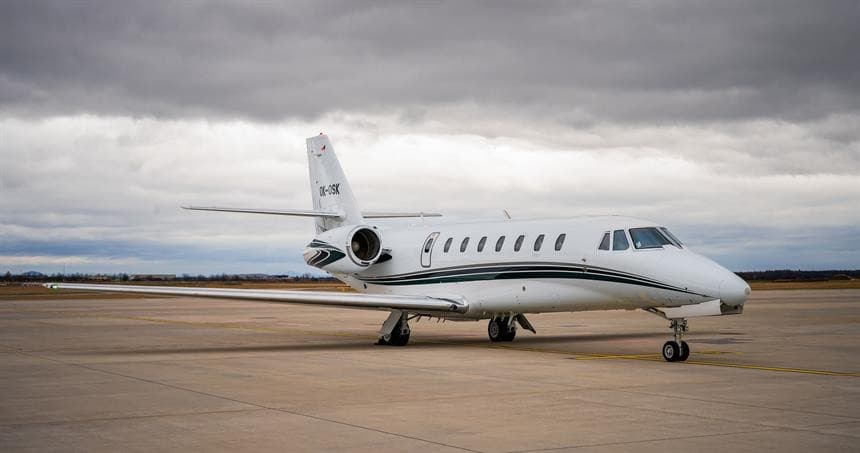
Estimated hourly rate — exact price on request.
- Passengers
- 9
- Range
- 5,300 km
- Cruise speed
- ≈ 825 km/h
- Max flight time
- ≈ 6 h
- Cabin length
- 7.70 m
- Cabin width
- 1.68 m
- Cabin height
- 1.73 m
- Aircraft length
- 19.35 m
Cruise speed is high-speed cruise. Manufacturers calculate range at the slower long-range cruise, with four passengers and NBAA IFR reserves — so a maximum-range leg takes longer than range ÷ speed, and a full cabin flies less far.
The Cessna Citation Sovereign offers a spacious stand-up cabin and impressive short-field performance for a jet of its size. Seating up to nine, it flies transcontinental legs while still using airports larger jets must skip.
We don’t own the jets — we source them. With access to 4,500+ aircraft, we pick the exact tail that fits your route, your group and your budget. These are estimated from-prices per flight hour, to give you a sense of cost. Your exact quote depends on the aircraft, route and dates — just ask.
In detail
The Cessna Citation Sovereign in practice
The Citation Sovereign is the value entry to the super-midsize class: nine seats, a 7.70 m cabin, around 825 km/h and a published 5,300 km, from about €5,200 per flight hour, the cheapest hour in the class. Two facts settle most decisions about it. It has the best short-field performance of the class, 1,109 m at maximum take-off weight, which opens Cannes, Sion and Samedan. And its headline range is measured on a different basis from its rivals', so a side-by-side table flatters it: with a full cabin the honest figure is nearer 4,600 to 4,800 km. Exact quote on request. Avily does not own aircraft; we charter across a large operator network.
Where it came from
Cessna announced the Sovereign at the NBAA convention in 1998, to replace a Citation III / VI / VII line that was ageing out of the midsize market. The brief named its targets: the range of a Hawker 800, the climb of a Learjet 60, better runway performance than either, and the longest cabin Cessna had built.
The prototype first flew in February 2002. The FAA certified the type on 2 June 2004 and the first aircraft went to its owner at the end of that September. It brought a new fuselage, a moderately swept wing, two Pratt & Whitney Canada PW306C engines and a Honeywell Primus Epic flight deck.
Production ran to 2013 and 349 were built, which is why the type is plentiful and inexpensive on the charter market today: a large European fleet, mature maintenance, no scarcity premium. What it is not is a modern airframe: interiors vary widely from tail to tail, connectivity is inconsistent, and the cabin cross-section and pressurisation belong to their decade. Ask which aircraft rather than which model — we do.
Who charters a Citation Sovereign
The usual booking is seven to nine people who want a super-midsize sector at the lowest hourly rate in the class: a working group to Cyprus, a family moving to the Riviera for August with a season's luggage, a party heading to Ibiza.
Against the Challenger 350 it saves about €700 an hour and gives up cabin width — 1.68 m against 2.19 — baggage access in flight and around 1,000 km of usable range. Against the Citation Latitude one class down, it buys a metre of cabin and a ninth seat, and loses the flat floor and the standing height.
What the 5,300 km actually means
This is the number to understand before booking. Cessna publishes 2,847 nm — 5,273 km — and the basis matters more than the figure: it is flown with full fuel at maximum take-off weight, to NBAA IFR reserves with a 200 nm alternate. Payload with full fuel is 543 kg, which is five or six adults with light bags, not nine.
Bombardier and Embraer quote their ranges differently: four passengers with NBAA IFR reserves. Our class page lists all of them side by side, and that comparison flatters the Sovereign, because its number is the only one measured with the tanks full. With nine aboard and their luggage you offload roughly 270 to 320 kg of fuel and lose 450 to 650 km. Plan on 4,600 to 4,800 km. It is a European, Middle East and North African aeroplane, and it is not transatlantic.
The cabin, the bags and the lavatory
The cabin is 7.70 m long, second only to the Embraers in this class, and seats nine in a double club with room to work. The other two numbers matter more: 1.68 m of width, the narrowest in the class, and 1.73 m of height that exists only in a trenched centre aisle. The floor is not flat and most adults will not stand upright. Said here it is a non-issue; discovered on board it is a complaint.
The aft lavatory is fully enclosed behind a solid door and serviced from outside. Baggage is 3.82 m³, the largest raw volume in the class, but roughly 2.8 m³ of it is external and sealed in flight; about 1 m³ inside the cabin is not. Cabin altitude is around 7,230 ft at the 47,000 ft ceiling — the highest in the class, and you notice it on a five-hour sector.
Where it flies, and the airports it can use
With the cabin full and no fuel stop: London to Geneva about 1h 25m, London to Nice 1h 40m, London to Barcelona 2h 10m, London to Ibiza 2h 30m, London to Larnaca 4h 30m. Paris to Cairo and Milan to Riyadh also sit inside the realistic full-cabin figure. London to Dubai, at 5,500 km, does not — not with nine aboard. Light it goes, and we will say which case you are in.
Runways are the quiet advantage: 1,109 m to take off at maximum weight and 808 m to land, the best in the class. Cannes-Mandelieu at 1,610 m, Sion and Ibiza are comfortable, and Samedan suits it well on payload, subject to seasonal limits and the mandatory crew briefing. London City is the exception — no steep-approach approval is published for the Sovereign, so plan on Farnborough, Luton or Biggin Hill.
What moves the price
From around €5,200 per flight hour, and four things move that number.
Positioning: the aircraft is rarely where you are, and the empty legs flown to collect you and return to base are part of the quote — which is why a same-day return usually beats two one-ways. Crew duty: a same-day Larnaca return can push a two-pilot crew past its legal limit, and the answer is a night stop or a second crew, both of which cost money. Season: Nice in July, Geneva in ski season, Cannes during the festival, when slots, parking and handling move together. And the individual aircraft: across a fleet built between 2004 and 2013, interior condition, connectivity and crew differ tail by tail, and so do the rates.
What it does well
- The lowest hourly rate in the super-midsize class, from around €5,200 against €5,900 for a Challenger 350.
- 1,109 m to take off at maximum weight and 808 m to land — the best field performance in the class, which puts Cannes, Sion and Samedan in reach.
- A 7.70 m cabin seating nine, second only to the Embraers in this class for length.
- A large, mature European fleet, so a trip normally draws several competing tails rather than a single offer.
Where it gives ground
- The 5,300 km headline is a full-fuel-at-MTOW figure with only 543 kg of payload — five or six people. With nine aboard, plan 4,600 to 4,800 km.
- Not a stand-up cabin: 1.73 m measured in a trenched aisle over a floor that is not flat, and 1.68 m wide, the narrowest in the class.
- No published steep-approach approval, so London City is out, and about 2.8 m³ of the 3.82 m³ hold is external and unreachable in flight.
The Cessna Citation Sovereign against the alternatives
- Cessna Citation Latitude8 · 5,000 km
One class down and about €600 an hour cheaper, and the better answer for eight people who want to stand up and walk about: a flat floor at 1.83 m, and steep-approach certification for London City. You give up the ninth seat and a metre of cabin.
- Bombardier Challenger 3509 · 5,900 km
Worth the extra €700 an hour whenever the cabin is full and the sector is long. 2.19 m wide, 1.83 m of stand-up height over a flat floor, baggage you can reach in flight, and 5,900 km that survives a full load.
- Embraer Legacy 5008 · 5,800 km
The choice when the flight is the working part of the day: 8.38 m of flat-floor cabin at 1.82 m, in-flight baggage access and 5,800 km, for around €5,500 per hour.
Routes the Cessna Citation Sovereign flies
- London → Geneva1h 25mfrom €7,600
- London → Nice1h 40mfrom €9,500
- London → Barcelona2h 10mfrom €11,000
- London → Ibiza2h 30mfrom €12,400
- London → Larnaca4h 30mfrom €22,000
Flight times are typical for this type with a full cabin. Headwinds, payload and slot restrictions move them.
Cessna Citation Sovereign charter — frequently asked questions
- How far does a Sovereign really go with nine people?
- Plan on 4,600 to 4,800 km. Cessna's 5,273 km is quoted with full fuel at maximum take-off weight, where payload is 543 kg — five or six adults. Filling all nine seats means offloading roughly 270 to 320 kg of fuel, which costs 450 to 650 km. London to Larnaca is comfortable; London to Dubai with a full cabin is not.
- Can I stand up in the cabin?
- No. The published 1.73 m is measured in a trenched centre aisle, the floor is not flat, and at 1.68 m the cabin is the narrowest in the class. It is a comfortable seated cabin with a long double club and real work space, but if standing and walking matter, the Citation Latitude or a Challenger 350 is the aircraft.
- Can it land at London City?
- Often yes, but only after we check the tail. Steep-approach certification exists for the Sovereign (FAA and EASA, 2017), and London City's own approved-aircraft list carries Sovereigns from several European operators. Not every aircraft flying holds the approval, though, and the operator must hold it too — we confirm both before quoting LCY. If the specific tail cannot be confirmed, plan on Farnborough, Luton or Biggin Hill, or take a Citation Latitude, where the approval is standard fit.
- Is there Wi-Fi on board?
- Often not usable in Europe. Sovereign tails typically carry Gogo Biz, which works over North America only, or a SwiftBroadband system that is slow by current standards; many European aircraft have nothing at all. This is a per-tail question rather than a per-type one, and we confirm it before quoting if connectivity matters.
Specifications
Full technical sheet
General
- Manufacturer
- Cessna (Textron Aviation)
- Category
- Super-midsize jet
- ICAO designator
- C680
- Production
- 2004–2013
- Flight crew
- 2
Performance
- Range (IFR reserves)
- 5,300km
- Range (nautical miles)
- 2,847nm
- Cruise speed (high-speed)
- ≈ 825km/h
- Long-range cruise
- 709km/h
- Max operating Mach (MMO)
- M 0.80
- Max operating speed (VMO)
- 305KIAS
- Approach speed
- 104kts
- Takeoff distance (balanced field)
- 1,109m
- Landing distance
- 808m
- Service ceiling
- 47,000ft
- Cabin altitude
- 7,230ft
- Max flight time
- ≈ 6h
Powerplant and avionics
- Engine type
- Turbofan
- Engines
- 2 × Pratt & Whitney Canada PW306C
- Thrust per engine
- 5,770lbf
- Avionics
- Honeywell Primus Epic
Dimensions and capacity
- Aircraft length
- 19.35m
- Aircraft height
- 6.20m
- Wing span
- 19.30m
- Cabin length
- 7.70m
- Cabin width
- 1.68m
- Cabin height
- 1.73m
- Baggage volume
- 3.82m³
- Seats (charter layout)
- 9
- Seats (max certified)
- 12
- Suitcases
- 8
- Carry-on bags
- 9
- Max payload
- 1,211kg
- Max takeoff weight (MTOW)
- 13,743kg
- Max landing weight (MLW)
- 12,292kg
- Fuel capacity
- 6,341L
Manufacturer and type-certificate figures, verified field by field. A line we could not source is left out rather than filled with a plausible number.
Gallery