Southern Europe
Private jet charter to Athens
A 24-hour airport with no curfew, and the mainland gateway to the Cyclades.
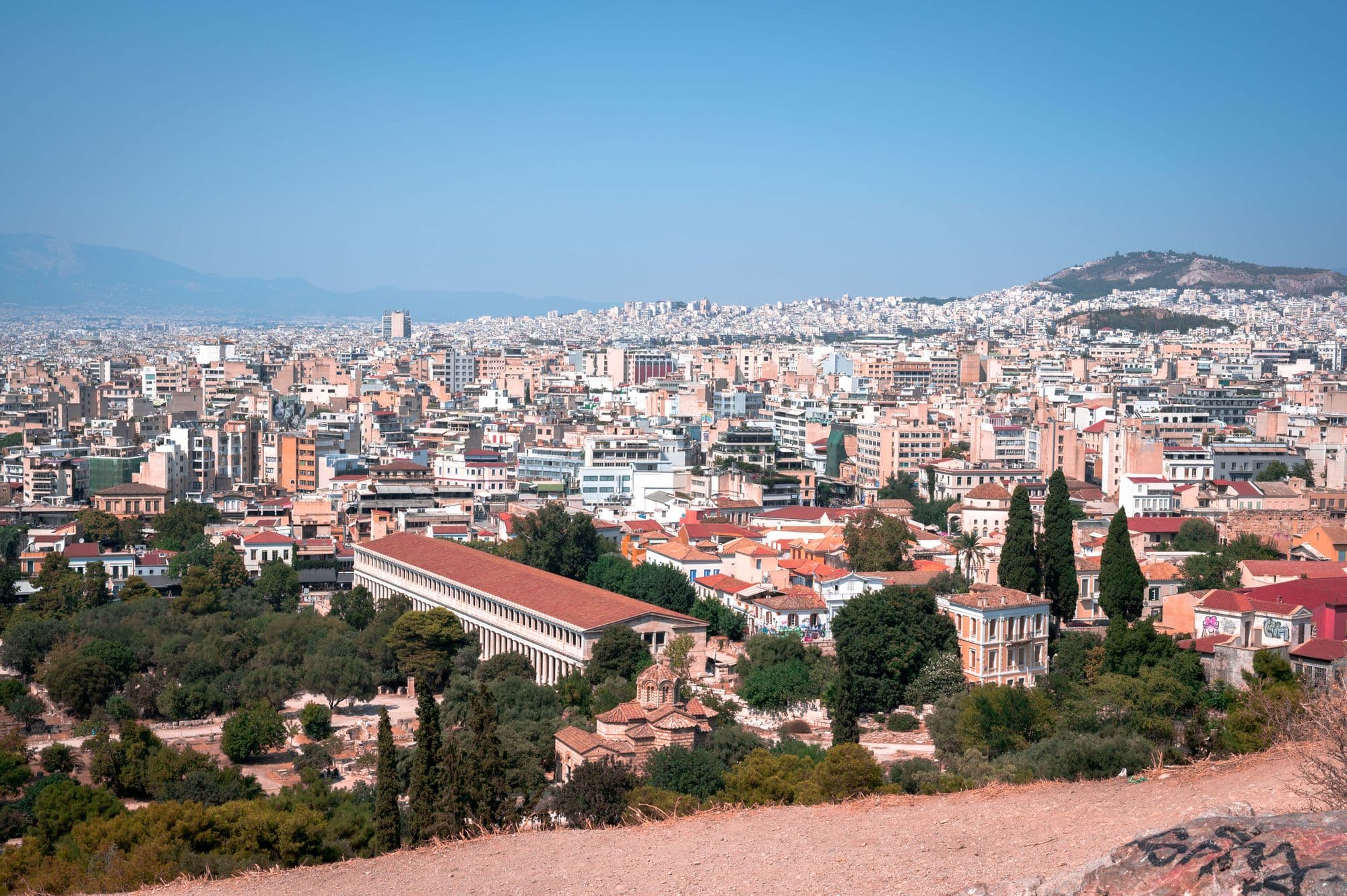
Athens is two arrivals in one airport. For some it is the destination — shipping, a board meeting in Piraeus, a week in the city and on the coast below it. For most of the summer traffic it is the hinge: the last place with a 24-hour runway, a full handling operation and no curfew before the trip turns into a forty-minute sector out to Mykonos, Paros or Santorini. Both versions land at the same general-aviation terminal, and the same ninety-minute parking rule applies to both.
How much does a private jet to Athens cost?
A private charter to Athens starts from around ~€14,850, depending on your departure point, the aircraft and the season.
- Nice Athens
- from ~€14,850
- Geneva Athens
- from ~€17,400
- Paris Athens
- from ~€21,550
Estimated one-way charter for the whole aircraft. The exact price depends on the aircraft and date, and is always quoted on request.
Popular routes from Athens
Where our clients fly from Athens — each corridor has its own guide to airports, flight time and cost.
Best airports for Athens
- ATH · Athens Eleftherios VenizelosThe only field a business jet uses in Athens; 24 hours, no curfew, separate general-aviation terminal
- 20 km
Which aircraft suit flights to Athens?
A few aircraft we regularly arrange for this route — your advisor will match the best option to your group and range.
| Aircraft | Passengers | Range | Cruise speed |
|---|---|---|---|
| Embraer Phenom 300 | 8 | 3,650 km | ≈ 840 km/h |
| Bombardier Challenger 350 | 9 | 5,900 km | ≈ 850 km/h |
| Embraer Praetor 600 | 9 | 7,400 km | ≈ 865 km/h |
What a private flight to Athens costs
Indicatively, from about €14,850 one way from Nice, €17,400 from Geneva and €21,550 from Paris, for the whole aircraft. The spread follows the flying: 2 hours 40 minutes, 2 hours 55 and 3 hours 20 respectively, so the longest leg carries the most hourly rate and the cabin you choose moves the number more than the date does. Two things add to that base rather than scaling it. The first is ground time: Athens gives a business jet ninety minutes free, and past that the aircraft usually leaves and comes back, which puts two repositioning legs in the quote. The second is the onward sector, if the trip continues to an island — it is a separate leg, it has its own slot, and it should be priced with the first one rather than after it. Every trip is quoted individually; these are starting points, not live prices.
Which airport a private arrival uses
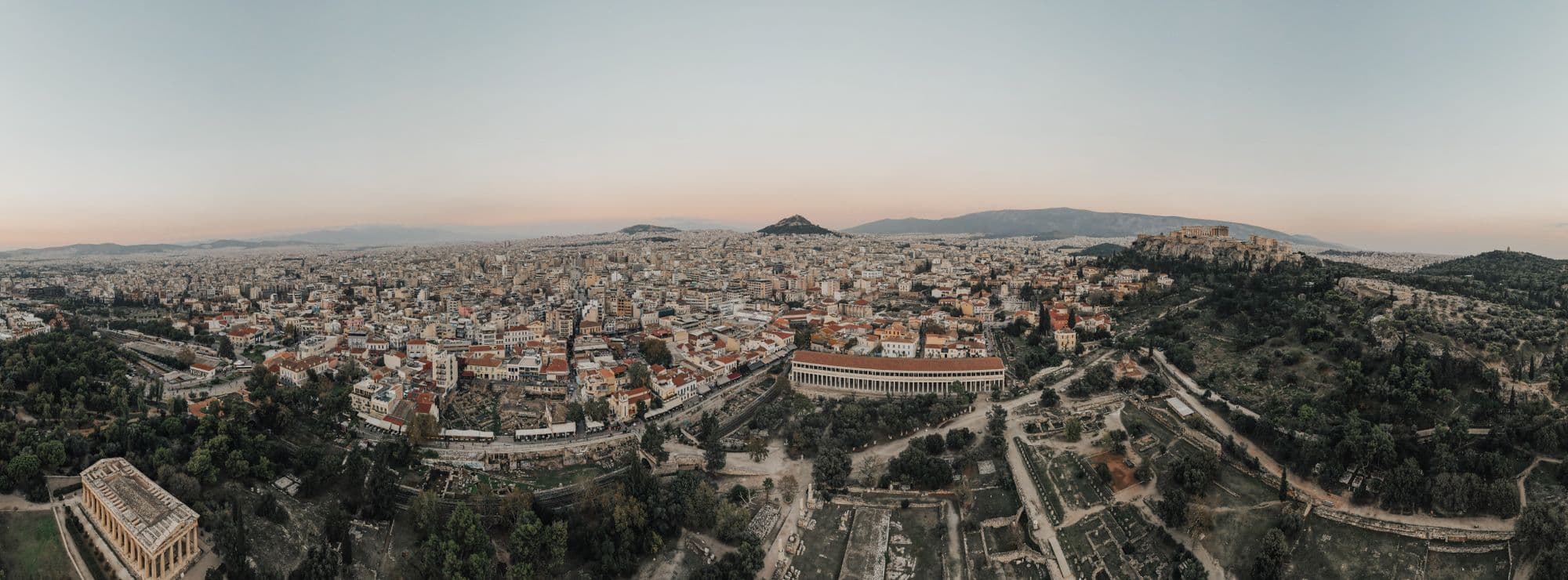
Athens Eleftherios Venizelos (ATH), and there is no alternative to weigh up. The old Hellinikon closed on the day the current airport opened in March 2001 and nothing replaced it, so unlike London, Paris or Milan, Athens offers no second field for a business jet and no near-in option to trade against a far-out one. What you get instead is a capital-city airport that behaves unusually well for private traffic. It sits at Spata, about 20 km east of the centre as the crow flies and roughly 30 km by road because of the hills between, on two parallel runways of 4,000 m and 3,800 m. It operates 24 hours a day with no night curfew — which is rarer in Europe than it sounds, and is the single most useful fact on this page for anyone planning an evening. Customs and immigration are on the field around the clock.
The general-aviation terminal, and the real time to a car
Private flights are handled through the airport's general-aviation terminal — a separate building with its own apron rather than a roped-off corner of the main hall. A dozen handlers work the field, among them Signature, Goldair Handling, Skyserv, Swissport Hellas and Universal Aviation, and the car is brought to the aircraft. Arriving from Nice, Geneva or Paris there is no passport control at all, because all three are inside the Schengen area, so the time from wheels-down to moving is a handful of minutes rather than the ten to fifteen a border adds. From outside Schengen, passports are checked and that figure goes up. Then the road does the rest: the Attiki Odos motorway runs from the airport to the city, and the centre is normally a 35 to 45 minute drive outside the rush, with Piraeus and the coast further. Avily owns no aircraft and no terminals — the handler is named on your confirmation.
The weeks that set the price
August is not a busy fortnight here, it is a busy month, and the fifteenth — the Assumption — is the densest single date in the Greek calendar, when the whole country moves at once. Orthodox Easter does the same thing on a date that shifts each year, emptying Athens towards the islands and the villages for a week. The business peak is separate and easier to plan around. Posidonia, the international shipping exhibition, is held every two years in early June at Metropolitan Expo, directly beside the airport; the 2026 edition ran from 1 to 5 June and the next falls in 2028. In the years it runs it fills the ramp, the hotels and the handlers together. Outside those blocks, June to September is the season and April, May and October are the weeks that book easily. One item belongs to this winter specifically: planned runway works reduce capacity, and the airport is fully coordinated for the W26 season.
Slots, curfews and where the aircraft sleeps
There is no curfew at Athens, which means an evening here does not end the way it does in Geneva or at Le Bourget. Slots are a different matter. Business aviation requests a slot through its handler from the Hellenic Slot Coordination Authority; Athens ran as a Level 2 schedules-facilitated airport through summer 2026, and planned runway works have made it Level 3 fully coordinated for the W26 season, with a short Level 3 window from 17 to 22 September 2026 as well. Parking is the rule that decides itineraries. Free ground time is ninety minutes. Up to that, no PPR is needed and the slot can be requested up to seven days ahead. Beyond it a PPR is required and is only issued within twenty-four hours of the flight — so on a peak date the aircraft does not sleep in Athens. It repositions empty to Thessaloniki, Ioannina or Kavala, or continues to a quieter island, and comes back for you. Both legs are in the quote before you book.
Ground, luggage and animals
The car meets the aircraft and the motorway does the rest. Piraeus and Rafina are the two ferry ports for the Cyclades, both reachable by road from the airport, and helicopter transfer to the islands exists — but helicopters fly visually, so a poor cloud base means the boat and the hour, which is worth agreeing as a fallback before departure rather than on the apron. Luggage is a planning number the moment an island sector is involved, because the second aircraft is smaller than the first: send the list with the enquiry, dive gear and golf bags included. For animals, a flight from anywhere in the EU is a non-commercial movement — ISO microchip, rabies vaccination given after it, at least 21 days after a primary course, and an EU pet passport; Greece does not require the tapeworm treatment. Animals arriving from outside the EU must land at a designated travellers' point of entry, and Athens is one of Greece's; the veterinary service expects notice before the flight. Whether the animal travels in the cabin is the operator's decision.
What Athens is for
One half of the traffic is business, and it is steadier than the beaches suggest: Greek shipping runs out of Piraeus and the Athenian coast, it travels midweek, and it keeps this airport useful in January as well as July. The other half is not staying. Athens is the mainland hinge for the Cyclades, and that relationship is the most useful thing to understand before booking. Flying a jet straight into Mykonos, Santorini or Paros is possible and often right — but those airports are fully coordinated at Level 3 through the summer while Athens is not, a slot carries a fifteen-minute tolerance, peak-season PPRs are approved for a stay of about forty minutes, and overnight parking is generally unavailable. Paros has 1,400 m of runway, Mykonos 1,903 m. Staging through Athens buys back a 24-hour airport, no curfew, real handling, fuel, and the choice between a short sector, a helicopter and the ferry from Piraeus or Rafina. For the city itself, the shoulder weeks in April, May and October are the ones to aim at: the heat is manageable and the ramp is not the problem it is in August.
Frequently asked questions
- Which airport serves Athens for private jets?
- Athens Eleftherios Venizelos (ATH), about 20 km east of the centre at Spata and roughly 30 km by road. It is the only field a business jet uses — the old Hellinikon closed when the current airport opened in March 2001 — and private arrivals are handled through a separate general-aviation terminal.
- How much is a private jet to Athens?
- Indicatively from about €14,850 one way from Nice, €17,400 from Geneva and €21,550 from Paris, for the whole aircraft. If the aircraft cannot park beyond ninety minutes, the repositioning legs are part of the figure and we show them before you book. Every trip is quoted individually.
- Is there a night curfew at Athens airport?
- No. Athens operates 24 hours on two runways, 4,000 m and 3,800 m, with customs and immigration on the field around the clock. A late departure that Geneva or Le Bourget would refuse is ordinary here — the constraint on those trips sits at the other end.
- How long does it take from the aircraft to the car in Athens?
- A few minutes on a flight from inside the Schengen area — Nice, Geneva and Paris all qualify, so there is no passport control at all. From outside Schengen, add the border. The drive to the centre on the Attiki Odos is normally 35 to 45 minutes outside the rush.
- Can I fly on from Athens to Mykonos or Santorini?
- Yes, and it is why a lot of these flights exist. The island leg needs its own slot: those airports are fully coordinated in summer with a fifteen-minute tolerance, peak-season PPRs allow roughly forty minutes on the ground, and overnight parking is generally unavailable. Book the island sector with the first leg, not after it.
From the journal
Southern Europe