Midsize jet
Bombardier Learjet 60XR
The fast one, if the runway allows
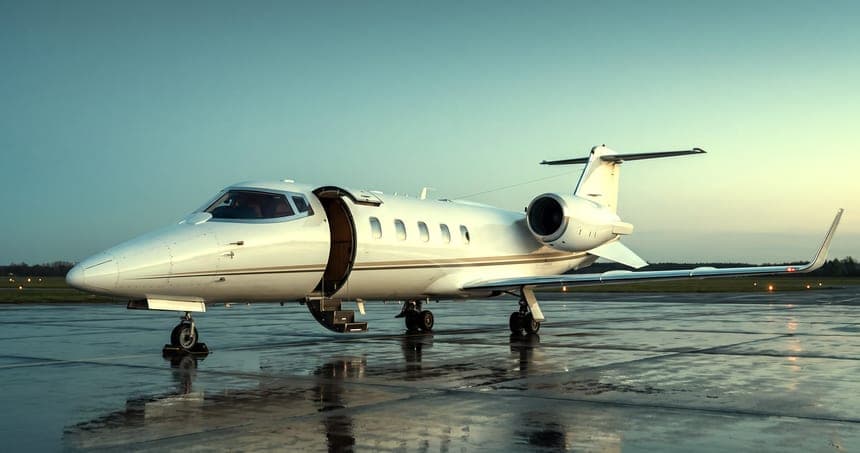
Estimated hourly rate — exact price on request.
- Passengers
- 7
- Range
- 4,250 km
- Cruise speed
- ≈ 825 km/h
- Max flight time
- ≈ 5 h
- Cabin length
- 5.40 m
- Cabin width
- 1.80 m
- Cabin height
- 1.73 m
- Aircraft length
- 17.88 m
Cruise speed is high-speed cruise. Manufacturers calculate range at the slower long-range cruise, with four passengers and NBAA IFR reserves — so a maximum-range leg takes longer than range ÷ speed, and a full cabin flies less far.
The Bombardier Learjet 60XR climbs and cruises like the Learjet name suggests, carrying seven people around 4,250 km. The trade is runway: it needs more of it than anything else in the class, which rules out short fields like Cannes and London City.
We don’t own the jets — we source them. With access to 4,500+ aircraft, we pick the exact tail that fits your route, your group and your budget. These are estimated from-prices per flight hour, to give you a sense of cost. Your exact quote depends on the aircraft, route and dates — just ask.
In detail
The Bombardier Learjet 60XR in practice
The Learjet 60XR is the fast, inexpensive end of the midsize class — the step above a super-light jet, where you buy about 4,250 km of range and a wider cabin without paying super-midsize rates. Seven seats, 446 kt in the cruise and a practical sector near five hours. One fact settles most conversations about it: the runway. It needs 1,661 m to leave at maximum weight and 2,597 m on a hot day at altitude, which takes London City, Cannes and Samedan off the list for good. Charter starts from around €4,000 per flight hour, exact quote on request. Avily does not own aircraft; we charter from operators across Europe, so the individual tail matters as much as the type.
Where it came from
The Learjet 60 was Bombardier's stretch of the Learjet 55: a longer fuselage and Pratt & Whitney Canada PW305 turbofans in place of the older Garretts. It first flew on 10 October 1990, was certified by the FAA in January 1993 and entered service the same month. The brief was to keep the Learjet reputation for climb and pace while giving the cabin enough length to fight the Citation III and the Hawker 800 — a fight the type won on speed and lost on volume.
Bombardier built 318 of the base Model 60 before replacing it in 2007 with the 60XR, launched in 2005. The XR is the same airframe and engines with a Rockwell Collins Pro Line 21 flight deck and a redesigned interior; it dominates the European charter fleet and is the version these figures describe. Production ran to 2013, by which point 430 Model 60s of all versions had been built. Bombardier announced the end of Learjet production altogether in February 2021.
For a charter client that history reads two ways. There are no new airframes, so cabins vary by owner and refit and the avionics are of their decade. But the type is plentiful and values are low, which is why it remains the cheapest way into the class.
Who charters a Learjet 60XR
Most 60XR bookings are four to seven people who want jet pace and a genuine four-hour European reach at the bottom of the midsize price band: London to Athens, Geneva to Casablanca, Milan to Cairo, non-stop, with the seats full.
The choice usually comes down to two neighbours. Against a super-light Citation XLS+, the Learjet buys roughly 850 km of extra range and 12 cm of cabin width for about €400 more an hour — and gives up airports to get them. Against the Hawker 900XP, the type it is most often quoted alongside, the Learjet is cheaper and climbs harder, while the Hawker offers a metre more cabin, baggage you can reach in flight and London City. Long legs into major airports suit the Learjet. Short legs into small ones do not.
The runway, and the airports that are out
Read this before anything else. The 60XR needs a balanced field of 1,661 m at maximum weight at sea level, rising to 2,597 m from a 5,000 ft airport at ISA+20. The cause is structural: a small, fast wing on wheels, tyres and brakes inherited from the 1970s Learjets, which gives high take-off speeds. Crews carry a rule of thumb for it — 5,000 ft of runway dry, 6,000 wet, 7,000 contaminated.
Landing is not the problem; 929 m and the aircraft is stopped. Departure is. London City, 1,508 m with a mandatory 5.5-degree approach the type is not approved for, is out. Cannes-Mandelieu, 1,610 m, is out. Samedan, 1,800 m at 5,600 ft of elevation, is out at any useful weight. Sion is a dry-day, weight-limited proposition. Nice, Geneva, Ibiza, Luton and Farnborough are non-events.
The cabin, the hold, and range with every seat sold
The cabin is 5.40 m long, 1.80 m wide and 1.73 m high, with a flat floor. The width is the good news: 12 cm more than a Citation XLS+, and a larger cross-section than the Citation III the type was built against. The height is the honest part — 1.73 m is upright for anyone under about 5 ft 8 in and a stoop for everyone else. The tube is the shortest in the class too, 447 cu ft against roughly 600 for a Hawker 800.
The lavatory is at the rear, full width, behind a solid door and externally serviced; it also houses the emergency exit. Baggage is 1.67 m³, about six suitcases, split roughly half and half: an external aft compartment sealed once the door closes, and a section by the lavatory you can reach in flight. Range is the steadiest number here — the published 4,250 km is a four-passenger figure, and with all seven seats sold you still plan on about 4,050 km.
The corridors it actually flies
Realistic block times, cabin full, no fuel stop: London–Geneva about 1h 25m, London–Nice 1h 40m, London–Milan 1h 50m, Geneva–Ibiza 1h 40m, London–Barcelona 2h 10m, London–Ibiza 2h 30m. The practical sector limit is around five hours, which covers the Mediterranean, North Africa, Scandinavia and the Canaries; the Gulf needs a stop or a bigger aircraft.
One number to treat carefully: you will see 466 kt quoted as the 60XR's maximum cruise. The placard limit is indeed Mach 0.81, but above 37,000 ft the aircraft is held to Mach 0.78 for buffet margin, so real high-speed cruise is 446 kt — about 825 km/h, the figure we publish and the one these block times are built on. What the type does deliver is climb: 41,000 ft in around eighteen minutes.
What moves the price
Charter starts from around €4,000 per flight hour, and on a midsize quote the 60XR is usually the cheapest tail on the sheet. The rate is rarely the whole answer. Aircraft are not parked where you need them, so the positioning leg goes on your quote — and because the type is particular about runways, the nearest 60XR is not always a candidate.
Crew duty is the next lever: an early departure with a late return can exceed what one crew may legally fly, and a second crew or a night stop moves the number. Then the calendar — Cannes in May, the Monaco weekend, Alpine half-term, August on the Riviera — which prices slots and handling at Nice, Geneva and Sion. Every trip is quoted individually.
What it does well
- Climbs to 41,000 ft in about eighteen minutes and cruises at 446 kt — nothing at this price is quicker.
- Loses only about 200 km of range with every seat sold: 4,050 km against a published 4,250.
- 1.80 m of cabin width over a flat floor, 12 cm more than a Citation XLS+ and more cross-section than the Citation III it was built to beat.
- Roughly half of the 1.67 m³ hold sits by the lavatory and can be reached in flight.
- The cheapest way into the midsize class: from about €4,000 an hour against €5,800 for super-midsize.
Where it gives ground
- 1,661 m to depart at maximum weight and 2,597 m hot and high — London City, Cannes and Samedan are all out.
- A 1.73 m cabin: upright only if you are under about 5 ft 8 in, a stoop for everyone else.
- The shortest cabin in the class — 447 cu ft against roughly 600 for a Hawker 800 — on an airframe out of production since 2013.
The Bombardier Learjet 60XR against the alternatives
- Hawker 900XP8 · 5,200 km
The better answer whenever the airports are small or the luggage is real: a metre more cabin, a heated hold you can open in flight, and steep-approach capability that puts London City back on the table. About €200 an hour more, and you give up the climb.
- Cessna Citation Latitude8 · 5,000 km
Pick the Latitude when someone has to stand up. Flat floor, 1.83 m of headroom, 1,091 m of runway needed — it is the one midsize that is relaxed about Cannes, Sion and Samedan. It costs roughly €600 an hour more.
- Cessna Citation XLS+8 · 3,400 km
Worth quoting when every leg is under two and a half hours. The XLS+ is a class down and cheaper, its cabin is the same 1.73 m height, and it uses the small Alpine and Riviera fields the Learjet cannot. You lose about 850 km of range.
Routes the Bombardier Learjet 60XR flies
- London → Geneva1h 25m
- London → Nice1h 40m
- London → Milan1h 50m
- Geneva → Ibiza1h 40m
- London → Barcelona2h 10m
- London → Ibiza2h 30m
Flight times are typical for this type with a full cabin. Headwinds, payload and slot restrictions move them.
Bombardier Learjet 60XR charter — frequently asked questions
- Can a Learjet 60XR use London City or Cannes?
- No, and this is the type's real limit. London City requires a 5.5-degree steep approach the 60XR is not approved for, on 1,508 m of runway. Cannes-Mandelieu is 1,610 m, against the 1,661 m the aircraft needs to depart at maximum weight. For those two airports we quote a Citation XLS+ or a Citation Latitude instead.
- Is it really faster than a Citation?
- Yes, though not by as much as some tables suggest. Published high-speed cruise is 446 kt, about 825 km/h; the 466 kt you will see quoted cannot be held above 37,000 ft, where the aircraft is limited to Mach 0.78 for buffet margin. The bigger real-world advantage is climb — 41,000 ft in around eighteen minutes.
- Can I stand up in the cabin?
- No. The cabin is 1.73 m high over a flat floor, which is upright for anyone under about 5 ft 8 in and a stoop for everyone else. At 1.80 m wide it is generous seated, and the walk to the lavatory is what reminds you of the height. For a stand-up cabin in this class, the Citation Latitude is 1.83 m.
- Can seven of us fly London to Athens non-stop?
- Yes, comfortably. With every seat sold the 60XR still plans on about 4,050 km against the published 4,250 — one of the smallest full-cabin penalties in the class — and London to Athens is roughly 2,400 km. Casablanca and Cairo are within reach on the same basis. For the Gulf you want a super-midsize, or a stop.
Specifications
Full technical sheet
General
- Manufacturer
- Bombardier (Learjet)
- Category
- Midsize jet
- ICAO designator
- LJ60
- Production
- 2007–2013
- Flight crew
- 2
Performance
- Range (IFR reserves)
- 4,250km
- Range (nautical miles)
- 2,292nm
- Cruise speed (high-speed)
- ≈ 825km/h
- Long-range cruise
- 783km/h
- Max operating Mach (MMO)
- M 0.81
- Max operating speed (VMO)
- 330KIAS
- Approach speed
- 131kts
- Takeoff distance (balanced field)
- 1,661m
- Landing distance
- 929m
- Service ceiling
- 51,000ft
- Max flight time
- ≈ 5h
Powerplant and avionics
- Engine type
- Turbofan
- Engines
- 2 × Pratt & Whitney Canada PW305A
- Thrust per engine
- 4,600lbf
- Avionics
- Rockwell Collins Pro Line 21
Dimensions and capacity
- Aircraft length
- 17.88m
- Aircraft height
- 4.47m
- Wing span
- 13.34m
- Cabin length
- 5.40m
- Cabin width
- 1.80m
- Cabin height
- 1.73m
- Baggage volume
- 1.67m³
- Seats (charter layout)
- 7
- Seats (max certified)
- 8
- Suitcases
- 6
- Carry-on bags
- 6
- Max payload
- 952kg
- Max takeoff weight (MTOW)
- 10,659kg
- Max landing weight (MLW)
- 8,845kg
- Fuel capacity
- 4,486L
Manufacturer and type-certificate figures, verified field by field. A line we could not source is left out rather than filled with a plausible number.
Gallery