Midsize jet
Hawker 900XP
Range and a hold you can reach in flight
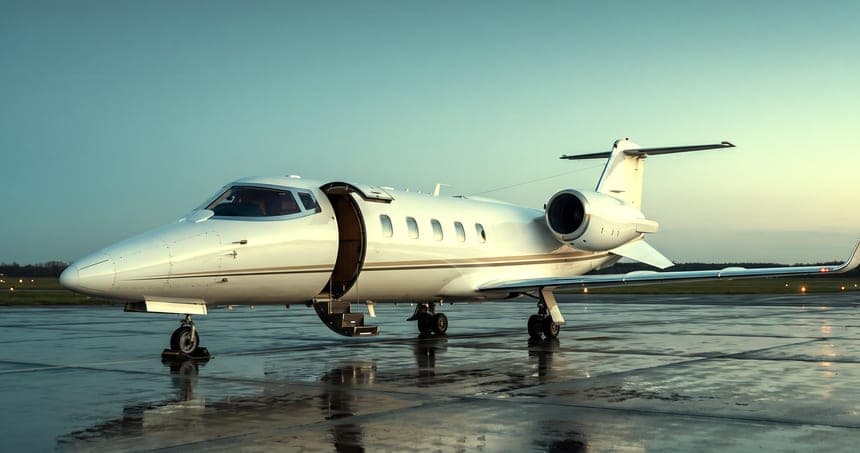
Estimated hourly rate — exact price on request.
- Passengers
- 8
- Range
- 5,200 km
- Cruise speed
- ≈ 835 km/h
- Max flight time
- ≈ 5.5 h
- Cabin length
- 6.50 m
- Cabin width
- 1.83 m
- Cabin height
- 1.75 m
- Aircraft length
- 15.60 m
Cruise speed is high-speed cruise. Manufacturers calculate range at the slower long-range cruise, with four passengers and NBAA IFR reserves — so a maximum-range leg takes longer than range ÷ speed, and a full cabin flies less far.
The Hawker 900XP flies eight people up to about 5,200 km with the widest useful cabin of the older midsize jets. Its baggage hold is heated, pressurised and reachable in flight — rare at this size, and the reason it keeps its following.
We don’t own the jets — we source them. With access to 4,500+ aircraft, we pick the exact tail that fits your route, your group and your budget. These are estimated from-prices per flight hour, to give you a sense of cost. Your exact quote depends on the aircraft, route and dates — just ask.
In detail
The Hawker 900XP in practice
The Hawker 900XP is the European midsize workhorse: eight seats, a 6.50 m cabin, 5,200 km of range and about 835 km/h. Midsize is the class above super-light — roughly 1,500 to 1,800 km more range and a materially bigger cabin than a Phenom 300 or a Citation XLS+, at an hourly rate well below the super-midsize jets it borders. The 900XP's distinguishing feature is prosaic and, in practice, decisive: 1.42 m³ of heated, pressurised baggage inside the cabin, which you can open in flight — rare at this size. It is also steep-approach equipped, so London City is on the table. Charter starts from around €4,200 per flight hour, exact quote on request. Avily does not own aircraft; we charter from operators across Europe, so the individual tail matters as much as the type.
Where it came from
The 900XP is the last chapter of a design that first flew as the de Havilland DH.125 in August 1962. British Aerospace approved a thorough rebuild of the aircraft in April 1981, and the resulting Hawker 800 flew on 26 June 1983 with a new wing and a redesigned rear fuselage. The 800XP followed in 1995 and sold 475 examples in ten years, which made it the definitive midsize jet of its generation.
The last two variants are refinements of that. The 850XP, certified in March 2006, added winglets worth about 100 nm of range. The 900XP, announced in October 2006 and certified in August 2007, kept the winglets and changed the engines to Honeywell TFE731-50R: more thrust, better hot-and-high performance and better fuel burn at altitude, which is where its 5,200 km comes from. It was built until 2013, when Beechcraft emerged from the Hawker Beechcraft bankruptcy and discontinued the jet lines. Around 650 aircraft were built across the 800 series in thirty years.
What that means for a charter client is straightforward. The type will not be built again. But it is everywhere in Europe, crews fly it every week, parts are common, and it is still the most cabin per euro in the class.
Who charters a Hawker 900XP
The 900XP is what a broker reaches for when six to eight people need real cabin for two to five hours and the budget stops short of super-midsize: corporate groups moving between European offices, families going south for a week with the luggage that implies, and anyone whose departure or arrival is London City.
Against the Learjet 60XR at the bottom of the class, the Hawker gives up some climb performance and buys a metre more cabin, an in-flight hold and far better airport access, for about €200 an hour. Against the Citation Latitude at the top, it is roughly €400 an hour cheaper and holds its range better with a full cabin; the Latitude answers with a flat floor, a stand-up cabin and a newer airframe. Against a super-light Phenom 300 or XLS+, it is a class up in every dimension and priced accordingly.
The cabin, and the hold you can reach in flight
The cabin is 6.50 m long and 1.83 m wide — the widest floor among the older midsize jets — usually in a double-club layout for eight, with a forward galley carrying a microwave and cold storage and a fully enclosed lavatory with a solid door at the rear. Headroom is 1.75 m, but it is measured down a dropped aisle: there is a trough between the seat rows rather than a flat floor, so you walk in it slightly stooped and step up to your seat. That is the honest description; a flat floor in this class means a Citation Latitude.
Baggage is where the type earns its keep. The 1.42 m³ hold is inside the pressure vessel, heated, pressurised and reachable from the cabin in flight — around seven suitcases, or the skis and golf bags that normally start a negotiation. Most rivals put their volume in an external compartment that is sealed the moment the door closes.
Airports, and range with every seat sold
Balanced field length is 1,603 m at maximum weight and the aircraft lands in 696 m, which is comfortable at every major European field and workable at most secondary ones; from a 5,000 ft airport at 25 °C it needs about 2,020 m. The card the type holds is steep approach: the Hawker 800/850/900 family is routinely chartered into London City, subject to the individual aircraft carrying the approval and the crew being LCY-qualified. We confirm both on the specific tail before quoting.
The limits are at the extremes. Cannes-Mandelieu, 1,610 m, is possible only weight-limited; Samedan, 1,800 m at 5,600 ft of elevation, is marginal to out. Sion and Ibiza are fine. Range holds up better than most: the published 5,200 km is a four-passenger figure, and with all eight seats sold you still plan on roughly 5,060 km — full-fuel payload is the best in the class.
The corridors it actually flies
Block times with the cabin full and no fuel stop: Geneva–Nice about 55 minutes, London–Geneva 1h 25m, London–Nice 1h 40m, London–Milan 1h 50m, London–Ibiza 2h 30m, London–Larnaca 4h 30m. The signature mission is the short one — London City to Nice or Geneva, out of an airport most of the class cannot use.
At the long end the practical sector is about five and a half hours, which puts Cairo, Reykjavik, the Canaries and much of the Middle East within a single leg from Western Europe. Geneva to Dubai sits inside the book range with four passengers and helpful winds, but it is a day on which the winds decide, and we would rather quote a super-midsize than sell you a fuel stop you did not plan for.
What moves the price
Charter starts from around €4,200 per flight hour. With a type out of production since 2013, the individual aircraft matters more than usual: two 900XPs on the same ramp can be quoted several hundred euros an hour apart depending on interior, connectivity, engine programme and how recently the cabin was refurbished.
Positioning is most of the rest. The aircraft is priced from where it is, not from where you are, so a same-day return often costs less than two one-ways and an empty leg costs less than either. Crew duty limits shape long days, and a second crew or a night stop changes the total. Seasonality does the remainder — the Riviera in August, the Alps at half-term, and the weekends when Nice and Geneva ration slots. London City handling is its own line on the quote.
What it does well
- 1.42 m³ of heated, pressurised baggage inside the cabin and reachable in flight — rare at this size.
- Steep-approach equipped, so London City is available subject to the individual aircraft's approval.
- Keeps its range with a full cabin: about 5,060 km with all eight seats sold against a published 5,200.
- 6.50 m long and 1.83 m wide, the most cabin per euro in the class, in a double-club layout for eight.
- 1,603 m to depart at maximum weight and 696 m to land, which covers every major European field.
Where it gives ground
- The 1.75 m headroom is measured down a dropped aisle — you walk in a trough, slightly stooped, rather than on a flat floor.
- Out of production since 2013, and every airframe was built between 2007 and 2013: ask which engine and maintenance programme the aircraft is on.
- Samedan is realistically out and Cannes only weight-limited — for the short Alpine and Riviera strips, a Citation Latitude or a super-light is the right tool.
The Hawker 900XP against the alternatives
- Cessna Citation Latitude8 · 5,000 km
The step up inside the class when the cabin has to be stand-up: a flat floor, 1.83 m of headroom, 1,091 m of runway needed and a far newer airframe, for roughly €400 an hour more. In exchange you lose in-flight access to most of your baggage.
- Bombardier Challenger 3509 · 5,900 km
The answer when the group is nine, or the leg runs well past five hours. It adds about 700 km of range and a 2.19 m stand-up cabin, at roughly €1,700 an hour more than the Hawker.
- Embraer Phenom 3008 · 3,650 km
Worth quoting when four or five people fly under two hours with light bags. A super-light costs about €700 an hour less and gets into Cannes, Sion and Samedan, and the Hawker's cabin and range advantages never come into play.
Routes the Hawker 900XP flies
- Geneva → Nice0h 55m
- London → Geneva1h 25m
- London → Nice1h 40m
- London → Milan1h 50m
- London → Ibiza2h 30m
- London → Larnaca4h 30m
Flight times are typical for this type with a full cabin. Headwinds, payload and slot restrictions move them.
Hawker 900XP charter — frequently asked questions
- Can a Hawker 900XP fly into London City?
- Yes, and it is one of the reasons the type is chartered so heavily in Europe. The Hawker family is steep-approach equipped for the 5.5-degree glidepath, but the approval sits with the individual aircraft and the crew must be LCY-qualified. We confirm both on the specific tail before quoting, rather than assuming the type answers for the aeroplane.
- Can I get to my luggage in flight?
- Yes. The 1.42 m³ hold is inside the pressure vessel, heated and pressurised, and reachable from the cabin — about seven suitcases, or skis and golf bags. This is unusual at this size: most midsize jets put their baggage in an external compartment that cannot be opened once the door closes.
- Can I stand up in the cabin?
- Not quite. The 1.75 m figure is measured down a dropped aisle, so there is a trough between the seat rows and you move along it slightly stooped rather than upright. It is still the roomiest cabin of the older midsize jets at 1.83 m wide. For a genuine flat-floor stand-up cabin, the Citation Latitude is 1.83 m high.
- Is a 2008 to 2012 airframe a problem?
- No, provided you ask the right questions. The 900XP was built between 2007 and 2013 and the fleet is well supported in Europe, but condition varies by owner. What matters is the engine and maintenance programme the aircraft is enrolled on, the age of the interior and whether it has connectivity. We check all of that per tail.
Specifications
Full technical sheet
General
- Manufacturer
- Hawker Beechcraft
- Category
- Midsize jet
- ICAO designator
- H25B
- Production
- 2007–2013
- Flight crew
- 2
Performance
- Range (IFR reserves)
- 5,200km
- Range (nautical miles)
- 2,818nm
- Ferry range
- 5,424km
- Cruise speed (high-speed)
- ≈ 835km/h
- Long-range cruise
- 745km/h
- Max operating Mach (MMO)
- M 0.80
- Max operating speed (VMO)
- 335KIAS
- Approach speed
- 125kts
- Takeoff distance (balanced field)
- 1,603m
- Landing distance
- 696m
- Service ceiling
- 41,000ft
- Max flight time
- ≈ 5.5h
Powerplant and avionics
- Engine type
- Turbofan
- Engines
- 2 × Honeywell TFE731-50R
- Thrust per engine
- 4,660lbf
- Avionics
- Rockwell Collins Pro Line 21
Dimensions and capacity
- Aircraft length
- 15.60m
- Aircraft height
- 5.51m
- Wing span
- 16.56m
- Cabin length
- 6.50m
- Cabin width
- 1.83m
- Cabin height
- 1.75m
- Baggage volume
- 1.42m³
- Seats (charter layout)
- 8
- Seats (max certified)
- 9
- Suitcases
- 7
- Carry-on bags
- 8
- Max payload
- 921kg
- Max takeoff weight (MTOW)
- 12,700kg
- Max landing weight (MLW)
- 10,591kg
- Fuel capacity
- 5,682L
Manufacturer and type-certificate figures, verified field by field. A line we could not source is left out rather than filled with a plausible number.
Gallery